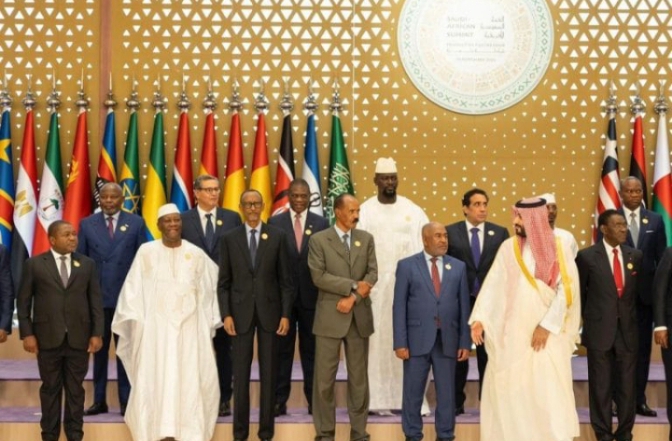
Saudi Arabia wants to deepen its economic relationship with Africa while establishing Riyadh as one of the world’s most influential centres of energy diplomacy. But the Kingdom’s decision to host the rescheduled World Petroleum Congress (WPC) Energy Congress almost simultaneously with African Energy Week (AEW) in Cape Town raises an uncomfortable question: does Riyadh’s partnership with Africa extend to respecting the continent’s own institutions?
The question is not about whether Saudi Arabia has the right to host a major international energy gathering. It unquestionably does. Nor is there evidence that Riyadh deliberately sought to undermine African Energy Week.
The concern is what happens when the exercise of enormous convening power collides with an established African platform.
The 25th WPC Energy Congress is now scheduled for Riyadh from October 11 to 15, 2026, while African Energy Week is scheduled for Cape Town from October 12 to 16. The overlap means that, for four critical days, two major energy gatherings will compete for many of the same ministers, chief executives, investors, financiers, energy companies and international media organisations.
That was not the original arrangement.
WPC’s earlier schedule placed the Riyadh congress from April 26 to 30 before the dates were changed to October 11–15. AEW, meanwhile, was already established in October.
That distinction matters.
The issue is therefore not whether African Energy Week happened to choose the same dates as WPC. It is that the rescheduled global congress moved directly into a week already occupied by an important African energy gathering.
And Saudi Arabia is not merely the location.
The Kingdom is hosting the congress for the first time, with its Ministry of Energy serving as host. Riyadh is therefore closely associated with the event and with the extraordinary convening power that will accompany it.
The legitimate question is simple: when the dates were being reconsidered, was Africa’s existing energy calendar taken into account?
That question deserves an answer.
The energy calendar is a map of power
International conferences are often dismissed as elaborate networking exercises. That understates their importance.
In the energy industry, the conference calendar is part of the architecture of power.
Governments use such gatherings to announce licensing rounds, court investors and promote national projects. Oil companies meet potential partners. Banks assess investment opportunities. National oil companies negotiate commercial relationships. Service providers seek contracts. Ministers meet executives outside the formal structures of diplomacy.
And journalists determine which conversations receive global attention.
The country capable of bringing all these actors into one room gains something more valuable than conference revenue.
It gains influence.
Saudi Arabia understands this better than most.
The Kingdom has deliberately expanded its role in global energy diplomacy, using its position as one of the world’s most important oil producers to influence discussions about investment, technology, energy security and the future of the industry.
The WPC congress is part of that broader strategy.
Its organisers expect more than 25,000 energy leaders, policymakers and innovators to attend. The event is designed to place the Kingdom at the centre of global discussions on energy, investment and innovation.
There is nothing inherently wrong with that ambition.
The problem begins when the same gravitational pull creates a disproportionate burden for a much less powerful institution elsewhere.
That is what the October clash threatens to do.
Africa is trying to build its own energy platform
For decades, Africa did more than export its natural resources.
It exported the conversations surrounding them.
African crude could be produced in Nigeria, Angola or Libya, financed through international financial centres, traded on global markets and discussed at conferences in Europe, North America or the Middle East.
The continent was frequently the subject of the conversation without being the centre of it.
That is gradually changing.
African Energy Week is part of that change.
The Cape Town gathering provides African governments, producers, investors, regulators, entrepreneurs and international energy companies with a platform on African soil to discuss the continent’s energy future.
Its importance, therefore, cannot be measured simply by attendance figures.
It represents an institutional ambition: that Africa should increasingly become a place where decisions about African energy are negotiated, rather than merely a market about which decisions are made elsewhere.
That ambition deserves respect.
If Africa is serious about building globally relevant institutions, its platforms cannot continually be treated as secondary whenever a larger international event enters the same space.
Otherwise, the geography of power changes without the underlying hierarchy changing with it.
Riyadh has created an unequal contest
Consider what the October calendar now presents to an African energy minister.
Should the minister attend Cape Town, where African energy investment, production, infrastructure and energy security are central to the agenda?
Or should the minister travel to Riyadh, where one of the world’s largest energy gatherings will assemble a formidable concentration of governments, multinational companies, financiers and investors?
The same dilemma confronts corporate executives.
International oil companies may have the resources to divide their delegations. Major financial institutions can deploy teams to both events.
But smaller African companies cannot necessarily do that.
Neither can many African governments.
A country may have one petroleum minister, one energy minister and a limited number of senior officials capable of negotiating investment agreements, presenting projects and meeting potential partners.
They cannot be in Cape Town and Riyadh at the same time.
That is why describing the situation simply as “competition” misses the point.
Competition assumes relatively comparable participants.
This is not an equal contest.
On one side is an African institution seeking to consolidate a continental platform. On the other is a Saudi-hosted global congress backed by one of the world’s most powerful energy economies.
The gravitational pull is obvious.
And when the stronger institution moves into the same calendar space as the weaker one, the consequences are unlikely to be evenly distributed.
This is bigger than two conferences
The issue also speaks to the changing politics of the Global South.
Saudi Arabia is no longer positioning itself solely as a major oil exporter.
Riyadh increasingly seeks a larger role in shaping the emerging international order, strengthening relationships across Africa, Asia and other parts of the developing world.
That ambition comes with expectations.
A genuinely multipolar international system cannot simply replace Western centres of influence with new centres of power that reproduce the same relationships with weaker institutions.
Changing who sits at the top of the hierarchy is not the same as dismantling the hierarchy.
If Saudi Arabia wants to be regarded as a strategic partner of Africa, African agency should matter in practical decisions as well as diplomatic speeches.
That includes something as mundane as the international conference calendar.
Calendar diplomacy may sound trivial.
It is not.
Dates determine attendance. Attendance determines access. Access determines deals, visibility and influence.
A conference that loses ministers, executives, investors and international media because another event has captured the same week does not suffer merely a scheduling inconvenience.
It loses institutional weight.
That is why reasonable questions should be asked.
Were African Energy Week’s dates considered before the WPC dates were changed?
Were its organisers consulted?
Were alternative weeks examined?
Could the congress have been held earlier or later?
Did the Saudi Ministry of Energy consider the consequences for African participation?
The publicly available announcement of the revised dates establishes the new schedule. It does not, however, answer these questions.
They should therefore be answered openly.
Africa must not become a supporting act
There is another danger, and this one lies within Africa itself.
African governments can undermine African institutions by repeatedly abandoning them whenever a larger or more prestigious international platform appears.
If African ministers choose Riyadh en masse because WPC carries greater global visibility, Africa could unintentionally reinforce the hierarchy it has spent years challenging.
That does not mean African governments should boycott Riyadh.
Far from it.
Africa needs Saudi investment.
African producers need international capital. African governments need partnerships with global energy companies. Saudi investors have legitimate commercial interests on the continent.
The answer is not to choose Africa instead of the world.
The answer is to ensure that Africa is not forced to choose between its own institutions and participation in the global system.
African governments should therefore treat African Energy Week as part of their institutional infrastructure, not simply another event competing for space on an overcrowded calendar.
African companies should also consider what their participation says about the importance they attach to the continent from which they derive their revenues.
If Africa’s energy industry is important enough to attract billions of dollars in investment, it should be important enough to sustain credible African platforms for discussing that investment.
“Energy for all” must include Africa
There is an irony in the timing of the Riyadh congress.
The theme is “Pathways to an Energy Future for All.”
“For all” is a powerful phrase.
It implies that the future of energy cannot be designed exclusively by countries with the deepest pockets, the largest corporations or the strongest geopolitical influence.
Africa will be central to that future.
The continent possesses enormous hydrocarbon reserves and vast renewable energy potential. At the same time, millions of people still lack reliable access to electricity.
African governments must therefore perform a difficult balancing act: expanding energy access, developing domestic industries, attracting investment, monetising natural resources and participating in an energy transition largely shaped by countries whose development trajectories were very different.
Africa cannot be peripheral to a serious discussion about an energy future for all.
Neither can African institutions.
If the world genuinely wants a more inclusive energy system, inclusion must extend beyond inviting African ministers to global conferences.
It must include recognising the platforms Africa is building for itself.
Riyadh should clarify how the dates were chosen
There is no evidence, at present, that Saudi Arabia deliberately selected the October dates to weaken African Energy Week.
Such a claim would go beyond the available evidence.
But the absence of evidence of hostile intent does not make the consequences irrelevant.
The revised WPC schedule has created an avoidable-looking collision between a powerful Saudi-hosted global energy congress and an established African energy gathering.
The simplest way to remove the uncertainty is transparency.
WPC and the Saudi Ministry of Energy should explain how the revised dates were selected, what alternatives were considered and whether the existing African energy calendar formed part of the deliberations.
That would not amount to an admission of wrongdoing.
It would demonstrate institutional sensitivity.
And that matters because this dispute is ultimately about something much larger than five days in October.
Africa has spent decades demanding greater representation in global institutions.
It has argued for a more equitable international economic system, greater control over its resources and a stronger voice in decisions affecting its development.
The emergence of a more multipolar world should create an opportunity to advance those objectives.
But multipolarity will mean little if the only thing that changes is the identity of the powerful.
Africa should not move from a world dominated by Western centres of influence into one dominated by a larger number of powerful centres, only to discover that the continent remains expected to adjust whenever those powers make room for themselves.
Saudi Arabia wants to be seen as Africa’s partner.
The October calendar offers a surprisingly simple test of what that partnership means.
A partner does not have to surrender its interests.
A partner does not have to subordinate its ambitions.
But a genuine partner should recognise when the exercise of its power risks pushing another partner away from the table.
And Africa should not have to fight for a seat at a table it is finally learning to build for itself.
We’ve got the edge. Get real-time reports, breaking scoops, and exclusive angles delivered straight to your phone. Don’t settle for stale news. Join LEADERSHIP NEWS on WhatsApp for 24/7 updates →
Join Our WhatsApp Channel