
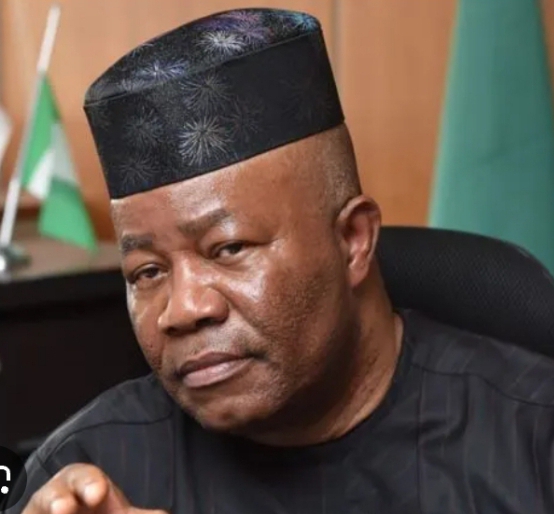
Senate President Godswill Akpabio has defended the relationship between the National Assembly and President Bola Tinubu’s administration, insisting that cooperation between both arms of government should not be mistaken for a surrender of legislative independence.
Speaking while declaring open the 2026 National Assembly Open Week in Abuja, Akpabio said the legislature’s primary constitutional responsibility is to serve Nigerians by supporting policies that advance the national interest while scrutinising and correcting those that require improvement.
“Throughout these responsibilities, the National Assembly has worked constructively with President Bola Ahmed Tinubu, GCFR, in pursuit of national progress,” he said.
“Constructive partnership should never be mistaken for constitutional surrender. Parliament does not prove its independence by manufacturing conflict, nor its relevance by opposing for opposition’s sake.
“Our constitutional duty is to support what advances the national interest, to question what requires scrutiny, and to correct what demands improvement. That is the balance we have sought to maintain, and history, I believe, will judge it fairly.”
His remarks come amid persistent criticism from opposition parties and civil society groups that the 10th National Assembly has failed to provide adequate checks on the executive arm.
Akpabio also stressed that the legislature exists to serve the Nigerian people and should remain open, transparent and accessible rather than function as an exclusive institution.
“These walls were never meant to keep Nigerians out. They were built to welcome them in — not merely as spectators of democracy, but as its rightful owners,” he said.
He added that Parliament belongs to citizens rather than lawmakers.
“Parliament belongs not to those elected to sit within it, but to the millions whose hopes and votes brought it into existence,” he said.
“Parliament was never built to keep the people out. It was built to bring them in, for democracy flourishes only in the confidence of an informed and engaged citizenry.”
The Senate President noted that transparency and accountability remain critical to strengthening public trust in democratic institutions.
“Public confidence is earned not by asking citizens to trust institutions blindly, but by embracing transparency and accountability,” he said.
“Parliament should never fear informed criticism. Questions strengthen democracy. Transparency strengthens legitimacy. The more Nigerians understand our work, the stronger our democracy becomes.”
Akpabio called on Nigerians to actively participate in the legislative process by attending public hearings, monitoring parliamentary activities and holding elected representatives accountable.
“We invite Nigerians not merely to observe us, but to engage with us; not merely to applaud where they agree, but to challenge us where they believe we can do better,” he said.
“A parliament that listens becomes wiser. A democracy that listens becomes stronger.”
Addressing citizens across the country, he added: “Whether you are with us today, following these proceedings online, listening on radio, watching on television, or gathered beneath a mango tree in a village square, this parliament belongs to you.
“Come closer. Attend our public hearings. Read the laws we make. Question us. Challenge us. Encourage us. Democracy flourishes when citizens remain active participants in the work of self-government.”
Highlighting the achievements of the 10th National Assembly, Akpabio said lawmakers had passed more than 100 bills within their first three years in office, describing the record as unprecedented at this stage of Nigeria’s democratic journey.
According to him, the legislature has enacted laws aimed at strengthening national security, improving access to education by returning out-of-school children to classrooms, modernising the country’s tax system, approving a new national minimum wage, stimulating investment and establishing regional development commissions.
He also said the National Assembly had discharged its constitutional responsibility in screening and confirming public officeholders with the seriousness required by law.
Akpabio further disclosed that Nigeria recently regained a seat on the Executive Committee of the Inter-Parliamentary Union after nearly 60 years, describing the development as evidence of renewed international confidence in the country’s democratic institutions.
He also praised the relationship between the Senate and the House of Representatives, saying both
chambers have worked with “uncommon harmony and mutual respect” over the past three years.
Expressing optimism about the National Assembly Open Week initiative, Akpabio said it would further strengthen public confidence in the legislature.
“The true measure of parliament is not the height of its walls, but the depth of its people’s confidence,” he said.
We’ve got the edge. Get real-time reports, breaking scoops, and exclusive angles delivered straight to your phone. Don’t settle for stale news. Join LEADERSHIP NEWS on WhatsApp for 24/7 updates →
Join Our WhatsApp Channel