Nigeria’s minister of Agriculture and Food Security, Abubakar Kyari and the executive secretary of the National Agricultural Development Fund (NADF), Mohammed Ibrahim, have called for a shift from conventional funding of agricultural research to investment models that drive commercialisation, attract private capital and deliver measurable returns across Africa’s food economy.
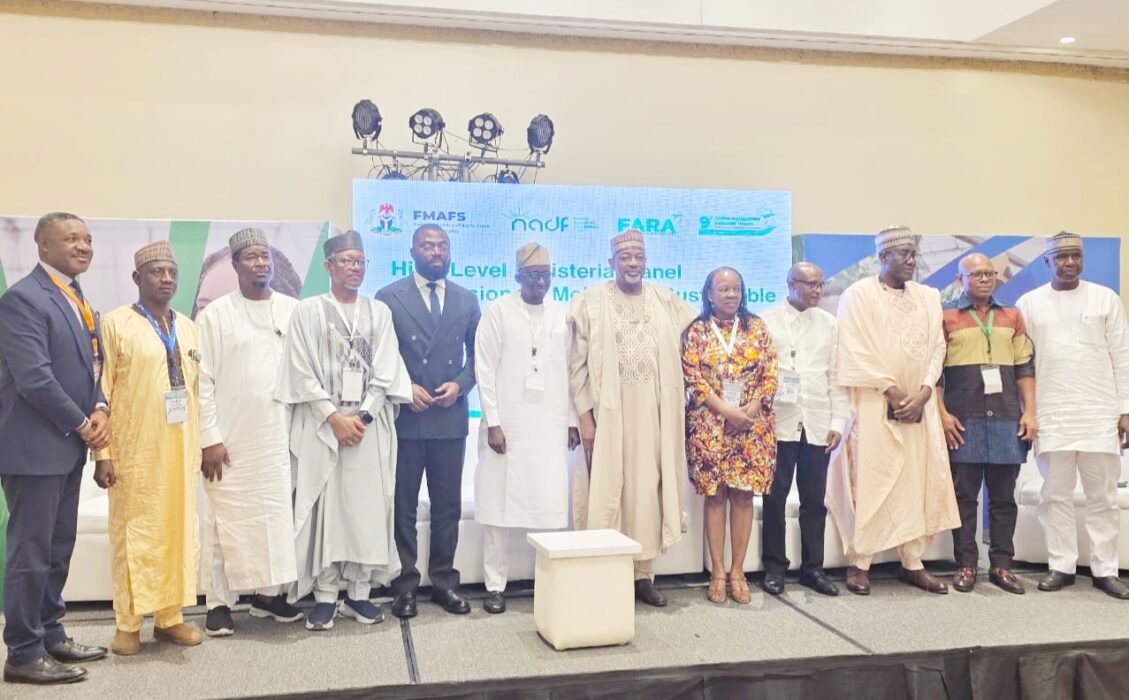
They made the call at a high-level ministerial dialogue on Sustainable Financing for Agricultural Research, Development and Innovation (AR4D), held during the 9th Africa Agriculture Science Week (AASW9) in Abuja.
The dialogue, organised by NADF and the Forum for Agricultural Research in Africa (FARA), brought together policymakers, researchers, development partners and private-sector stakeholders to explore mechanisms for mobilising strategic investment in agricultural science and innovation.
Held under the theme: “Financing Africa’s Agricultural Future: Mobilizing Strategic Investments for Science, Innovation and Transformation,” the session focused on the continent’s persistent funding gaps and the need to ensure that agricultural research produces commercially viable technologies capable of improving productivity and attracting private capital.
Ibrahim argued that the central problem confronting agricultural research in Africa was not simply a shortage of money, but the absence of an effective innovation ecosystem capable of connecting research institutions with industry and market demand.
He said agricultural research must move beyond academic publications and generate innovations that can attract investment, achieve commercialisation and be adopted at scale.
He identified three interconnected pillars required to build an effective agricultural innovation system: government institutions responsible for policy and funding; research institutions that generate knowledge; and industries that convert research outputs into marketable products and services.
Ibrahim said financing would increasingly follow research innovations that demonstrate clear economic value, raising questions about whether many research projects across Africa are sufficiently demand-driven and aligned with market realities.
“Financing is not the major challenge. It’s actually an ecosystem challenge. As much as research requires funding, the market also requires research. Financing flows wherever there are returns,” he noted.
Speaking further, the Minister of Agriculture and Food Security , Abubakar Kyari said the establishment of NADF was intended to address years of underinvestment in agricultural research and create a stronger foundation for improving productivity and rural incomes.
Kyari identified poor access to quality seeds and finance, shrinking arable land, climate pressures and inadequate research investment as major constraints on productivity.
He commended NADF for its baseline assessment of 16 agricultural research institutes and 17 colleges of agriculture, saying the exercise would help identify investment gaps and guide efforts to rebuild research infrastructure.
“Eighty-five percent of the food we consume comes from smallholder farmers, yet their living conditions have remained virtually unchanged. That shows there is a structural imbalance in the agricultural economy,” he said.
The dialogue ended with the Abuja Clarion Call, urging African governments to increase predictable domestic investment, establish sustainable agricultural development funds, deepen public-private partnerships and expand blended-finance mechanisms to accelerate technology commercialisation, food security and economic transformation.
We’ve got the edge. Get real-time reports, breaking scoops, and exclusive angles delivered straight to your phone. Don’t settle for stale news. Join LEADERSHIP NEWS on WhatsApp for 24/7 updates →
Join Our WhatsApp Channel