…55km of Erosion Corridors Controlled, Communities Protected and Livelihoods Secured
By Adamu Abubakar Kumo
Gully erosion is more than an environmental problem. Across many parts of Nigeria, it has become a social and economic challenge, cutting off communities, destroying homes, disrupting businesses, threatening roads and public infrastructure, and leaving families to live with the constant fear of the next heavy rainfall.
In Gombe, the problem has been particularly severe. The state capital’s difficult geophysical terrain, combined with years of unchecked erosion, has left behind a network of gullies that have continued to threaten communities and constrain urban development.
Taming this age-long, hydra-headed challenge is no small task. Given the scale of the damage, the resources required to comprehensively address the problem could run into hundreds of billions of naira—an undertaking that would ordinarily appear far beyond the financial capacity of a state.
It was against this difficult reality that the administration of Governor Muhammadu Inuwa Yahaya chose to confront the challenge through a series of major erosion-control interventions across Gombe metropolis.
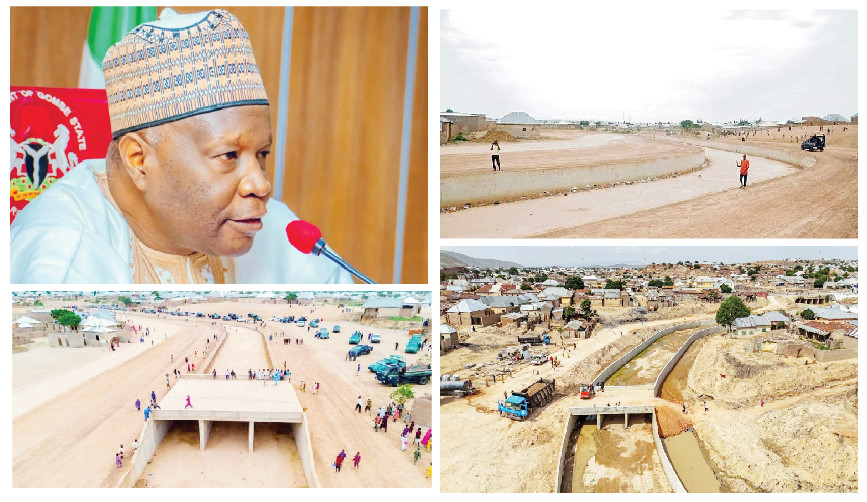
From London Mai Dorawa through Unguwa Uku, covering about nine communities and stretching approximately 21 kilometres, to the 8.5-kilometre GSU-Malam Inna Gully Project and the 7.5-kilometre stretch from the International Hotel to Ganduje Road, the interventions have progressively expanded into some of the most densely populated parts of the metropolis.
The latest phase extends into the Doma axis, where multiple tributaries and gully heads have been tackled from their sources down to what has become one of Gombe’s largest gully sites, spanning about 18 kilometres.
The network links to the Hayin Kwarin Misau area, where advancing erosion has displaced not hundreds, but thousands of houses and claimed numerous lives over the years.
Governor Inuwa had earlier constructed a four-span bridge, valued at ₦4.2 billion, to reconnect the community with Gombe Metropolis. The extension of the gully control project into the area now adds another layer to that intervention.
But beyond the concrete channels, bridges, pavements and other visible structures lies a much bigger story.
During my recent tour of the area, from Gabukka through Bagadaza to the midstream down east, I found myself looking beyond the concrete.
What I saw was not simply an erosion-control project. I saw communities being socially reconnected and economically revived. I saw schools that previously had no direct access now connected through bridges and improved passages. I saw businesses and economic structures that had once been cut off beginning to function again.
This is perhaps one of the least discussed dimensions of erosion-control projects.
When a road is cut off by a gully, it is not just a road that is lost. A community can become isolated. Children may struggle to get to school. Traders lose access to customers. Farmers face difficulties moving produce. Emergency services become harder to reach. Businesses suffer. Property values decline. Families become increasingly vulnerable as access to healthcare facilities becomes more difficult.
Therefore, when that connection is restored, the benefit goes far beyond the structure itself. Every bridge constructed, every passage reopened and every dangerous crossing made accessible represents a reduction in the daily difficulties faced by residents.
The same applies to the homes protected.
Imagine having half of your house consumed by a rapidly expanding gully, while the remaining half stands under the constant threat of collapse. Imagine knowing that the same house is the only roof over your family’s head and that another heavy rainfall could take it away.
For such families, erosion control is not an abstract government project. It is about safety. It is about dignity. It is about having a place to call home without living in fear.
And this is where the socioeconomic value of the intervention becomes clearer.
The true cost of gully erosion is rarely reflected in the size of the channel or the amount of soil washed away. Its real cost is found in the homes lost, businesses disrupted, roads destroyed, schools disconnected, farmland made inaccessible and public infrastructure repeatedly exposed to damage.
Conversely, the value of controlling erosion should not be measured only by the amount spent on construction. It should also be measured by the economic activity preserved, the businesses revived, the communities reconnected, the public infrastructure protected and the future losses avoided.
This is why the ongoing interventions deserve to be viewed beyond their engineering components. A bridge is not just a bridge when it reconnects a community. A paved passage is not just a pavement when it allows children to reach school safely. A reclaimed space is not simply an empty piece of land when it becomes a place where children can play, trees can grow and families can potentially earn a livelihood.
This is the socioeconomic angle of the project.
Another important aspect of the intervention is what happens after the erosion has been controlled.
During my tour, I saw reclaimed spaces where children now happily play in the evenings. These areas are expected to be fenced, with trees planted to further reclaim and stabilise the ecology, while some could be developed into fruit gardens to support livelihoods and food security.
The FCE gully site provides an example of how reclaimed spaces can be given a productive second life.
This is important because erosion control should not end with stopping the water. The larger objective should be to restore the environment, reclaim damaged land and return those spaces to productive community use.
In this sense, erosion control, environmental restoration and livelihood development can become part of the same integrated intervention, with Gombe providing a model that other states can learn from.
If properly maintained and protected, the infrastructure and reclaimed spaces can continue serving communities long after the administration that delivered them has left office.
To some, Governor Inuwa’s tenure is gradually approaching its end. But for the hundreds of thousands of people whose lives have been touched by these interventions, the story is bigger than the tenure of an individual administration.
For a family whose home has been protected, a trader whose business has been reconnected to customers, a child who can now reach school more safely, or a community that has regained access to the metropolis, the intervention is not simply another government project. It is a generational intervention.
As Governor Inuwa Yahaya moves towards the next phase of his public service journey, there is hope that the momentum will be sustained, with NEWMAP also preparing for similar interventions and other environmentally and ecologically focused projects in the state capital and other LGAs facing related challenges.
For Gombe, the task is far from over. The gullies are extensive, the challenges are real, and the need for sustained intervention remains.
But for Governor Inuwa Yahaya, the direction is clear: reclaim the land, reconnect the communities, protect lives and restore the economic activities that erosion has taken away.
This legacy will, Insha Allah, continue as another visionary leader, Dr. Jamilu Ishyaka Gwamna, prepares to take over from Governor Inuwa, while Governor Inuwa Yahaya moves on to the Senate as Senator Inuwa Yahaya.
Long live Gombe State.
We’ve got the edge. Get real-time reports, breaking scoops, and exclusive angles delivered straight to your phone. Don’t settle for stale news. Join LEADERSHIP NEWS on WhatsApp for 24/7 updates →
Join Our WhatsApp Channel