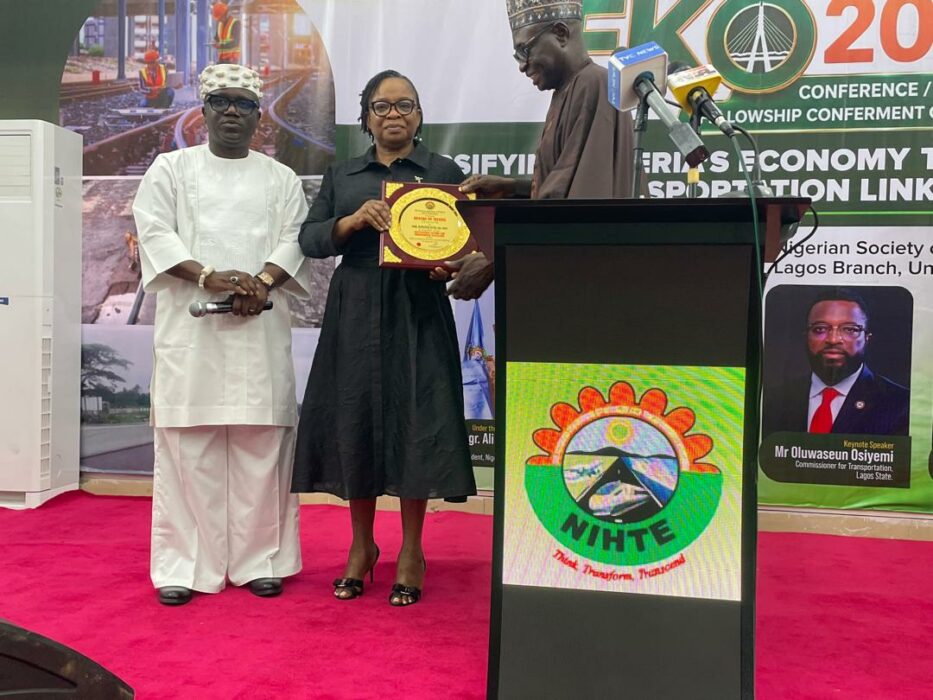
The immediate past chairman of the Nigerian Society of Engineers (NSE), Lagos Branch, Engr. Olukorede Kesha, has tasked engineers across the country to take a more active role in politics and policymaking, saying their expertise is critical to infrastructure development and national transformation.
Kesha spoke with journalists on the sidelines of the 2026 Conference and Annual General Meeting of the Nigerian Institution of Highway and Transportation Engineers (NIHTE), held in Lagos.
She said engineers could not effectively contribute their technical knowledge to national development if they remained outside the political and policy-making process.
According to her, having the best technical ideas would amount to little if engineers lacked the opportunity to influence decisions on how the country should develop.
“Even if you have the best idea, if you don’t have the opportunity, it leads nowhere. So, as engineers, we need to get involved in politics,” she said.
Kesha, however, cautioned engineers who choose to venture into politics against pursuing personal interests, stressing that their participation should be driven by the desire to improve the country.
She said engineers should approach political positions as opportunities to serve society and deploy their professional knowledge to address national challenges.
“There is no other profession that understands infrastructural innovation like the engineers. If a nation wants to be developed, infrastructural innovation must be at the forefront,” she said.
The former NSE Lagos chairman also stressed the need for engineers to play a greater role in transportation planning, particularly in developing an integrated system involving roads, rail, waterways and other modes of transportation.
She noted that some developed countries had deliberately integrated different modes of transportation, including roads, rail, boats and cable cars, to improve connectivity and provide commuters with alternatives.
According to her, such transportation systems require deliberate planning and should not be allowed to develop haphazardly.
“We must be intentional, and there is no careful planner like engineers because we understand the terrain and we know the risks associated with it,” she said.
Kesha said engineers should therefore be involved from the conceptualisation and design of infrastructure projects through execution and maintenance.
She also called for greater emphasis on sustainability, noting that infrastructure should be designed to withstand the pressure and conditions for which it was intended.
Using heavily trafficked roads in Lagos as an example, she said engineers must consider traffic volume and other factors before designing roads, adding that proper supervision was equally important to ensuring that contractors adhered to approved specifications.
“It is not enough to design. It is good enough to supervise and implement according to design,” she said.
Kesha warned that cutting corners in infrastructure projects could have serious consequences for the country, stressing that the quality of Nigeria’s infrastructure also contributes to how the country is perceived by visitors and foreign investors.
She urged Nigerians to recognise that their actions and inactions could affect the nation’s image, particularly because foreigners also use the country’s roads and other public infrastructure.
The engineer further identified responsible leadership and proper prioritisation as essential to attracting private-sector investment into infrastructure development.
She argued that Nigeria had substantial financial resources but had not always prioritised its needs appropriately.
“There is money in Nigeria. Our problem is we are not holding our priorities very well,” she said.
According to her, some individuals and businesses with the capacity to invest remain reluctant because they are not sufficiently confident that the prevailing environment is conducive to investment.
She therefore called for leadership that would put national interest above personal considerations, saying the country’s resources must be directed towards projects and programmes capable of delivering broad benefits to society.
Kesha also pointed to the need for Nigeria to learn from countries such as China in the area of infrastructure development, saying the progress recorded by some countries demonstrates what can be achieved through deliberate planning and commitment.
She maintained that engineers, because of their understanding of terrain, risks, design and infrastructure systems, were strategically positioned to contribute to such transformation.
She urged engineers who seek political office to do so with a clear commitment to national development.
“We don’t seek elective positions just for personal gains. We should seek it for the betterment of our society and our country,” she said.
Kesha concluded that sustainability must remain a key consideration in infrastructure development, from the initial concept through design, construction, implementation and maintenance.
“We should build from conceptualisation to design, to implementation, to maintenance. We must have sustainability in mind,” she said.
We’ve got the edge. Get real-time reports, breaking scoops, and exclusive angles delivered straight to your phone. Don’t settle for stale news. Join LEADERSHIP NEWS on WhatsApp for 24/7 updates →
Join Our WhatsApp Channel