Two weeks ago, this column began by arguing that Nigeria’s policy conversation – especially in the subnational – must move closer to lived reality. Last week, we examined what happens between policy intention and policy outcome: how incentives shape behaviour, how politics shapes choices, how institutions mediate decisions, and how frontline officials translate rules into everyday practice. Today, as the third and concluding part of the series, the argument moves from diagnosis to direction. For emphasis, Nigeria does not suffer from a shortage of policies. It suffers from weak problem definition, fragmented implementation, inadequate learning and a persistent tendency to measure government by what it spends rather than by what citizens experience.
Local Knowledge, Better Policy
Given all the above foregoing, we recommend the following. First, every major state or local government intervention should pass a mandatory problem-definition test before funds are committed. The sponsoring agency should specify the problem, identify who experiences it, present evidence about its causes, compare alternatives, estimate costs and benefits, identify implementation risks, and state how success will be measured. A proposed rural agro-processing centre, for instance, should establish whether processing capacity is truly the binding constraint, or whether farmers are constrained by roads, insecurity, storage, electricity, aggregation, finance or markets. The most visible solution is not necessarily the most valuable.
This reflects a basic principle of disciplined policy analysis: policymakers should not leap from problem to preferred solution. Alternatives should be compared against effectiveness, cost, equity, administrative feasibility and political acceptability. Such discipline could prevent expensive projects whose logic exists mainly because a contractor, agency or political constituency already favours them. Sometimes the best recommendation will be to do less, regulate differently, partner with the private sector or solve another constraint first.
Evidence At the Centre
Second, each state should establish a small Policy Delivery and Learning Unit, professionally staffed and close enough to political leadership to influence decisions. Its mandate should be practical: maintain problem maps, establish baselines, scrutinise major programmes, track implementation, commission evaluations and advise whether interventions should continue, adapt, scale or stop. Its value should be measured by better decisions.
The unit should maintain a public evidence register showing each significant programme’s objective, target population, budget, location, indicators and results. UNICEF reports that 10.2 million primary-school-age children and 8.1 million junior-secondary-school-age children are out of school, while 74 percent of children aged seven to fourteen lack basic reading and mathematics skills. States should therefore know, local government by local government, not merely how many classrooms were built, but how many additional children attend and learn. The same principle applies to primary healthcare: the question is not how many facilities were renovated, but whether people obtain timely, affordable and effective care.
Experiment Before Scaling
Third, states should institutionalise policy experimentation. Nigeria’s diversity makes uniform solutions inappropriate. A riverine local government, an agrarian community and a metropolitan council face different constraint. States should create policy challenge funds through which local governments, universities, civil society and private providers can propose low-cost interventions addressing clearly defined problems. Each experiment should have a baseline, a plausible theory of change, measurable outcomes and a predetermined review point.
One local government might test attendance incentives for vulnerable children; another community-based waste collection; another performance-linked support for primary health centres; another farmer aggregation and market information. Successful approaches should be independently evaluated before scaling. Failed interventions should be redesigned or discontinued. Minimum standards and safeguards must remain.
Incentives, Not Announcements
Fourth, policymakers should subject major interventions to an incentive test. Before introducing a tax, levy, subsidy, regulation or enforcement regime, officials should ask how citizens, businesses and frontline workers will respond. A market levy that raises government revenue but drives traders into informal markets may be fiscally successful and economically counterproductive. A transport restriction that removes informal operators without alternatives may shift congestion elsewhere. A dumping prohibition without affordable collection may criminalise poverty rather than solve waste.
Policy design must therefore consider behavioural responses, externalities, information failures and unintended consequences. Government should align private incentives with public objectives wherever possible. In agriculture, public resources should remove bottlenecks preventing viable value chains rather than indefinitely substituting for private investment. In waste management, reliable collection, transparent contracting, recycling markets and proportionate enforcement should work together. In ease of doing business, the goal should be less time, uncertainty and transaction cost, not another reform document.
Frontline Delivery, Citizen Results
Fifth, every public service should have a frontline delivery compact. Teachers, nurses, extension officers, environmental inspectors and local government officials should have defined responsibilities, adequate resources, usable information and realistic performance expectations. Policy reaches citizens through people, not documents. Where officials receive conflicting rules, insufficient resources and weak supervision, informal practices emerge.
The compact should specify the minimum service citizens can expect, resources available to frontline workers, information they must report and a mechanism through which communities can verify performance. A primary health centre should not be judged solely by staffing if medicines are unavailable. A teacher should not be held responsible for absenteeism caused by insecurity without considering surrounding conditions. An extension officer cannot reasonably serve hundreds of dispersed farmers without transport and communication support. Accountability begins by making performance possible.
Money For Outcomes
Sixth, states should progressively link part of discretionary local government funding to independently verified improvements in outcomes. This should not become crude competition because starting conditions differ. Financing should reward measurable improvement while protecting minimum standards and equity. A rural local government that improves functional health facilities, school attendance, learning, waste collection or road accessibility should be able to demonstrate that improvement and receive additional support.
Financing should distinguish outputs from outcomes. Constructing a borehole is an output; a functioning water point providing reliable access months later is closer to an outcome. Training teachers is an activity; children learning to read is an outcome. Disbursing agricultural credit is an input; higher productivity and household income are outcomes.
Memory, Continuity, and Courage
Seventh, states should publish an annual policy learning report explaining which major interventions were continued, scaled, redesigned or terminated and why. This would create institutional memory across electoral cycles. New administrations should inherit evidence, evaluations and implementation lessons rather than beginning again with new names for old problems. Governments must also create political space for honest failure. Terminating an ineffective intervention should be treated as responsible stewardship, not political embarrassment.
Finally, governors and local government chairpersons should make policy learning part of political leadership. The strongest administration will not necessarily launch the most projects or initiate the most programmes . It will identify binding constraints, allocate scarce resources intelligently, anticipate behavioural responses, understand implementation realities, listen to citizens and change course when evidence demands it. Nigeria’s states and local governments have enough diversity to become laboratories of disciplined policy learning.
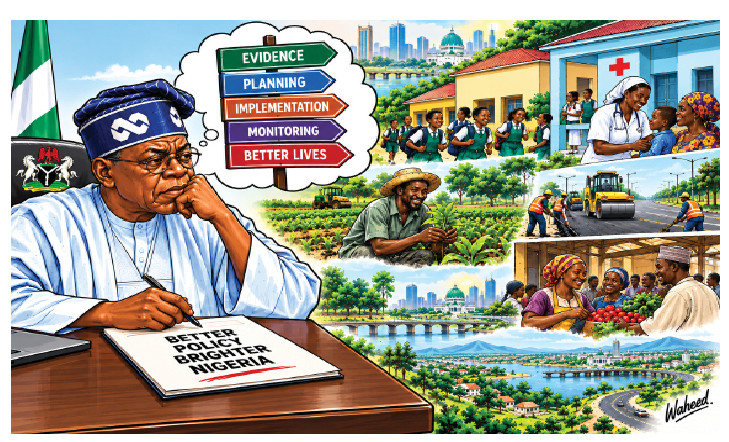
Build fewer programmes, but design them better. Ask harder questions before spending. Compare alternatives. Measure results. Give frontline workers the means to perform. Reward improvement. Protect citizens from unintended consequences. Preserve institutional memory. Above all, make public policy iterative. The ultimate test is whether children learn, mothers receive care, farmers earn viable incomes, businesses operate with less friction, and rural households escape poverty. That is where policy becomes value, and that is the standard by which Nigeria’s subnational governments should be judged.
We’ve got the edge. Get real-time reports, breaking scoops, and exclusive angles delivered straight to your phone. Don’t settle for stale news. Join LEADERSHIP NEWS on WhatsApp for 24/7 updates →
Join Our WhatsApp Channel