
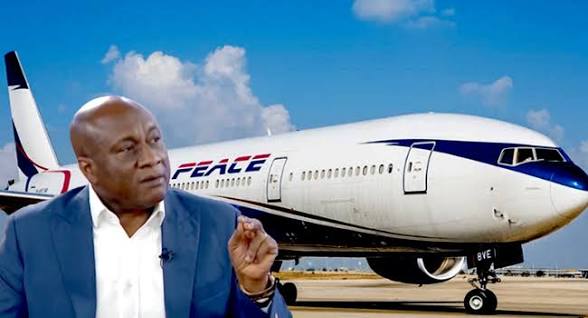
Air Peace has challenged the9 August 2026 flight disruption report released by the Nigeria Civil Aviation Authority (NCAA), saying only 15 per cent of the delays recorded by the airline during the month were attributable to internal operational factors.
The airline, in a statement signed by its Chief Operating Officer, Oluwatoyin Olajide, on Thursday, disputed the NCAA’s reported figures and accused the regulator of failing to properly account for external factors that disrupted flight operations during the month.
Air Peace said it operated 2,564 flights in August, contrary to the 1,864 flights contained in the NCAA report, arguing that the omission of more than 700 flights distorted the airline’s reported delay rate.
The airline also questioned the decision to commence the NCAA’s monthly delay data series with August, rather than July, noting that there was no equivalent monthly data for July despite the publication of the first and second-quarter reports on July 31.
According to Air Peace, the rapid publication of the August report, 13 days after the end of the month, should have been accompanied by a clear breakdown of the causes of the disruptions experienced by individual airlines.
The airline said its internal review showed that only 391 flights, representing about 15 per cent of its August delays, were caused by internal factors, while the remaining 85 per cent were linked to external circumstances beyond its control.
It identified the internal causes as mainly technical issues resulting in unscheduled aircraft maintenance and fuel-related challenges.
On the external factors, Air Peace said airport congestion and traffic accounted for more than 51 per cent of its external delays, with aircraft frequently held on the ground or in holding patterns because of infrastructure and capacity constraints.
The airline also cited bird strikes, airport facility deficiencies, adverse weather conditions, industrial action by aviation unions, and damage to its aircraft by a ground-handling company as major causes of disruptions.
On bird strikes, Air Peace said one of its aircraft, 5N-BYG, was struck by a bird in Abuja, damaging its inlet cowl and requiring repairs costing about $1.8 million.
The aircraft, which the airline said normally operates at least eight sectors daily and carries about 1,000 passengers, was subsequently removed from service for more than a week while the damaged component was replaced.
Air Peace also said the picketing of its operations by aviation union members from August 11 caused disruptions that lingered for more than 14 days, resulting in flight rescheduling, delays and cancellations.
It further cited damage to another aircraft by a ground-handling company, saying the incident kept the aircraft out of active service for more than 14 days.
On weather-related disruptions, the airline said adverse conditions during the rainy season led to mandatory safety holds and diversions, with a single diversion capable of generating consequential delays of up to three hours.
Air Peace argued that such delays should not be attributed to the airline because safety requirements prevent carriers from bypassing adverse weather, airport congestion, infrastructure limitations or other operational constraints.
The airline said it had continued to invest in its fleet, crew availability, training and maintenance protocols to improve on-time performance and passenger satisfaction.
It, however, maintained that the NCAA report did not sufficiently distinguish between delays caused by airlines and those arising from systemic or external challenges.
“Again, the narrative that Air Peace is primarily responsible for these delays is completely false. The majority of the delays experienced by our passengers were driven by external factors and completely outside of our control,” the airline said.
Air Peace urged the NCAA to review and audit its data collection methodology to ensure that future flight disruption reports accurately reflect airline operations and the causes of delays.
The airline further stated that it remained committed to improving its internal processes and mitigating delays within its control, while urging the regulator to provide a fuller picture of the operational environment when publishing industry performance data.
We’ve got the edge. Get real-time reports, breaking scoops, and exclusive angles delivered straight to your phone. Don’t settle for stale news. Join LEADERSHIP NEWS on WhatsApp for 24/7 updates →
Join Our WhatsApp Channel