Economists have flayed Nigeria’s N12.6 trillion merchandise trade surplus in the second quarter of 2026, saying the figure masks the country’s continued weak export diversification, with crude oil and other petroleum products accounting for 86.2 per cent of total export revenue.
The National Bureau of Statistics (NBS), in its latest Foreign Trade in Goods Statistics, reported that the surplus rose from N7.55 trillion in the first quarter to N12.59 trillion in Q2, as total exports increased by 27.64 per cent quarter-on-quarter to N27.02 trillion, compared with a 5.91 per cent rise in imports to N14.42 trillion.
However, the composition of the exports raised concerns among economists, as crude oil alone contributed N12.91 trillion, or 47.79 per cent of total exports, while other oil products accounted for N10.38 trillion. In contrast, non-oil exports stood at about N3.73 trillion, representing only 13.8 per cent of total exports.
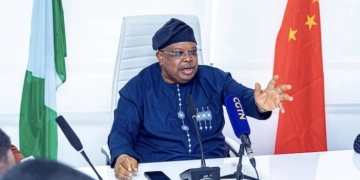
The president of the Association of Small Business Owners of Nigeria (ABSON), Dr. Femi Egbesola said that Nigeria’s N12.59 trillion trade surplus in Q2 2026 should not be mistaken for meaningful export diversification.
Egbesola said while the surplus is encouraging, crude oil and other petroleum products still account for about 86 per cent of exports, with non-oil exports contributing only 13.8 per cent.
“What we are seeing is essentially export growth without sufficient structural diversification. The economy therefore remains vulnerable to oil-price volatility and other external shocks,” he said.
He called for urgent measures to reduce the cost of doing business and make Nigerian products internationally competitive.
“This means reliable and affordable electricity, better roads and logistics, efficient ports, faster customs and export documentation, affordable export finance and insurance, and easier access to product certification, standards, packaging and international markets,” Egbesola said.
According to him, the bottlenecks disproportionately affect SMEs, who should be at the centre of Nigeria’s export strategy. We must also move from exporting raw commodities to exporting value-added products and services. Rather than exporting cocoa, cashew, leather and agricultural produce largely in raw form, we should process more of them locally and develop competitive manufacturing, solid-mineral, creative and digital-service value chains.
Egbesola urged the government to set clear, measurable targets for non-oil export earnings and export-ready SMEs, stating that “the objective should not merely be a bigger trade surplus, but an economy where non-oil exports are strong enough to provide sustainable foreign exchange, jobs and resilience.”
The director-general of the Nigerian Textile Manufacturers Association (NTMA), Hamma Kwajaffa, emphasized that comparing the non-oil sector to the oil industry is not reasonable.
The primary reason for this, he explained, lies in the failure to meet the stringent laboratory requirements necessary for successful exports.
“Many textile products face rejections at international borders due to non-compliance with these standards. Additionally, other agricultural products like beans and yam often do not reach their intended destinations. This is largely because they are inadequately packaged and lack sufficient protection during transport, leading to damage before they arrive at markets,” he explained.
Kwajaffa stressed the urgent need for deeper understanding and insight into these trade-related issues, believing that addressing these challenges is crucial to ensure that local producers and exporters can truly benefit from international trade.
The director/CEO of Centre for the Promotion of Private Enterprise (CPPE), Dr Muda Yusuf pointed out that Nigeria is recording some level of diversification in exports, but the non-oil sector remains constrained by high production costs and weak competitiveness.
Yusuf said the trade data shows a shift from crude oil dominance to value-added exports, stating that “crude oil, which used to account for about 80 per cent to 90 per cent of exports, is now accounting for about 50 per cent or less. Then there is non-crude oil and gas, and that is significant.
“By non-crude oil and gas, I mean exports of refined petroleum products, fertilizer, gas, and petrochemicals. Those now account for about 62 per cent. So unlike in the past when we were only exporting crude oil, we are now adding value. We are now exporting processed or refined petroleum products, petrochemicals, and gas. That, for me, is significant.”
However, he noted that non-oil exports remain extremely low due to structural weaknesses in manufacturing and agriculture.
According to Yusuf, non-oil exports are still extremely low because our manufacturing sector is still very weak. You need a strong manufacturing sector to boost non-oil exports.
“Right now, the cost of production is high. Cost of credit is high. Cost of logistics is also very high. Cost of energy is very high. In international trade, if your product is not competitive in price and in quality, you cannot make an impact. Our agricultural sector is also exporting largely primary products, and that does not give us much value.”
Yusuf said the key challenge is to improve productivity and competitiveness in the non-oil sector, stating that “unless we address these structural problems, it will be very difficult to achieve that productivity and competitiveness.”
To boost non-oil exports, the CPPE CEO urged government to focus on lowering business costs and improving security.
“We need to bring down the cost of production. We need to bring down energy costs. We need to bring down the cost of credit. We also need to improve our logistics. Those things are important. In addition, we need to address insecurity, because our agricultural products are being affected by insecurity. Those are some of the things government can do to boost our non-oil exports,” he added.
According to the NBS, Nigeria’s merchandise trade surplus surged to N12.59 trillion in the second quarter of 2026 from N7.55 trillion in the first quarter, as total exports rose faster than imports.
Total exports increased 27.64 per cent quarter-on-quarter to N27.02 trillion, while imports rose by 5.91 per cent to N14.42 trillion. However, the composition of exports suggests that Nigeria’s improved external trade position remains heavily exposed to petroleum.
Crude oil exports alone stood at N12.91 trillion during the quarter, accounting for 47.79 per cent of total exports. Other oil products contributed another N10.38 trillion. By comparison, genuinely non-oil exports stood at about N3.73 trillion, representing only 13.8 per cent of total exports.
The data showed that raw-material exports recorded one of the strongest increases among non-oil categories, rising 50.31 per cent quarter-on-quarter to N2.31 trillion. Solid-mineral exports also increased by 42.91 per cent to N146.91 billion.
Agricultural exports, however, moved in the opposite direction, falling 31.51 per cent quarter-on-quarter to N803 billion. Manufactured exports increased 29.87 per cent to N393 billion, but remained significantly below their level in the corresponding quarter of 2025.
For industry, the figures underline the distance Nigeria still has to cover before manufacturing can become a significant foreign-exchange earner.
We’ve got the edge. Get real-time reports, breaking scoops, and exclusive angles delivered straight to your phone. Don’t settle for stale news. Join LEADERSHIP NEWS on WhatsApp for 24/7 updates →
Join Our WhatsApp Channel