Despite contributing over 20 per cent to Nigeria’s GDP, agriculture accounts for just 4.1 per cent of merchandise export earnings, a gap that FirstBank, state governors and Brazil say must be closed through patient capital, value addition and stronger agricultural value chains.
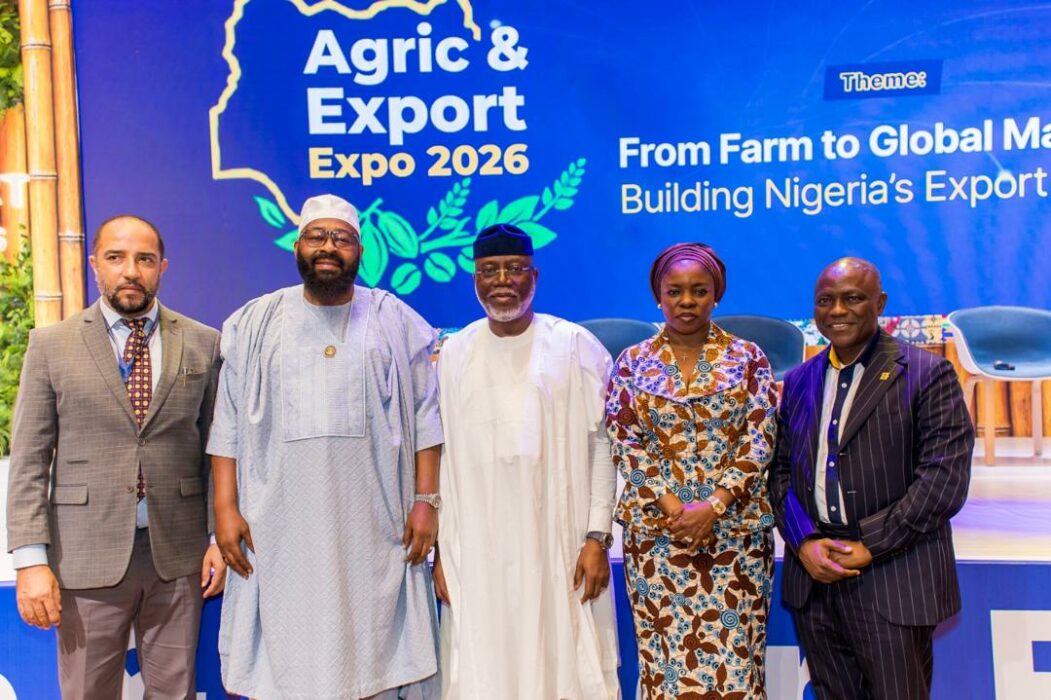
Speaking severally at the fifth FirstBank Agric & Export Expo in Lagos, they called for a shift from short term commercial lending and raw commodity exports towards financing and developing the entire agribusiness value chain.
FirstBank Chief Economist, Chinwe Egwim, noted that the wide gap between agriculture’s contribution to the economy and its share of merchandise exports showed the enormous potential for growth if more capital was directed towards aggregation, storage and processing.
“When a sector that is contributing as high as 20 per cent to total GDP is only contributing about 4.1 per cent to merchandise trade, that creates compelling growth opportunities,” Egwim said, adding that capital would have greater impact when it connected different parts of the agricultural value chain rather than focusing solely on production.
“Financing additional production has greater commercial impact when there is sufficient capacity to aggregate, to store, or to process that output,” she added. Egwim also urged agricultural exporters to adopt a market led strategy, designing products around international buyer specifications, certification requirements and supply reliability.
The Group Managing Director and Chief Executive of FirstBank Group, Olusegun Alebiosu, said the bank was moving beyond conversations about agriculture to actual partnerships, financing and capital deployment.
“Our objective is not only to showcase opportunities within agriculture and exports but also to facilitate the connections, partnerships, financing solutions, market access opportunities, and knowledge exchange required to transform ideas into thriving enterprises,” Alebiosu said.
He said the expo had evolved into a platform for collaboration capable of advancing Nigeria’s agricultural and non oil export sectors.
Lagos State Governor, Babajide Sanwo-Olu, who was represented by the Commissioner for Agriculture and Food Systems, Ruth Olusanya, said agricultural financing must reflect the realities of the sector, particularly its planting, harvesting and processing cycles.
“A good harvest without financing cannot become a good business, and a good product without access to markets cannot become a successful export,” Sanwo-Olu said, urging financial institutions to move away from conventional short term financing models that do not adequately accommodate the long gestation periods associated with agricultural production.
Sanwo-Olu also warned that Nigeria would continue to lose the economic benefits of its agricultural resources if it remained primarily an exporter of raw commodities. “If you produce and just export raw, you remain perpetually broke. You add value to it, you determine the global price,” he said.
He called for greater investment in processing, noting that commodities such as cassava and cocoa should not leave Nigeria only in their raw form.
On his part, Ondo State Governor, Lucky Aiyedatiwa, similarly called for a transition from primary production to full value chain development, stressing that the state’s agricultural potential would only translate into prosperity when backed by processing, storage, logistics, traceability, financing and market access. “Comparative advantage alone does not create prosperity. Our responsibility as government is to convert the comparative advantage into competitive advantage,” Aiyedatiwa said.
He said Ondo State was seeking to attract investment across the agricultural value chain, particularly in cocoa, oil palm, cassava, fisheries, aquaculture and livestock. According to him, the focus must extend beyond producing more commodities to ensuring that more value is retained within Nigeria.
Aiyedatiwa also identified insecurity and access to land as major constraints to agricultural investment, saying investors needed an environment where they could operate alongside smallholder farmers. He further stressed the growing importance of international standards, particularly in cocoa exports, as global buyers increasingly demand traceability and compliance with environmental requirements.
Niger State Governor, Mohammed Umaru Bago, drawing attention to Nigeria’s growing food import bill, said the country had imported food worth more than $3 billion this year and that the figure could reach $4 billion before the end of the year.
“It is scary. First of all, the global market. We need to have a local market. We need to feed ourselves. Food sovereignty is very paramount,” Bago said, calling for increased investment in domestic food production, agricultural research and seed development, arguing that weak research capacity had constrained productivity
Bago also linked food production to the fight against insecurity, saying, “One of the panaceas for insecurity is food first. When you do agriculture, you solve your problems.” He urged greater access to finance for agriculture, saying the sector required a financial framework that recognised its strategic importance and long production cycles.
Brazil’s Consul General in Lagos, Ronaldo Vieira, pointed to Brazil’s agricultural transformation as an example of how Nigeria could develop its own agribusiness potential. He said Brazil’s agricultural growth had been driven by collaboration among government, research institutions, universities, farmers, private businesses and financial institutions.
Vieira stressed that Nigeria could draw lessons from Brazil’s experience by strengthening the link between research, technology, financing, production and markets.
We’ve got the edge. Get real-time reports, breaking scoops, and exclusive angles delivered straight to your phone. Don’t settle for stale news. Join LEADERSHIP NEWS on WhatsApp for 24/7 updates →
Join Our WhatsApp Channel