Long before modern electioneering reduced statecraft to mere transactional diplomacy, Thucydides recorded in his History of the Peloponnesian War that the strong do what they can while the weak suffer what they must. Yet when power seeks to expand beyond its organic frontiers, even the most formidable empires encounter the unyielding boundaries of institutional self-preservation. When Xerxes I marched his vast, multi-ethnic horde across the Hellespont, he believed that sheer numerical variety and central imperial directive could overrule the fierce, localized discipline of the Greek city-states. History ultimately recorded that an unwieldy army composed of disparate, coerced contingents fractures the moment it strikes a consolidated defense.
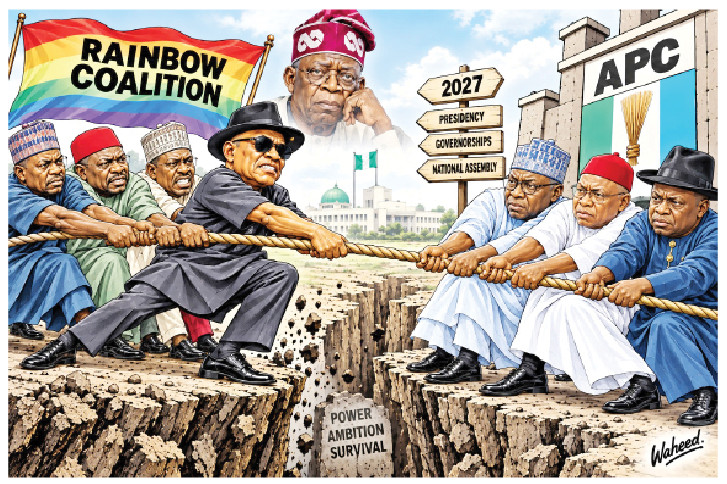
In the turbulent arena of contemporary Nigerian realpolitik, the escalating confrontation between Federal Capital Territory Minister Nyesom Wike and the Progressive Governors Forum attempts a similar defiance of structural gravity. As reported across national newspapers – from The Sun’s analysis of September 20, 2026, “Nyesom Wike: tackling APC govs over ‘Rainbow Coalition‘”, to Daily Post’s report on September 15, “’They’ve no basis’ – Wike tackles APC govs over Rainbow Coalition” – Wike’s ambition to erect an independent cross-party platform collides directly with established party hierarchies. By constructing a multi-party “Rainbow Coalition” to safeguard President Bola Tinubu’s national interests while systematically contesting down-ballot seats against the ruling All Progressives Congress (APC), this architecture relies purely on personal leverage rather than institutional duty.
This friction reveals a classic structural paradox. Does political power reside in the charismatic maneuvering of an individual warlord, or does it belong to the cold, impersonal machinery of organized party structures? It is a contemporary drama reminiscent of Thomas Hobbes’s warning in Leviathan that covenants without the sword are but words. In this political theater, actors attempt to forge a compact where rival factions share a single presidential champion, provided each regional boss retains the right to dismantle his ally’s local foundation. But can a political house stand when its builders deliberately undermine its pillars to secure its roof?
The Alcibiades Fallacy and the Condottieri Complex
The theoretical scaffolding of Nyesom Wike’s grand design mirrors the volatile career of the Athenian strategist Alcibiades, whose brilliance as an individual operator was matched only by his fluid allegiances between Athens, Sparta, and Persia. Like Alcibiades, who persuaded opposing camps that his personal charisma was indispensable to their triumphs, Wike’s strategy presumes that a single political figure can straddle ideological chasms while remaining inside the opposition Peoples Democratic Party (PDP).
In his classic treatise The Prince, Niccolò Machiavelli highlighted the tragic trajectory of Cesare Borgia, who mastered the art of raw force and tactical cunning, yet ultimately discovered that personal brilliance unanchored to permanent institutional legitimacy collapses the moment external circumstances shift. Like the Renaissance condottieri – mercenary commanders hired to fight state battles – auxiliary figures operate outside orthodox command structures. Machiavelli warned explicitly that reliance on mercenaries and auxiliaries is inherently dangerous because such forces remain disunited, ambitious, and fundamentally undisciplined.
To expect an established ruling party like the All Progressives Congress to passively watch an auxiliary enterprise dismantle its legislative and gubernatorial seats is to ignore the primary law of political survival. Realism dictates that institutions, much like biological entities, will fiercely reject any external body that threatens their systemic integrity. When the dust settles on any political theater, history demonstrates that institutional structures invariably outlive the individual mercenaries who seek to master them, leaving personal brilliance stranded without a permanent altar upon which to anchor its authority.
The Rejection of Parallel Altars
The stern resistance mounted by state governors illustrates the immutable principle of organizational self-defence. The party guardians recognize that allowing an independent political enterprise to dictate regional terms renders their own party apparatus obsolete. As highlighted in BusinessDay on September 17, 2026 (“2027: Wike-APC governors’ feud raises stakes for Tinubu’s re-election”), this fierce, uncompromising conflict centers squarely on raw sub-national survival and territorial authority.
This sudden, solemn devotion to organizational purity carries a rich touch of irony, coming from seasoned political figures who have historically navigated unprincipled pragmatism whenever political expediency demanded. Yet hypocrisy does not invalidate the cold, foundational law of self-preservation. In the unyielding calculations of power, party discipline serves as a protective shield deployed whenever an external rival threatens local territory.
Much like Jean Bodin’s classical doctrine of sovereignty, which dictates that supreme power within a domain must remain indivisible and unshared, political parties cannot tolerate parallel centers of authority operating within their territory. When an auxiliary force attempts to construct a competing altar, the institutional establishment must act decisively to neutralize the threat to its sovereign supremacy. Why should any landlord honour a guest who openly invites rival invaders to share the master suite? To yield local control to an external contractor is to invite systemic irrelevance, guaranteed internal subversion, and ultimate institutional death. When existential survival is threatened, house rules are swiftly elevated to sacred, unbreakable doctrine.
The Waterloo of Dual Electoral Logic
Through statements issued by his media team, Wike defends the coalition by citing split-ticket voting, arguing that citizens can seamlessly isolate national presidential choices from state-level contests. This argument relies on a romanticized view of campaign mechanics reminiscent of Carl von Clausewitz’s analysis of military friction – the invisible element that distinguishes paper strategy from real war.
Napoleon Bonaparte’s disastrous campaign at Waterloo provides a sobering historical parallel: when a commander relies on complex, multi-pronged maneuvers requiring perfect synchronization among mutually distrustful generals, the inevitable operational friction destroys the entire force. While individual voters exercise complex preferences, elections are fundamentally logistical wars driven by ground command, campaign treasuries, polling unit monitoring, and patronage networks. When two hostile factions attempt to mobilize the exact same grassroots base for a single president while destroying each other for state seats, internal friction strips the gears of both campaign machines. Sun Tzu famously warned in The Art of War that a house divided within itself cannot sustain a prolonged campaign.
The Immutable Wall of Institutional Power
Beyond theoretical debates lie insurmountable practical contradictions. As noted by political analysts in Premium Times on September 18, 2026 (“The Political Undercurrents of the Feud Between Wike and APC Governors”), operating two parallel political engines creates the single biggest centrifugal force within the president’s coalition. In a high-stakes campaign, practical decisions regarding poll agents, mobilization funds, and ward executives cannot be settled by national rhetoric.
This collision ultimately exposes the insurmountable limits of Wike’s Rainbow Coalition when confronted by the established party wall. A candidate-centric alliance offers striking visual drama, yet it lacks the structural roots required to survive post-election governance. A rainbow remains a temporary optical phenomenon – visually impressive from a distance, but devoid of solid mass that can be captured, stored, or converted into permanent power.
As Alexis de Tocqueville observed, long-term democratic stability rests not on extraordinary individual moments, but on the enduring strength of permanent institutions. A political actor may possess extraordinary tactical agility, but no individual can indefinitely defy the foundational laws of realpolitik. When the illusion dissipates, those enamoured with their own political shadows inevitably discover that institutional power always claims the final victory.
We’ve got the edge. Get real-time reports, breaking scoops, and exclusive angles delivered straight to your phone. Don’t settle for stale news. Join LEADERSHIP NEWS on WhatsApp for 24/7 updates →
Join Our WhatsApp Channel