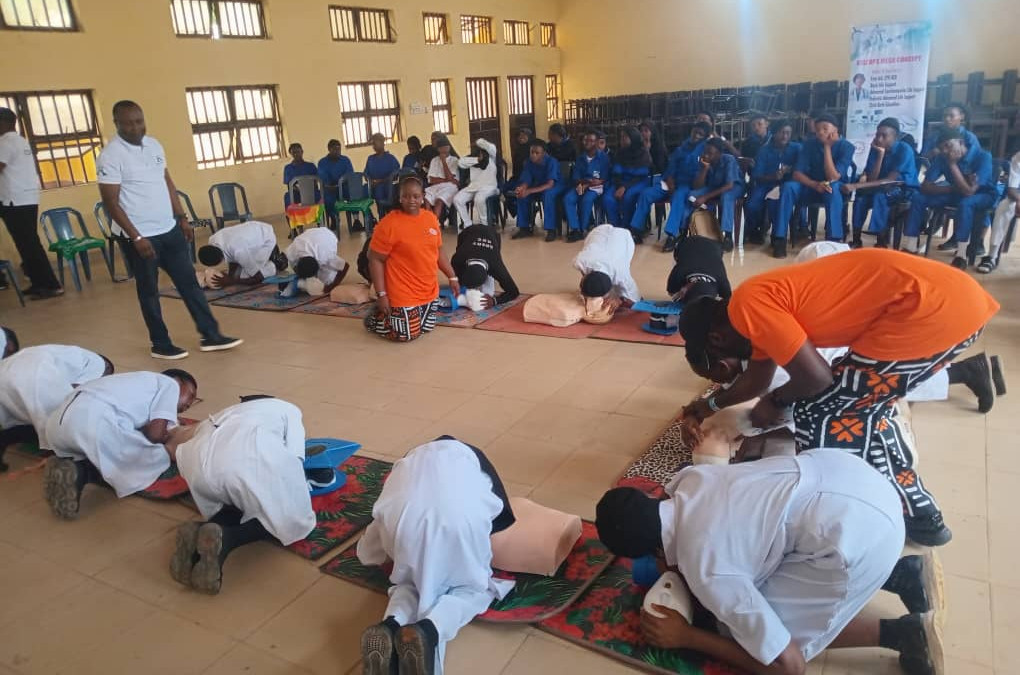
The City Club Abuja has trained students of Government Science Technical College, Garki, Abuja, on cardiopulmonary resuscitation (CPR) and basic life support (BLS) as part of efforts to improve young people’s ability to respond to medical emergencies.
The practical training, organised in collaboration with the school, focused on basic emergency-response skills that can be used when a person suddenly collapses or becomes unconscious before professional medical assistance arrives.
Speaking during the programme, President of The City Club Abuja, Mr Oluwasanmi Ajayi, said the club decided to focus on knowledge transfer through the initiative rather than its usual charitable activities.
Ajayi said the organisation planned to extend the training to other schools, adding that it intended to make it a regular part of its community service activities.
He said the club had been involved in different community interventions since its establishment in 2019, but decided to introduce CPR and basic life-support training because of the potential impact of the skills on the wider community.
“We decided to impart knowledge in these students and teach them CPR and all this kind of thing so that it can be useful for them in future,” he said.
Also speaking, Chairman, Board of Trustees of the club, Mr Deji Adetuberu, said the decision to introduce the training was informed by the increasing occurrence of situations where people suddenly collapsed but those around them lacked the skills to provide immediate assistance.
According to him, training students could also extend the reach of the programme because they could pass the knowledge to their parents, siblings, relatives and friends.
Adetuberu said the club was considering how to sustain the programme and extend it to other groups in the society.
Head of Cardiology, National Hospital Abuja, Dr Oladipupo Fasan, who participated in the training, said basic life-support knowledge was important because many cardiac arrests occurred outside hospitals.
Fasan said victims of cardiac arrest could require immediate intervention before they reached a healthcare facility, stressing that members of the public needed to know what to do in such situations.
“We are here to teach these children survival skills, how to help someone who falls down and is unconscious, and what do we do? How do we help the person before the doctors come or the nurses come or before they get to hospitals?” he said.
He also noted that Nigeria was yet to have automated external defibrillators (AEDs) widely available in public places, despite their potential role in responding to some cardiac-arrest emergencies.
Fasan further raised concern over the country’s cardiovascular disease burden, noting that cardiovascular diseases were major causes of cardiac arrest and sudden collapse.
He said hypertension was also a major risk factor for cardiovascular complications, including stroke, heart attack, heart failure and kidney failure.
The cardiologist said starting the training with students could have a wider effect because the beneficiaries could share the skills with people in their homes, schools and communities.
An SS3 student, Igwu Chimamanda, said the training had taught her how to respond when someone collapsed.
She said the knowledge would also support her career aspiration of becoming a cardiologist.
Another student, Awelewa Elijah, an SS2 student, said the training could help reduce panic during emergencies.
He said wider knowledge of basic life support would enable more people to respond appropriately when emergencies occurred.
The City Club Abuja said it planned to replicate the training in other schools as part of its continuing community service programme.
We’ve got the edge. Get real-time reports, breaking scoops, and exclusive angles delivered straight to your phone. Don’t settle for stale news. Join LEADERSHIP NEWS on WhatsApp for 24/7 updates →
Join Our WhatsApp Channel