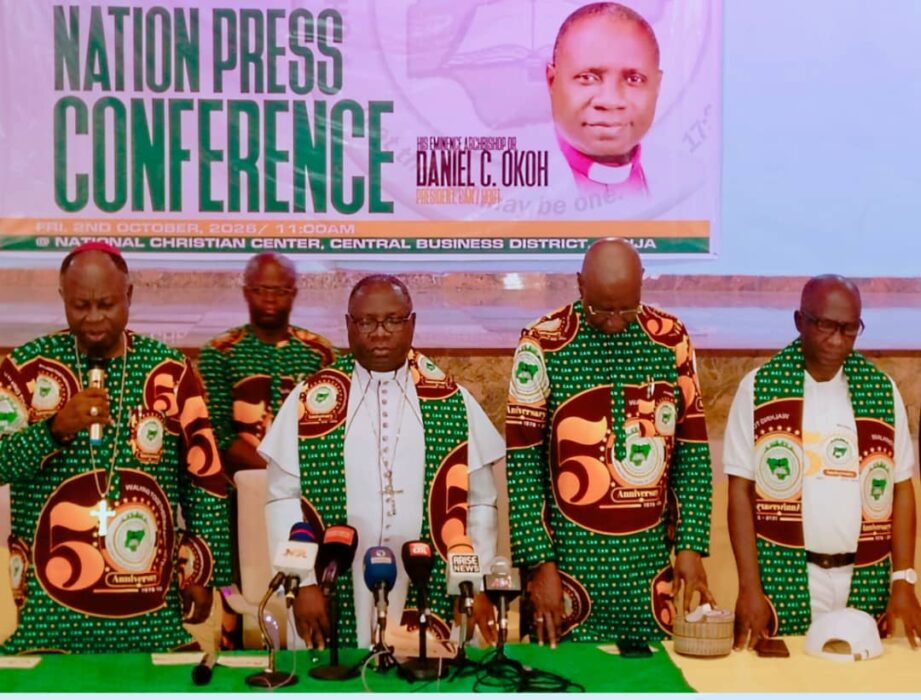
The Christian Association of Nigeria (CAN) will mark its 50th anniversary with a celebration of five decades of Christian unity, service and collective witness, its President, Archbishop Daniel Okoh, has said.
Okoh disclosed this in Abuja at a press conference to herald the Golden Jubilee of the association, which has adopted the theme, “Walking Together in Faith: Celebrating 50 Years of CAN’s Journey.”
The CAN president described the anniversary as a significant milestone in the history of the Christian community in Nigeria, saying the theme represented not only a celebration of the past but also a statement about the association’s future direction.
“These words are not merely a description of an anniversary. They are a statement of who we are, where we have come from and, more importantly, how we intend to journey into the future,” Okoh said.
He said CAN had, over the past five decades, brought together Christians from different traditions, denominations, theological backgrounds and cultural contexts under one national umbrella.
According to him, the association had not always enjoyed complete agreement among its constituent bodies, but its ability to remain together despite disagreements constituted one of the major testimonies of its 50-year journey.
“We have not always agreed. We have had our differences. We have experienced difficult moments, disagreements and leadership challenges. There have been times when denominational interests appeared to compete with our collective interests. Yet, through all these seasons, we have remained together,” he said.
Okoh explained that CAN’s unity had never been about eliminating the distinctive identities of its member churches, but about finding common ground on issues that transcend denominational boundaries.
“Our unity has never meant uniformity. We remain different churches with distinct traditions, structures and expressions of faith. But we have also recognised that there are issues that are bigger than our denominational differences,” he said.
He identified the dignity of the human person, the welfare of citizens, peace and the future of Nigeria as some of the issues that had continued to bring Christians together.
Reflecting on the history of the association, Okoh said CAN was established in 1976 following efforts by Christian leaders to create a national platform for cooperation among Nigeria’s diverse Christian traditions.
He recalled that on August 27, 1976, church leaders representing different Christian denominations met following an invitation from the Federal Military Government.
The meeting, he said, provided an opportunity for the Christian leaders to deliberate on matters concerning the Church and eventually led to discussions on the creation of a single ecumenical body.
“That historic conversation laid the foundation for the emergence of the Christian Association of Nigeria as the national umbrella body for the Christian community,” he said.
The CAN president said the association’s motto, taken from the prayer of Jesus Christ in John 17:21, “That they all may be one,” had remained its guiding principle since its establishment.
Okoh described the Golden Jubilee as a testimony to what he called “God’s faithfulness,” as well as the sacrifices and perseverance of generations of Christian leaders.
“50 years is not a small milestone. It is a testimony of divine faithfulness, human sacrifice, perseverance and the enduring relevance of Christian unity,” he said.
He paid tribute to CAN’s founding fathers, past presidents, national officers and members who served at national, state, local government and grassroots levels.
According to him, some of those who served the association did so when CAN had limited institutional capacity, while others faced difficult circumstances in defending the cause of Christian unity.
“To all of them, we say: Your labour was not in vain. The CAN of today stands on the foundation that you laid,” he said.
The CAN president said the anniversary should not be reduced to festivities, stressing that the milestone offered the association an opportunity for honest reflection.
He acknowledged that CAN had experienced internal disagreements, leadership tensions and occasions when denominational interests competed with collective interests.
He said the association must learn from those experiences while strengthening its institutional structures.
“We cannot celebrate fifty years merely by congratulating ourselves. We must have the courage to ask difficult questions about ourselves and about the kind of CAN we want to become,” he said.
Okoh said the association would focus in its next phase on stronger governance, research, communication, leadership development and financial sustainability.
The CAN president also identified young people and women as critical to the future of the association.
He said the association must deliberately create opportunities for the next generation to participate in leadership and decision-making.
“If CAN is to remain relevant for another fifty years, we must deliberately make room for the next generation on the table,” he said.
Okoh added that the Church must also adapt to the changing technological environment, including the growing influence of digital platforms and artificial intelligence.
He said young Christians should be equipped not only to consume technology but also to use it creatively and responsibly for the benefit of society.
Okoh described the Golden Jubilee as the beginning of another phase rather than the conclusion of CAN’s journey.
“CAN at 50 is not a retirement celebration. It is a re-commissioning,” he declared.
He said the first 50 years had been characterised by efforts to build inclusiveness, mutual understanding and a collective Christian voice, while the next 50 years should focus on deepening unity, strengthening institutions and expanding CAN’s contribution to national development.
According to him, the association wants to build a CAN that is “more united in purpose, stronger in its institutions, more credible in its public engagement, more present at the grassroots, more intentional about young people and women, more research-driven, more financially sustainable, more digitally relevant and more committed to peace and national development.”
He said the Golden Jubilee marked a transition “from remembrance to renewal, from celebration to responsibility, from experience to intentional succession, and from the achievements of the past to the possibilities of the future.”
The anniversary programme will feature a series of activities beginning with a road walk in Abuja, followed by an anniversary crusade, football competition involving CAN teams from the six geopolitical zones and a national ecumenical workshop.
Other activities include a Bible quiz, community responsibility project, women and youth assembly, jubilee colloquium and anniversary music cantata.
The association will also honour deserving individuals whose contributions have impacted Christianity and the Nigerian society.
The history of CAN, titled “CAN @ 50: Walking Together in Faith,” will be formally presented on October 17, while the Golden Jubilee celebrations will culminate in an anniversary church service and thanksgiving on October 18.
Okoh urged Christians and Nigerians to join the association in celebrating the milestone and renewing its commitment to the foundational principle of Christian unity: “That they all may be one.”
We’ve got the edge. Get real-time reports, breaking scoops, and exclusive angles delivered straight to your phone. Don’t settle for stale news. Join LEADERSHIP NEWS on WhatsApp for 24/7 updates →
Join Our WhatsApp Channel