
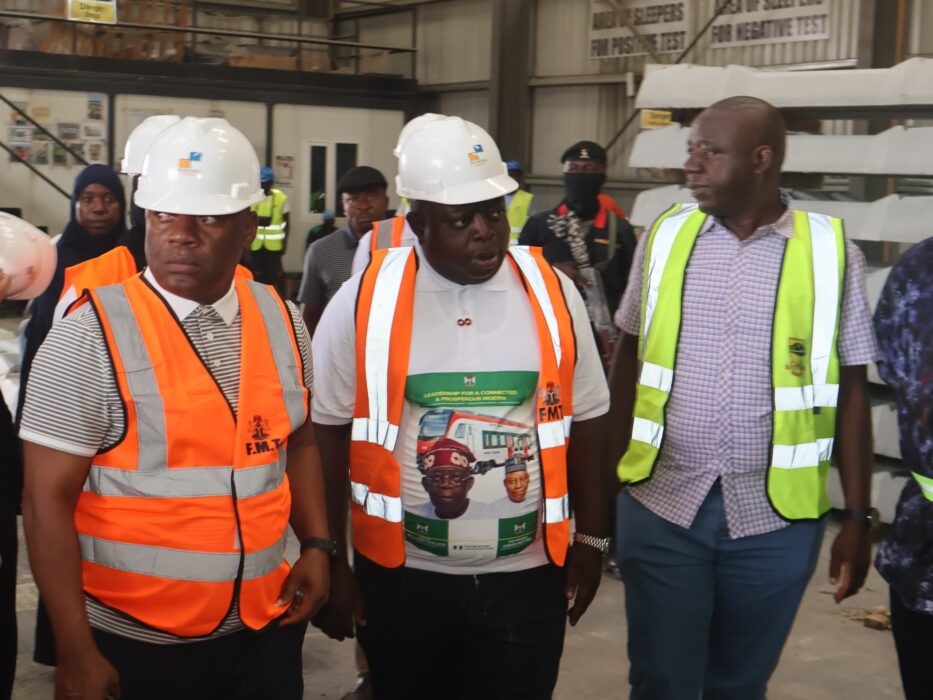
The permanent secretary of the Federal Ministry of Transportation, Engr. Funso Adebiyi has directed contractors handling railway projects across the country to ensure durable infrastructure, provide sustainable maintenance systems and train Nigerian engineers before handing over facilities to the Nigerian Railway Corporation (NRC).
Adebiyi said the directive was aimed at preventing premature deterioration of railway infrastructure, reducing dependence on foreign contractors and ensuring that Nigerian professionals could independently operate and maintain railway facilities.
He gave the directive during a joint fact-finding inspection of the ongoing Kano Railway Station construction project, accompanied by ministry officials, agency representatives and the senior special assistant to the president on Transportation and Mobility, Prince Ademola Adetokunbo Ade-John.
The permanent secretary insisted that contractors must prioritise quality and long-lasting materials, rejecting the use of short-life consumables in railway facilities.
He specifically directed that bulbs and light fittings must have a minimum lifespan of three years, while customised lamp holders and mobile motorised equipment should be provided to make replacements easier and reduce maintenance difficulties.
Adebiyi also instructed contractors to provide mechanised cleaning equipment for the maintenance of terminal glass structures, noting the need to account for thermal expansion and contraction in the design and upkeep of the facilities.
He cautioned against excessive dependence on diesel generators and other costly energy solutions that could undermine the long-term sustainability of railway infrastructure.
To strengthen local technical capacity, the permanent secretary directed the NRC managing director, Dr Kayode Opeifa, represented by the director of corporate planning, Dr James Zang, to assemble a team of young, qualified Nigerian engineers for an intensive, month-long practical training programme.
The training is expected to cover facility operations, replacement of consumables and maintenance procedures, equipping the engineers with the practical skills required to manage the infrastructure after handover.
He stressed that the programme must be conducted locally and include rigorous, examination-based assessments, warning that staff who fail the computer-based test would face consequences in accordance with applicable Civil Service regulations.
According to Adebiyi, priority should be given to engineers aged 35 and below who have at least 20 years of service remaining to ensure continuity, accountability, and career development within the railway system.
He said the approach would help the NRC build a technically competent workforce capable of preserving public infrastructure and reducing the need for foreign technical assistance.
Adebiyi reaffirmed the federal government’s commitment to sustainable infrastructure development, stressing that railway projects must deliver value for taxpayers’ money, ensure effective technology transfer, and provide a seamless handover to competent Nigerian professionals.
He maintained that the success of railway investments should be measured not only by the completion of construction but also by the durability of the facilities and the ability of local personnel to operate and maintain them efficiently.
We’ve got the edge. Get real-time reports, breaking scoops, and exclusive angles delivered straight to your phone. Don’t settle for stale news. Join LEADERSHIP NEWS on WhatsApp for 24/7 updates →
Join Our WhatsApp Channel