| How Ebola Spreads And What Nigerians Should Know
Twelve years after Nigeria was declared free of Ebola following an outbreak that killed eight people, the country has confirmed a new case of the disease in the Federal Capital Territory (FCT).
The federal government disclosed the case on Tuesday, October 20, 2026, following laboratory confirmation of the infection in a woman who recently arrived in Nigeria on an international flight from Uganda.
The patient had been admitted to a private hospital in Abuja, where she received treatment for several days before the diagnosis was confirmed.
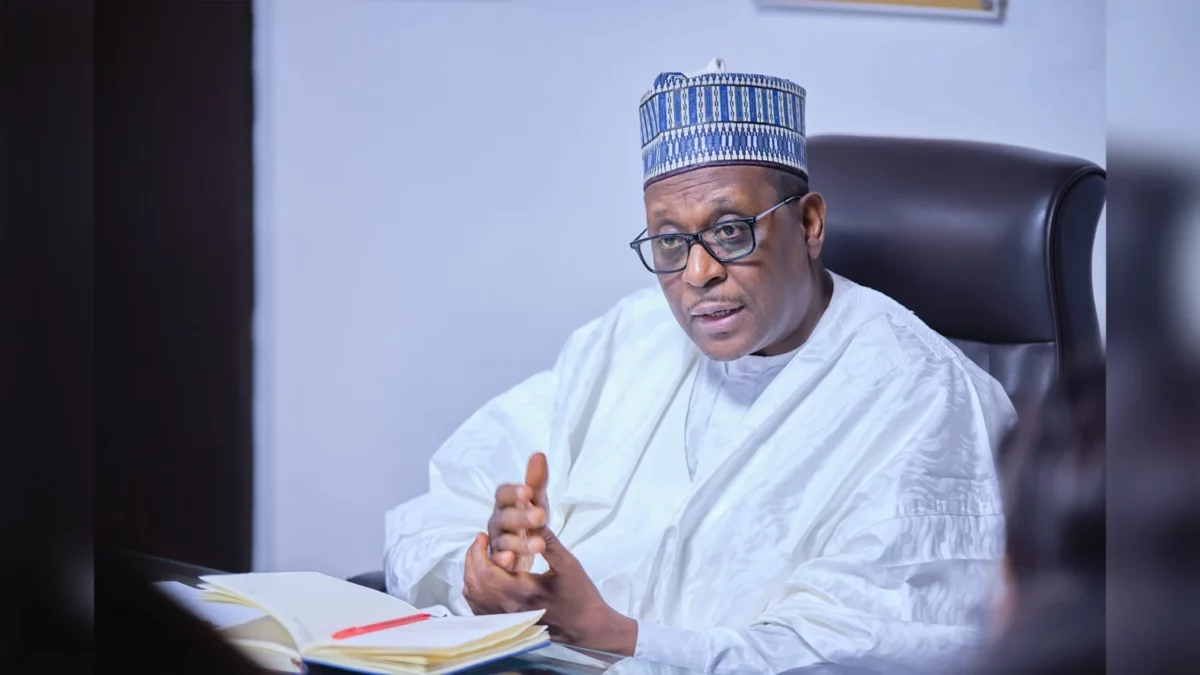
The coordinating minister of health and social welfare, Prof. Muhammad Ali Pate, announced the development in a statement, adding that the woman was in isolation and receiving medical care.
He said 44 close contacts had been identified as authorities intensified efforts to contain the infection and prevent further transmission.
According to the minister, contact tracing had commenced, with public health teams working to identify and monitor people who might have been exposed to the virus, including healthcare workers, patients, caregivers and travel contacts.
He added that surveillance had been intensified and the hospital where the patient received treatment was receiving immediate support to strengthen infection prevention and control measures.
Pate directed public and private healthcare facilities nationwide to remain on high alert and maintain a high index of suspicion for possible Ebola cases.
He also urged healthcare workers to identify and isolate suspected cases promptly, observe strict infection prevention and control measures, and immediately report suspected infections to public health authorities.
The minister advised Nigerians to remain calm but vigilant, stressing that early detection and compliance with public health measures were critical to preventing further transmission.
He said containing the infection would require public cooperation and coordinated action by the federal government, FCT authorities and other partners.
Pate assured Nigerians that investigations were ongoing and pledged that the government would continue to provide accurate and timely updates.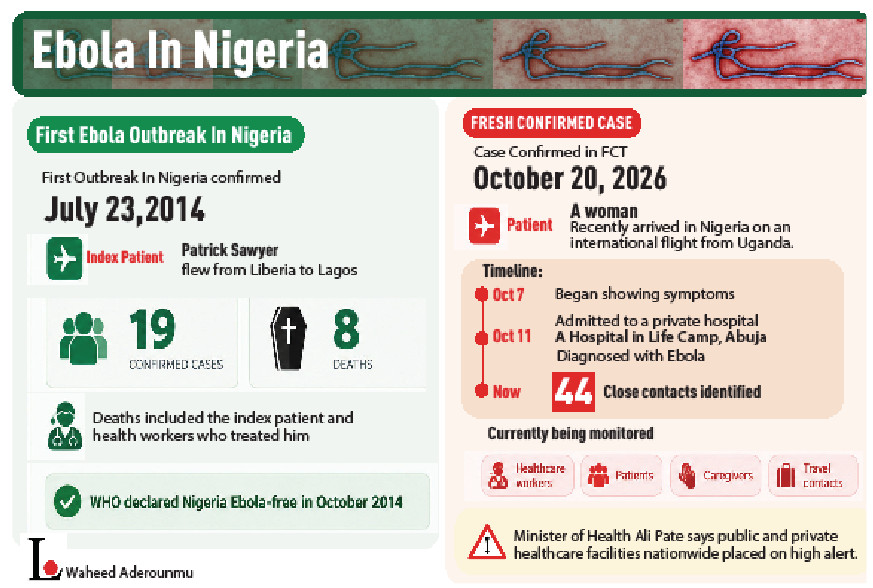
Remembering Nigeria’s 2014 Ebola Battle
Nigeria’s first major encounter with Ebola occurred in July 2014, when an infected Liberian-American, Patrick Sawyer, arrived in Lagos by air.
Sawyer was admitted to a private hospital, where he died five days later. His arrival triggered an outbreak investigation in Lagos, a densely populated commercial city with extensive domestic and international travel connections.
The incident posed a significant risk of wider transmission because Sawyer had interacted with people at the airport and in healthcare facilities before his infection was confirmed.
However, Nigeria’s response, including the sacrifice of the late Dr Ameyo Stella Adadevoh, demonstrated how rapid case identification, contact tracing, isolation, coordinated emergency management and public awareness could help contain a dangerous infectious disease.
According to the World Health Organisation (WHO), the outbreak resulted in 20 cases and eight deaths, including the index case. Nigeria was officially declared free of Ebola transmission on October 20, 2014, after completing the required 42-day period without a new case.
The response involved the Federal Ministry of Health, Lagos State authorities, the Nigeria Centre for Disease Control (NCDC), international health partners and other stakeholders.
An emergency operations structure was established to coordinate the response, investigate suspected infections, identify contacts and monitor people who might have been exposed.
Public awareness campaigns and engagement with community, traditional and religious leaders also helped communicate the risks associated with the disease.
The successful containment of the 2014 outbreak established Nigeria as an example of how a country could interrupt transmission even when confronted with a potentially devastating epidemic.
However, the confirmation of another case 12 years later underscores the fact that previous success does not eliminate the risk of new infections entering the country.
Nigeria’s Ebola Preparedness
Before the latest confirmation, Nigeria had intensified its preparedness following the spread of Ebola in parts of Central and East Africa.
On October 6, 2026, the NCDC announced heightened vigilance after Kenya confirmed an imported case linked to an outbreak in the Democratic Republic of the Congo (DRC).
At the time, the agency said Nigeria had no confirmed Ebola case.
It also disclosed that preparedness activities were being strengthened in collaboration with the Federal Ministry of Health and Social Welfare, Port Health Services, state governments and other partners.
The measures included surveillance, early detection, laboratory diagnosis, isolation and referral, contact tracing, infection prevention and control, risk communication, and the protection of healthcare workers.
The NCDC also reported that a national Ebola preparedness tabletop simulation exercise had been conducted to test response arrangements and identify gaps requiring attention.
LEADERSHIP reports that President Bola Tinubu established a Presidential Task Force on Ebola Virus Disease Preparedness and Emerging Public Health Threats in June 2026. The task force was created to strengthen national preparedness and prevent the importation and spread of the disease following outbreaks in the DRC and elsewhere in the region.
It is chaired by the Chief of Staff to the President, Femi Gbajabiamila, and comprises representatives of relevant ministries, departments and agencies, state governments and public health partners.
Its responsibilities include coordinating the national response, overseeing the implementation of Nigeria’s Ebola preparedness plan, reviewing surveillance reports and coordinating decisions on emergency measures.
As part of the preparations, Tinubu approved the release of N10 billion in emergency intervention funding to strengthen the NCDC’s operational capacity and support critical public health response activities.
The confirmation in Abuja now puts these preparedness arrangements to a practical test.
Expert Calls for Calm, Effective Risk Communication
Meanwhile, an infectious disease expert, Dr Oladipo Elijah Kolawole, has urged Nigerians to remain calm but vigilant following the federal government’s confirmation of an Ebola case in the FCT.
Kolawole, an associate professor of infectious diseases, pathogen genomics and molecular epidemiology at Adeleke University and founder of Helix Biogen Institute, told LEADERSHIP that early detection and strict adherence to public health measures were critical to containing the disease and preventing wider transmission.
He advised Nigerians to practise regular hand hygiene, avoid direct contact with the bodily fluids of sick individuals and promptly report suspected cases to health authorities.
The expert stressed that public vigilance and evidence-based interventions, rather than panic, were essential to managing the situation.
He urged the government to prioritise rapid case investigation, contact tracing, laboratory confirmation and effective risk communication to contain the infection.
Kolawole also called for stronger infection prevention and control measures in healthcare facilities, noting that transparency, preparedness and a coordinated public health response would be crucial to preventing further transmission.
How Ebola Spreads and What Nigerians Should Know
Ebola is a severe viral disease that can cause serious illness and death.
The virus spreads through direct contact with the blood or other bodily fluids of an infected person who is sick or has died, or through contact with contaminated objects and materials.
It is not spread simply because an infected person is in the same room, nor through ordinary casual contact without the necessary exposure.
Symptoms
Symptoms can include fever, severe weakness, headache, muscle pain, vomiting and diarrhoea. Some patients may develop bleeding, although this does not occur in every case.
The incubation period generally ranges from two to 21 days.
Precautions
The federal government has advised Nigerians to practise regular hand hygiene, avoid contact with the bodily fluids of anyone suspected of having the disease and report possible exposure to public health authorities.
Anyone who develops compatible symptoms after possible exposure should contact public health authorities for guidance rather than visiting a healthcare facility without prior notification.
People identified by contact-tracing teams should cooperate with health officials and follow instructions on monitoring and other recommended public health measures.
Assurance to Nigerians
The Federal Ministry of Health has said Nigeria successfully contained Ebola in 2014 and has the experience and public health systems to respond to the current case.
However, the ministry stressed that containing the disease requires everyone to play their part.
We’ve got the edge. Get real-time reports, breaking scoops, and exclusive angles delivered straight to your phone. Don’t settle for stale news. Join LEADERSHIP NEWS on WhatsApp for 24/7 updates →
Join Our WhatsApp Channel