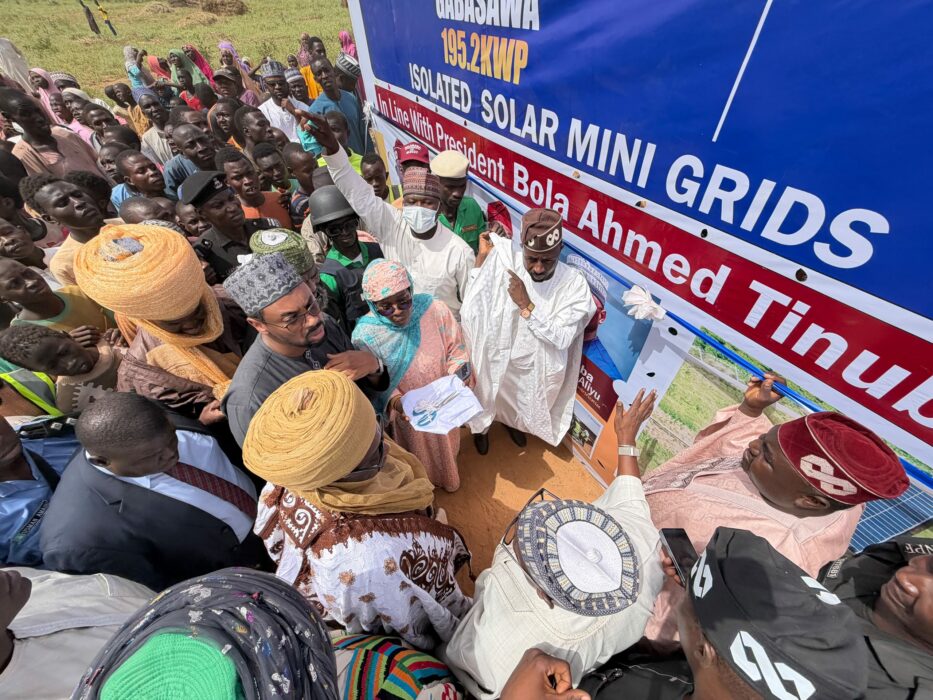
Two rural communities in Kano State have received electricity for the first time in more than 16 years following the commissioning of solar mini-grids by the Rural Electrification Agency (REA).
The projects, located in Ballagaza in Gabasawa Local Government Area and Marayar Rogo in Warawa Local Government Area, comprise a 195kWp mini-grid in Ballagaza and a 70kWp facility in Marayar Rogo. They are expected to supply power to 2,222 households.
The managing director of the REA, Abba Aliyu, said the projects marked another step towards the federal government’s target of providing electricity to more than 17 million Nigerians under the Renewed Hope Agenda.
He said the initiative demonstrated the value of collaboration between government and private investors.
“The federal government did not build these mini-grids and hand them over,” Mr Aliyu said. “Alfuttaim Nigeria Limited invested its own money, built them, and will own and operate them for many years. What the government did, through the DARES programme delivered by the REA with support from the World Bank, was to subsidise part of the cost to ensure the electricity is affordable.”
He explained that the Distributed Access through Renewable Energy Scale-up (DARES) programme was targeting 1,350 mini-grids across Nigeria and had already provided new or improved electricity access to more than five million people.
Aliyu said Nigeria still had more people without electricity than any other country, adding that the challenge required investment by private companies and ownership by beneficiary communities.
He also commended the Kano State governor, Abba Kabir Yusuf, for prioritising electricity and creating an enabling environment for the projects.
The Ballagaza community, known for the production of groundnuts, millet, sorghum and soya beans, is expected to benefit from improved agricultural processing. Residents will be able to use electric machines to press groundnuts into oil and produce kuli-kuli for sale at better prices.
The mini-grid will also supply electricity to the community’s primary healthcare centre, which had previously operated without power.
The Co-founder of Alfuttaim, Dr Nabilah Sani, expressed satisfaction with the completion of the projects, saying they would power homes and support agricultural productivity.
She thanked the Federal Government for facilitating the funding that made the projects possible and disclosed that the two sites were part of 10 projects being developed by the company in Kano State.
Dr Sani urged residents to protect the facilities, describing them as community assets, and warned against vandalism.
The DARES programme, supported by the World Bank, is designed to expand electricity access through private-sector-led solar mini-grids and standalone solar systems.
We’ve got the edge. Get real-time reports, breaking scoops, and exclusive angles delivered straight to your phone. Don’t settle for stale news. Join LEADERSHIP NEWS on WhatsApp for 24/7 updates →
Join Our WhatsApp Channel