
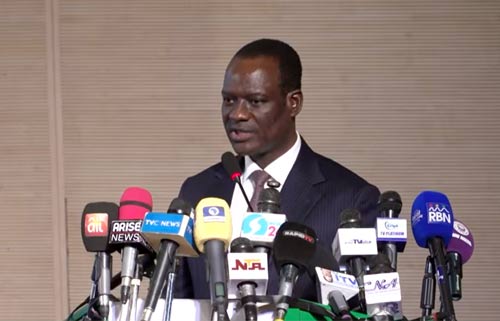
The federal government has said it plans to spend about $10.6 billion of its proposed $21.7 billion external borrowing on transportation infrastructure, including the Sokoto-Badagry and Lagos-Calabar highways and the Kano-Kaduna rail project, the Minister of Finance and Coordinating Minister of the Economy, Taiwo Oyedele, has said.
Oyedele defended the borrowing plan as an investment strategy meant to create assets, stimulate economic growth and improve living standards.
He spoke with State House correspondents after the Federal Executive Council (FEC) meeting presided over by President Bola Tinubu at the Presidential Villa, Abuja.
The plan, submitted to the National Assembly, is estimated at $21.7 billion equivalent in dollars and euros. Beyond transportation, it covers security, healthcare, agriculture, energy, digital infrastructure, education and social protection.
“This is investment, not borrowing,” Oyedele said, arguing that the funds should be judged by the projects they will finance and the economic benefits expected from them.
He said the government was seeking financing from multilateral and bilateral development partners, as well as other sources. About $7.9 billion will come from multilateral and bilateral partners, with the World Bank among the leading lenders.
Oyedele said a $5 billion World Bank component would attract concessional financing at an average interest rate of about 2.1 per cent, while some social-sector loans would carry rates of around two per cent. He added that the arrangements were being structured to secure better terms than commercial borrowing would offer.
He stressed that the projects would be assessed on their capacity to deliver economic returns and improve national productivity, rather than on their addition to the country’s debt stock.
Inflation target
On the economy, the minister said the government was targeting single-digit inflation by the end of 2027 or earlier.
He said inflation fell to 14.63 per cent in September, from 20.98 per cent a year earlier and a peak of about 34 per cent. FEC, he said, had resolved to intensify efforts to stabilise prices, particularly food prices, while sustaining investment in infrastructure, human capital development and job creation.
Oyedele said the administration would continue to pursue fiscal discipline and measures to improve economic stability and expand opportunities for Nigerians.
Reserves, growth and revenue
He disclosed that Nigeria’s foreign reserves had risen above $55 billion, the highest in 18 years, while net reserves had increased to more than $45 billion from less than $1 billion three years ago.
The economy grew by 4.43 per cent in the second quarter, compared with 2.74 per cent in May 2023, he said, adding that growth measured in dollar terms had also improved.
He said reforms had improved revenue mobilisation, with the tax-to-GDP ratio rising from about seven per cent in 2023 to 12.5 per cent by the end of 2025. The debt-service-to-revenue ratio, he added, had declined from 97 per cent to below 60 per cent.
Subsidy removal
Oyedele also defended the removal of the petrol subsidy, arguing that successive increases in petrol prices over several decades had failed to resolve the underlying problem. He said Nigeria had increased petrol prices about 3,050 times over 50 years without finding a lasting solution.
The previous arrangement, he said, imposed a growing fiscal burden that limited the government’s capacity to invest in infrastructure and essential public services. He maintained that removal was necessary to address the long-standing structural problem, although measures to cushion vulnerable households had to be sustained.
Social interventions and tax relief
According to him, more than 10 million households have received over N600 billion in cash transfers, while the Nigerian Education Loan Fund has disbursed N372.6 billion to more than 1.5 million students. More than 800,000 micro, small and medium-sized enterprises have benefited from subsidised single-digit interest loans.
Oyedele said low-income earners making up to N100,000 monthly were exempt from personal income tax, while small businesses with annual turnover of up to N100 million were exempt from corporate income tax, value-added tax and withholding tax under the tax reforms.
He said the government would continue to monitor the impact of its policies and make adjustments where necessary to support economic recovery and protect vulnerable citizens.
Capital market and naira
The minister also pointed to growth in the capital market, whose value, he said, had risen from about N30 trillion to more than N160 trillion. He expressed optimism about the naira’s outlook, citing improved foreign reserves and other economic fundamentals.
Oyedele said the government’s broader objective was to sustain the reform gains, strengthen economic resilience and ensure that investments in infrastructure and social services translated into better living conditions for Nigerians.
We’ve got the edge. Get real-time reports, breaking scoops, and exclusive angles delivered straight to your phone. Don’t settle for stale news. Join LEADERSHIP NEWS on WhatsApp for 24/7 updates →
Join Our WhatsApp Channel