

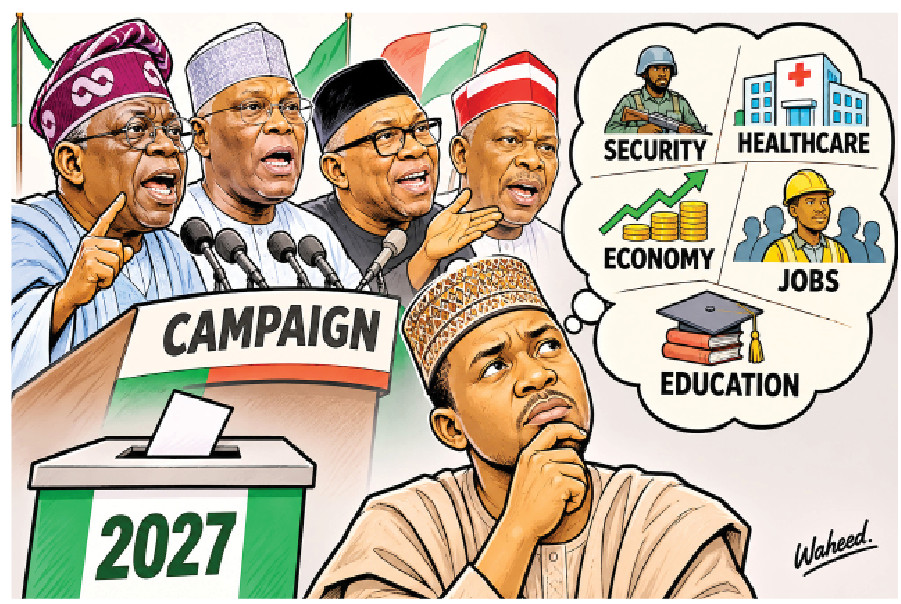
Nigeria’s political parties can tell us who will coordinate their campaigns, mobilise supporters and deliver strongholds. They owe us comparable clarity on who will deliver safer communities, functioning hospitals and an economy where work pays. As preparations for the 2027 elections gather momentum, the machinery for winning power is becoming visible. The case for exercising it deserves closer examination.
Campaign, no campaign. That is the paradox of an election season in which political activity can outpace public understanding. After the appointments, alliances and speeches, voters should be able to explain what separates competing programmes and what those differences would mean for their lives.
Organisation Is Not a Programme
Consider the Nigeria Democratic Congress. Reports on October 26 detailed its National Campaign Council, chaired by Seriake Dickson, with Peter Obi as co-chairman and Ibrahim Abdulkarim as campaign director-general. The party promised a “people-centred and issue-based campaign”. Its appointments establish who will organise the electoral effort. Its campaign must establish how its candidates would govern. A coalition that wins an election does not automatically have a coherent governing programme.
The All Progressives Congress faces the same distinction. President Bola Tinubu inaugurated its Presidential Campaign Council on October 14. According to the State House account, the party’s national chairman called for a contest of ideas, records and policies, acknowledging that reforms must translate into practical improvements. Nigerians should hold the party to that standard.
Fairness requires resisting the exaggeration that opposition parties have no policies while the governing party offers only the word “reform”. The stronger question is whether published commitments provide credible choices that citizens can compare.
The African Democratic Congress unveiled proposals in May, after adopting them at its April convention. They included a living wage, independent electoral management, preventive healthcare and a production-driven economy. Its August Orange Book included commitments to abolish opaque security votes and reduce governance costs. These positions deserve examination, not dismissal.
What would a living wage mean for public finances, small employers and informal workers? How would security spending become accountable without compromising operational confidentiality? Which expenditure would be cut, and through what authority? Proposals gain credibility when their advocates confront such difficulties.
The Allied Peoples’ Movement publishes positions on security, the rule of law, federalism and foreign policy. Its commitment to genuine federalism raises practical questions: which powers would move, which revenues would follow and which responsibilities would remain shared? Principles matter, but voters need to understand the governing arrangements they imply.
Put Every Promise to the Test
The APC identifies subsidy removal, exchange-rate unification, tax reforms and local government autonomy among the achievements it intends to campaign for. It also cites student loans, consumer credit and healthcare initiatives. The issue is whether the results justify renewed confidence and whether its next programme addresses what has fallen short.
An incumbent must account for what changed, who benefited, who bore the costs and what remains unresolved. Disbursed money does not necessarily create opportunity; a commissioned project does not necessarily sustain a service. Government must demonstrate the connection between its actions and the improvements it claims.
“Reform” describes a process whose value depends on its consequences. Policy may address a structural problem while being poorly sequenced or insufficiently protective of vulnerable people. A household struggling to afford essentials should not have to apologise for asking when adjustment will produce relief. Economic credibility requires a defensible destination and a convincing account of the journey.
Opposition parties face an equivalent obligation. Frustration with government creates an audience; it does not establish competence. Challengers must explain what they would retain, reverse or redesign, including the costs. Otherwise, voters may mistake a change of personnel for a change of programme.
Food provides a useful test. Every party can promise to end hunger. A credible programme connects farm security, inputs, irrigation, storage, transport and market access. It also addresses the tension between immediate relief for consumers and incentives for producers. Would temporary imports help? When would they end? How would emergency measures avoid becoming permanent privileges for favoured businesses?
Employment promises require similar scrutiny. Which enterprises will employ the proposed millions of workers? What will they produce, and who will buy it? A training certificate is not a vacancy. A loan cannot rescue a business without reliable power or sufficient demand. Candidates must explain how their interventions would support viable enterprises and sustained employment.
Healthcare reveals the difference between visible projects and functioning government. A hospital can be photographed; reliable treatment requires staff, medicines, maintenance and affordable access. Education similarly depends on teachers, attendance and learning, alongside classrooms. Who will fund these continuing obligations? Campaigns should explain recurring service costs as clearly as construction plans.
Security proposals must address power and its limits. Advocates of decentralised policing should explain recruitment, financing, professional standards and safeguards against political abuse. Promises of better intelligence require clarity about coordination and responsibility when warnings are ignored. Protecting citizens from criminals and unlawful state coercion are both public obligations.
Make Commitments Measurable
Every promise eventually encounters the question: what will it cost? Parties should distinguish immediate commitments from those requiring additional revenue and identify what they would postpone or discontinue. Savings from waste and corruption require specific measures and realistic estimates. Borrowing needs a repayment argument; private investment needs conditions that make it plausible. Acknowledging limits offers a more honest basis for trust.
Voters should also ask who can legally deliver each pledge. A presidential candidate cannot treat every state or local responsibility as a federal undertaking. Promises involving other tiers of government need an explanation of cooperation, incentives and the consequences when those partners refuse to act.
Personal integrity must translate into institutional safeguards. Citizens need arrangements that can expose wrongdoing even when offenders are politically connected. What procurement information would be published? How would oversight bodies obtain records and enforce consequences? Would these protections remain effective under a less scrupulous successor? Reform should outlast its author.
The media must make these distinctions unavoidable. Appointments, defections and endorsements are news but should not consume an election’s intellectual energy. Every major promise deserves questions about financing, authority, implementation and obstacles. Interviewers should not accept a second slogan as an explanation of the first. Scrutiny must remain consistent across parties and persist beyond individual broadcasts.
Every serious contender should publish five priority commitments, each with a starting baseline, estimated cost, funding source, responsible institution and deadline. These would provide a manageable basis for comparison and a record against which to judge the winner. Governors and legislators should face scrutiny appropriate to their powers and responsibilities.
Such commitments would also improve the debate between elections. Citizens could track delivery, distinguish delays from abandonment and question changes in priorities. Parties would have to explain departures from their promises instead of relying on fading memories. Accountability begins when electoral language becomes specific enough to be tested against experience.
Nigeria needs public understanding to match its political enthusiasm. Campaign councils organise the pursuit of office; candidates must explain how they will use it. By election day, Nigerians should know more than who joined whom or which rally drew the largest crowd. They should understand what leaders have undertaken to deliver, what sacrifices their choices entail and how failure will be judged.
Until then, there may be campaigns everywhere, and still too little case for governing.
Dakuku Peterside is a leadership and management turnaround expert.
We’ve got the edge. Get real-time reports, breaking scoops, and exclusive angles delivered straight to your phone. Don’t settle for stale news. Join LEADERSHIP NEWS on WhatsApp for 24/7 updates →
Join Our WhatsApp Channel


