
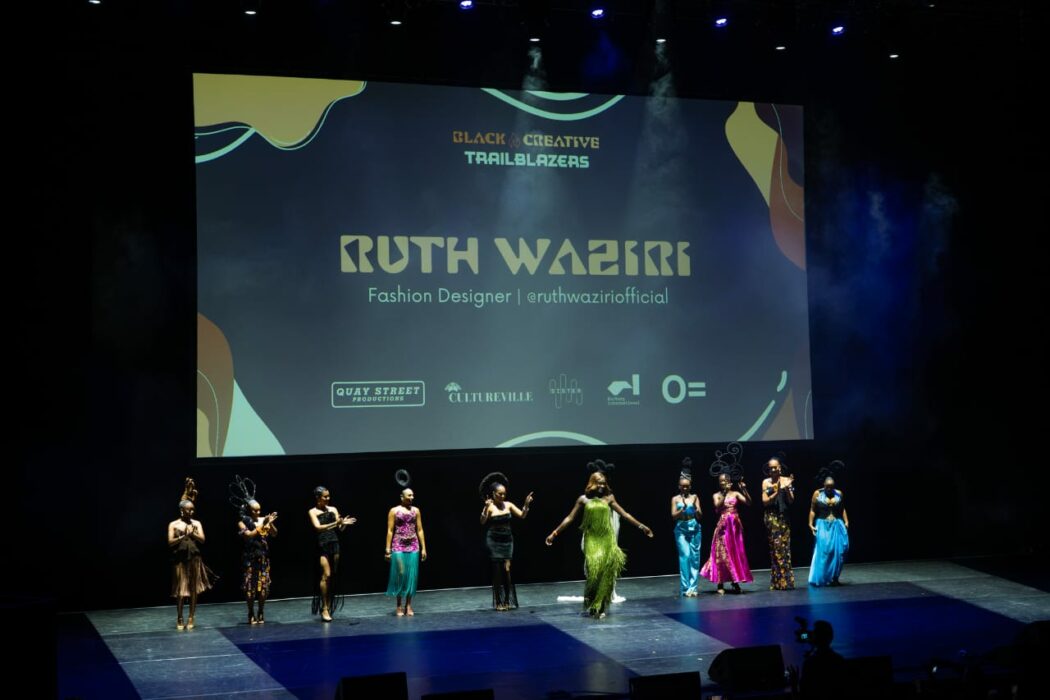
At the Black Creative Trailblazers Showcase, a designer who taught herself resilience the hard way delivered a collection that made the case for her as one of Britain’s most compelling emerging voices.
There is a particular thrill in watching a designer arrive at the moment their ambition and their ability finally meet. On a September evening in Manchester, beneath the industrial grandeur of Aviva Studios, Ruth Waziri reached that moment. Presenting RUN THE LIGHT at the Black Creative Trailblazers Showcase, the city’s flagship celebration of Black creativity, the Manchester-based designer delivered not merely a collection but a declaration: this is who I am, and this is where I intend to stay.
Waziri’s route to that runway was anything but conventional. Raised in northern Nigeria and trained in public health, she came to fashion by way of memory: the rhythms of traditional dress, the ceremony of celebration, the unspoken authority of clothes that mean something. She launched her eponymous atelier in 2018, fresh out of university, on a single conviction: that tailoring should do more than flatter. It should empower. Eight years on, that founding idea has matured into a design language all her own, heritage and modernity held in deliberate, graceful tension.
The journey was not smooth, and the collection is better for it. Waziri’s first attempt at ready-to-wear ended in the kind of disaster that finishes young labels. An entire production run of 240 pieces arrived unusable, the pop-up was cancelled, and the loss was absorbed alone. She rebuilt from a rented studio, order by order, learning to command every seam of her business in the process. That apprenticeship in adversity shows. RUN THE LIGHT moved down the runway with the composure of a designer who has already survived her worst night and no longer has anything to prove. She only has something to say.
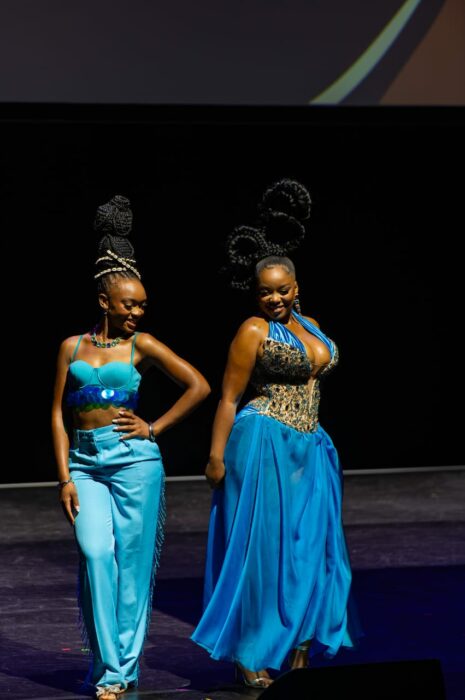
And she said it beautifully …
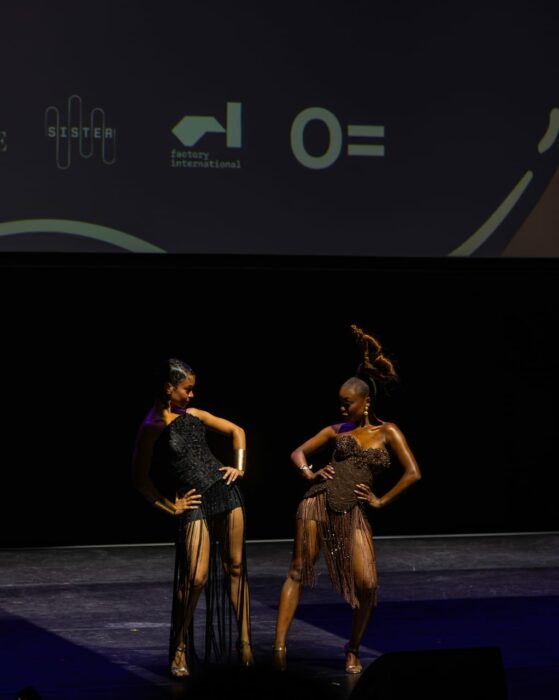
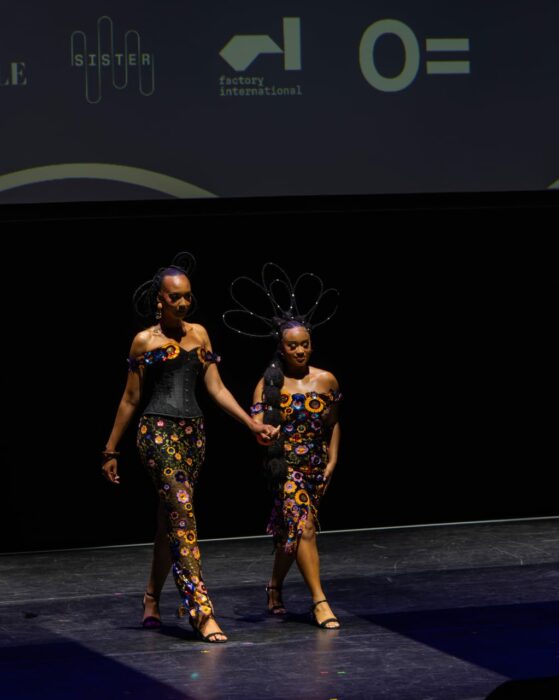
The collection spoke in controlled contrasts: structure softening into movement, precision giving way to ease, silhouettes that held the body with respect rather than constraint. These are clothes made by a tailor’s hand but worn with a woman’s freedom, garments in conversation with the women beneath them rather than imposed upon them. There was no filler in the lineup, no look that existed to pad the count. Each exit felt inevitable, part of one sustained argument about femininity, strength, and self-possession.
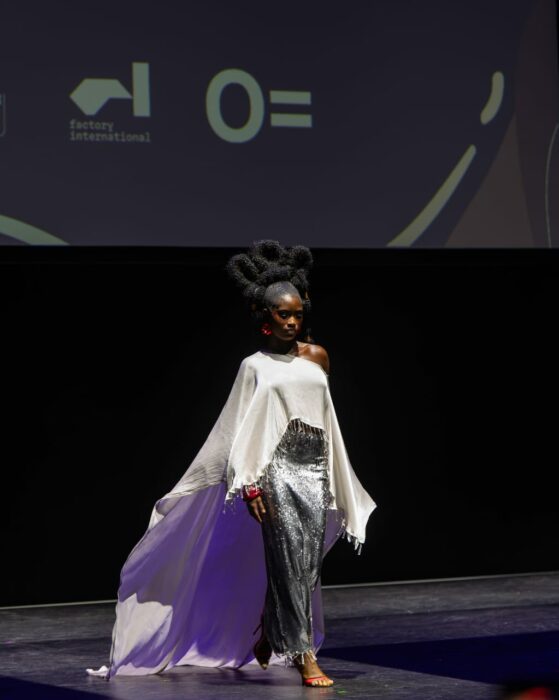
Two looks crystallised the collection’s range. The first, a floor-sweeping royal blue halter gown, paired a plunging bodice worked in gold embroidery with a skirt cut high enough to turn every stride into punctuation. Above it rose a sculptural braided headpiece, looped like calligraphy, the kind of craftsmanship that reads as jewellery. It was regal without tipping into costume: heritage worn at full wattage. The second look worked in the opposite register, an asymmetric white drape falling from one shoulder into a fluid train, anchored by a column of silver sequins and crowned with a towering sculpted updo. Where the blue gown celebrated adornment, the white look proved Waziri can do restraint with equal conviction. Together they framed the evening’s true signature: hair treated as architecture, braided into halos, hearts, and looping wire forms that gave every silhouette its own skyline.
What distinguishes Waziri from the crowded field of emerging talent is the authenticity of her dual inheritance. This is not heritage deployed as decoration, the familiar Ankara-as-exoticism that too often passes for African fashion in Western rooms. Her Nigerian identity runs through the work structurally, from the cut to the naming: her ready-to-wear line carries Hausa-inflected names like Yarwa and Yanga, deliberate signatures of a designer with no interest in sanding down where she comes from. It is the same sensibility that animated Awumba, her 2024 British runway debut at Manchester’s Afro Fashion Show, which drew notice for its narrative clarity. Where Awumba introduced the vocabulary, RUN THE LIGHT speaks it fluently.
The evening’s staging matched the clothes in intelligence. Within a programme that wove fashion together with poetry, music, and visual art, Waziri’s segment held the room with unhurried assurance. The styling served the garments rather than competing with them; the models inhabited rather than displayed. Nothing reached for spectacle, and that restraint became its own kind of spectacle, a refusal, increasingly rare, to design for the thumbnail instead of the woman.
As the final look passed through the hall, what lingered was not noise but mood: assured, luminous, unselfconscious. The collection’s title turned out to be less a name than a description. Ruth Waziri has spent eight years building toward the light, through cancelled launches, borrowed studio space, and the long apprenticeship of believing in work no one had seen yet. At Aviva Studios, she stepped into it fully.
She is no longer a name to watch. She is now a name to remember.
We’ve got the edge. Get real-time reports, breaking scoops, and exclusive angles delivered straight to your phone. Don’t settle for stale news. Join LEADERSHIP NEWS on WhatsApp for 24/7 updates →
Join Our WhatsApp Channel