
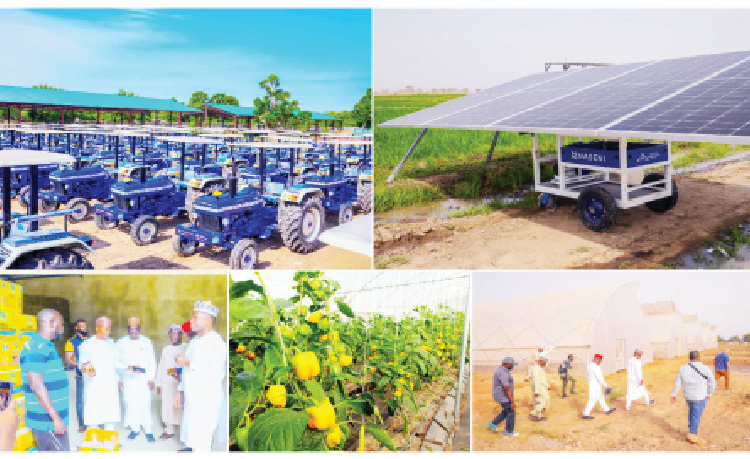
The Federal Government of Nigeria has called on development partners such as FAO, AfDB, IFAD and the World Bank to consider deeper collaboration in technology transfer, technical capacity development, investment de-risking, and financing of agricultural mechanisation to achieve food security.
The minister of Agriculture and Food Security, Senator Abubakar Kyari, represented by the permanent secretary, Dr. Marcus Ogunbiyi, stated this at the 3rd edition of the Farm Food and Allied Technology Expo (FARMFATECH) 2026 with
the theme “Driving Agricultural Industrialisation: Local Manufacturing, Technology Transfer and Export for Africa’s Prosperity”.
He said Nigeria presents a huge and growing market for agricultural machinery and mechanisation services. He noted that, with Nigeria’s vast arable land, rapidly growing population, and increasing demand for food, the need for tractors, harvesters, irrigation equipment, processing machinery, storage technologies, and other agricultural equipment will continue to expand.
“To our development partners, including FAO, AfDB, IFAD, World Bank, JICA, Sahel Consulting, UNIDO, GIZ and other institutions, we appreciate your continued support. We invite deeper collaboration in technology transfer, technical capacity development, investment de-risking and the financing of agricultural mechanisation,”.
“To the private sector, manufacturers and investors, Nigeria is ready for business. We welcome joint ventures, public-private partnerships, equipment leasing, mechanisation service centres, local assembly and manufacturing, and Build-Operate-Transfer arrangements”.
He also called on financial institutions to develop innovative financing products specifically for agricultural machinery.
According to him, a tractor or agricultural machine should be treated not merely as an equipment purchase, but as a productive investment asset capable of generating income and supporting agricultural expansion.
He urged farmers to embrace mechanisation and organise into cooperatives and viable producer groups.
He said, “Through collective action and commercially structured mechanisation services, we can expand access to modern equipment and improve productivity, reduce production costs and minimise post-harvest losses.
“With the need for everyone to redirect investment in agribusiness in mind, the Federal Government is set to unlock the job creation potential of cold chain systems through engagement of private sector participation in community cold chain enterprises; to incentivise the establishment of new food storage ventures across the country with direct and indirect new job creation.
“It is believed that the provision of food security/safety initiatives is germane to sustainable and regenerative economic development”, he said. He reiterated that the Government has devised a unique innovative strategy to guarantee the vibrancy of the food industry sector; to modernise the agricultural sector in line with the changing global food systems and supply chains.
He explained that the policy is aimed at integrating food production, storage, food processing and industrial manufacturing to establish the linkages necessary in the agricultural commodity value chain to adopt digital technology as a veritable instrument for accelerating the attainment of food and nutrition security. “The value chain as a development strategy considers the role of the players from food production to consumption and is designed to empower the smallholder Agroprenuers, ensure that processors have good quality raw materials, and that consumers accept products with satisfaction,”.
The Minister emphasised that the Federal Ministry of Agriculture and Food Security (FMAFS) is committed to a robust and sustainable agricultural sector and will continue to work with all relevant stakeholders to build an agriculture and agribusiness economy capable of delivering sustained prosperity by meeting domestic food and nutrition security goals, employment generation, economic diversification, poverty reduction, increase in foreign exchange earnings and supporting sustainable income growth.
“The Federal Ministry of Agriculture and Food Security is committed to postharvest management and value chain financing through focusing on the provision of an enabling institutional and consistent regulatory policy environment for free flow of agricultural commodities between farm gate and off-farm agribusiness enterprises, other end users as well as cross-border trades,” he added.
He said that establishing agro-processing facilities in rural areas to primary-process crops into intermediate raw materials for major agro-industries will reduce transportation costs, postharvest losses, and spoilage, enhance rural transformation, and improve farm-level profits.
The Minister said the National Agricultural Technological and Innovation Policy (NATIP) of 2022-2027 presents a six-year strategic plan to improve the efficiency of the Nigerian agricultural sector through specific interventions such as rapid mechanisation, knowledge creation and transfer, the establishment of an agricultural development fund, market development, among others.
“Through the NATIP framework, cold chain technology innovation is now being employed. The establishment of agro-conditioning centres to serve as warehouses equipped with effective and efficient cold chain facilities for preservation of agricultural produce. These centres across the country will facilitate the timely linkage of farmers to local and foreign markets, reduce delays in disposing of their produce, and provide the benefits of optimal prices, thereby opening up the rural economy and increasing agricultural production for local consumption and exports. He assured that the Federal Ministry of Agriculture and Food Security will continue to promote agribusiness investment and postharvest management, and to strengthen production technology and value chain financing.
He said Nigeria cannot achieve sustainable food security using predominantly manual methods.
“Mechanisation is the bridge between our agricultural potential and agricultural prosperity. It will enable us to cultivate more land, increase productivity, create jobs, attract investment and make agriculture more competitive. Therefore, the success of FARMFATECH 2026 should not be measured only by the number of machines displayed, but by the investments mobilised, partnerships established, financing agreements concluded, technologies transferred and equipment deployed to farms. Let us therefore move from exhibition to execution; from machines on display to machines in the field; and from talk to tractors,” he added.
He expressed optimism that, with the right investments, partnerships, and technologies, Nigeria can become a major hub for agricultural machinery manufacturing, assembly, distribution, and mechanisation services for the African market.
In his remarks, the Head, Sustainability and SDG Alignment, World Agriculture Forum Nigeria Council, Farmfatech 2026, Atai Akpan, said the Expo is about local manufacturing, technology transfer, finance and export.
He said that an agribusiness with reliable records gives its lender a clearer view of its operations, risks, and proposed investment.
He said the demand for cleaner agriculture therefore becomes demand for local manufacturing and local jobs, with openings for young people and women-led enterprises
We’ve got the edge. Get real-time reports, breaking scoops, and exclusive angles delivered straight to your phone. Don’t settle for stale news. Join LEADERSHIP NEWS on WhatsApp for 24/7 updates →
Join Our WhatsApp Channel