The Association of Senior Civil Servants of Nigeria (ASCSN) on Thursday demanded an immediate increase in the minimum monthly salary of the lowest-paid federal worker to N300,000, rejecting temporary wage awards and palliatives as inadequate to address the rising cost of living.
The union also threatened nationwide picketing and withdrawal of services against federal institutions accused of interfering in its internal affairs, warning that it would mobilise organised labour to resist attempts to undermine its activities.
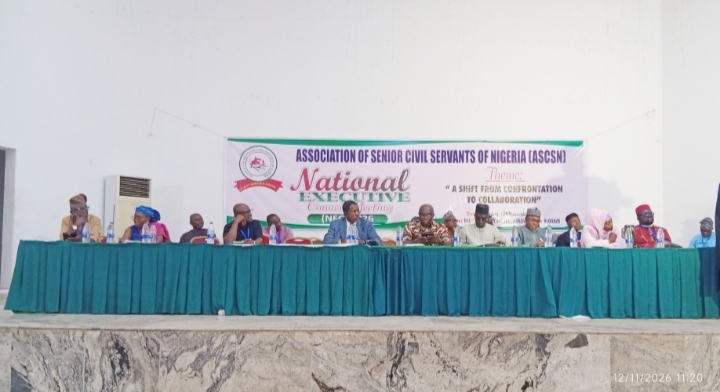
The national president of ASCSN, Comrade Shehu Mohammed, made the demands on Thursday in Abuja while addressing the association’s National Executive Council (NEC) meeting.
Mohammed said the N70,000 minimum wage had become insufficient amid rising food, transportation, energy and healthcare costs, leaving workers struggling to maintain a decent standard of living.
He argued that the federal government should not wait for the next statutory minimum wage negotiation cycle before reviewing salaries, insisting that a permanent increase was necessary to restore workers’ purchasing power.
He also demanded consequential adjustments across higher salary grade levels to prevent middle- and senior-level civil servants from being disadvantaged.
On the restoration of gratuity for federal public servants, Mohammed commended the Federal Government for approving the payment but urged it to commence immediate implementation.
He called for a transparent disbursement process without bureaucratic delays, noting that retiring public servants had waited long enough for the restoration of the benefit.
The ASCSN president also urged the Office of the Head of the Civil Service of the Federation to address capacity-building gaps through continuous training and retraining of senior civil servants, particularly in response to technological advancements and the growing application of artificial intelligence in public administration.
He said, “Comrades, there is no maximum wage law in Nigeria, rather than waiting until the next statutory minimum wage negotiation cycle, we demand that federal government should act immediately by raising the salary of its lowest-paid worker to N300,000, with appropriate consequential adjustments across higher salary grade levels.
“We hereby warn that ASCSN in association with the organised labour will not hesitate to deploy all lawful industrial mechanisms, including nationwide picketing and withdrawal of services, against any federal institution that attempts to hijack or destabilize ASCSN activities.”
On insecurity, he commended the federal government and security agencies for their efforts against insurgency but expressed concern over persistent kidnapping, banditry and highway attacks.
He advocated the establishment of state police, urging the 36 state governors to prevail on the national assembly to expedite the legal framework for its creation.
The union further raised concerns over the stagnation of education officers in the Federal Ministry of Education, alleging that promotions into the directorate cadre on grade levels 15, 16 and 17 had recorded minimal or no vacancies in the past five years.
Mohammed called on the Office of the Head of the Civil Service of the Federation and the Federal Civil Service Commission to review the ministry’s establishment structure and create more vacancies for qualified officers.
He also demanded the payment of outstanding promotion arrears, peculiar allowances and retirement benefits under the Contributory Pension Scheme.
On the implementation of the N70,000 minimum wage, the union urged state governments yet to conclude consequential adjustments to expedite the process, arguing that increased Federation Account allocations had improved their capacity to meet workers’ demands.
Meanwhile, the minister of labour and employment, Muhammadu Maigari Dingyadi called for stronger collaboration between government and organised labour, describing dialogue and partnership as more productive approaches to resolving industrial disputes.
Speaking on the theme: “From Confrontation to Collaboration,” the minister said the relationship between government and labour should move beyond suspicion, strikes and prolonged disagreements.
He maintained that collaboration did not mean weakness or surrender but a mature approach in which government listens, labour articulates workers’ concerns and both parties work towards sustainable solutions.
The minister reaffirmed the ministry’s commitment to working with ASCSN on workers’ welfare, the review of the National Minimum Wage through the Tripartite Committee, pensions, training and decent working conditions.
“Let me be clear, collaboration does not mean weakness. It does not mean surrender. It means maturity. It means that Government listens, labour speaks and together we find solutions that work for workers and for the nation.
“Workers are not a cost to be managed. They are the greatest asset of this nation. When we collaborate, workers win, government works, and Nigeria moves forward.
“As your ministry, we embrace this new spirit wholeheartedly. Our door is open, not just in words, but in action. We are committed to working with ASCSN as true partners on the welfare of senior civil servants, the timely review of the national minimum wage through the tripartite committee, pensions, training, decent work, and the building of a civil service that is modern, motivated and respected,” the minister said.
We’ve got the edge. Get real-time reports, breaking scoops, and exclusive angles delivered straight to your phone. Don’t settle for stale news. Join LEADERSHIP NEWS on WhatsApp for 24/7 updates →
Join Our WhatsApp Channel