
The development comes amid reports of two extramarital relationships involving Huang, including an alleged relationship with a Chinese businesswoman suspected by United States authorities of having links to Chinese intelligence. The allegations triggered an internal investigation, intensified scrutiny of corporate governance and placed the leadership of the $4.2 trillion technology giant under pressure.
Huang, 63, co-founded Nvidia in 1993 and transformed it from a graphics processing chip manufacturer serving the video-game market into the world’s leading supplier of advanced processors powering artificial intelligence systems.
His departure is particularly significant because Nvidia’s success has been closely tied to his leadership, technology vision, and ability to build relationships across the global technology ecosystem.
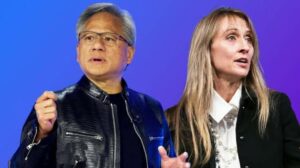
According to reports from the firm, Chief Financial Officer Colette Kress will serve as interim chief executive while the company considers internal and external candidates for a permanent replacement. The board also appointed former Synopsys chief executive and board member Harvey Jones as its first chairman.
The immediate financial impact of the development was reflected in the stock market, where Nvidia shares fell more than 12 per cent in early trading, putting the company on course to lose approximately $500 billion in market value. The sell-off also weighed on the broader market, while rival chipmakers Advanced Micro Devices (AMD) and Broadcom recorded gains.
Analysts warn that replacing Huang could present a significant challenge because his influence extends beyond product development to investment decisions, customer relationships and the coordination of Nvidia’s extensive AI infrastructure ecosystem.
Portfolio Manager at ClearBridge Investments, Michael Feldman, said: “The risk is not that Nvidia suddenly loses its technology roadmap … that roadmap is largely visible for the next several years. The risk is execution. Jensen has been the chief conductor of an extraordinarily complex system.”
He added that in an industry facing significant supply constraints, the ability to coordinate different parts of the technology ecosystem represents a competitive advantage.
Indeed, Nvidia’s influence extends across cloud computing providers, data centre developers, semiconductor manufacturers and major artificial intelligence companies. The company has also reinvested substantial cash resources into cloud providers, suppliers and leading AI laboratories, helping to finance the infrastructure supporting the global AI expansion.
Consequently, Huang’s exit could affect investment confidence across companies that depend on Nvidia’s chips and financial support. A disruption in its leadership could also raise questions about the pace of future investments in data centres and the sustainability of the AI spending boom, particularly as technology companies face rising borrowing costs and questions about returns on their investments.
The development also has geopolitical implications, especially for US-China technology relations. Huang had advocated preserving access to the Chinese market, arguing for a commercial approach to advanced chip exports. His departure could weaken an influential industry voice at a time when US lawmakers are pushing for tighter restrictions on semiconductor exports to China.
US House Speaker Mike Johnson said choosing the right successor was critically important, pointing to growing consensus in Congress on restricting semiconductor chip exports to China.
The controversy surrounding Huang intensified after reports of his relationships with two women, including Alice Huang, a former executive at Singapore-based cloud company Megaspeed, whom US authorities reportedly suspect of having links to Chinese intelligence. Beijing has denied the allegation, while the claims have not been independently established.
Nvidia’s board had earlier initiated an investigation, involving independent directors and external legal advisers, into whether Huang had been targeted by a foreign intelligence operation. The company also faced questions about corporate governance and the potential implications of the alleged relationship for sensitive chip shipments.
Huang had acknowledged being unfaithful to his wife in an internal communication to employees, taking responsibility without providing details of the relationships.
US President Donald Trump, who previously described Huang as having done an amazing job for the country, subsequently suggested former Apple chief executive Tim Cook as a possible replacement following the resignation.
For Nvidia, the immediate challenge will be to reassure investors, maintain customer confidence and preserve its technological leadership during the transition. The company’s next leadership decision will therefore carry implications beyond its boardroom, given its central position in the global AI industry.
Similarly, its ability to sustain growth without the founder who built its current market position will be an important test of whether its institutional structure and technology strategy can withstand a major leadership change.
We’ve got the edge. Get real-time reports, breaking scoops, and exclusive angles delivered straight to your phone. Don’t settle for stale news. Join LEADERSHIP NEWS on WhatsApp for 24/7 updates →
Join Our WhatsApp Channel