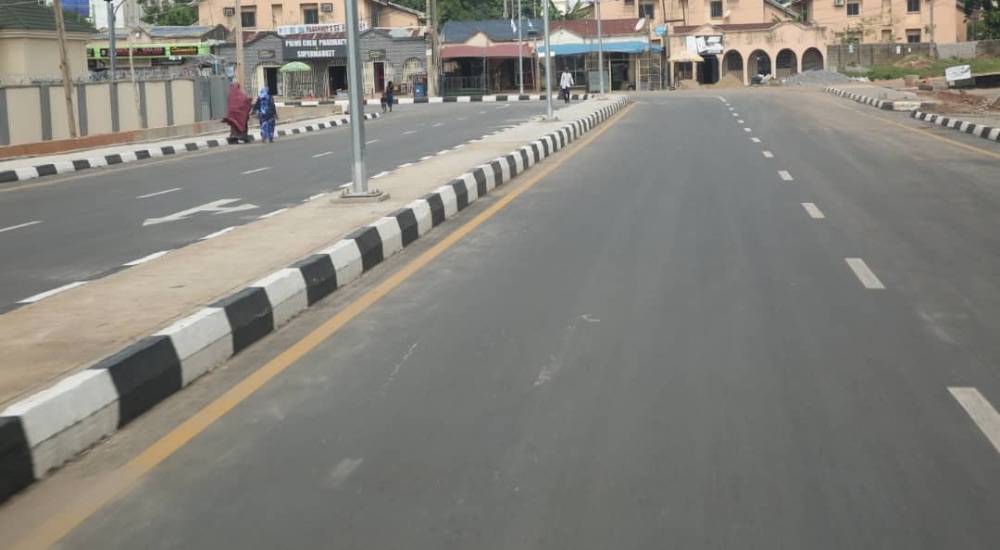
Few features of a road network are as misunderstood as the one-way street. To the careless motorist, it is an inconvenience, a detour placed between a driver and his destination. To the traffic engineer, it is among the most effective tools for ordering movement in crowded places. To love one-way driving is not to enjoy being inconvenienced. It is to appreciate a system built on safety and efficiency, which are only achieved when everyone agrees on a single direction.
What really is the scope of the problem? To dissect the road safety challenge in our clime, our searchlight must begin with the data. The Federal Road Safety Corps (FRSC) data covering the first nine months of 2026 speak volumes. While 7,156 road traffic crashes were reported, total deaths stood at 3,445, while 22,292 injuries were reported. Behind each of these figures is a family, a workplace and a community left poorer and traumatised.
The global picture is still troubling, despite some progress. The World Health Organization estimates that 1.16 million lives were lost in 2025. Although the global death rate dropped by 21 per cent between 2011 and 2025, despite the growing number of vehicles, road traffic injuries remain the leading cause of death among children and young adults aged 5 to 29. The African region experienced a 17 per cent rise. The conclusion is that our roads are far deadlier than they should be.
What is the logic behind a single direction? On a two-way road, every vehicle faces the risk of a head-on collision, among the most lethal crashes on any highway. Opposing streams of traffic meet at speed, and one lapse of concentration, one daring overtaking manoeuvre or one moment of fatigue can turn a pleasurable journey into another tragedy. A one-way street removes that danger. When all vehicles move in the same direction, the head-on conflict simply ceases to exist.
The benefits extend to junctions, where a large share of urban accidents occur. At a typical intersection of two-way roads, a driver must watch traffic from several directions, judge gaps in oncoming traffic and turn across opposing lanes. A one-way system sharply reduces the number of possible conflict points. Turning vehicles no longer cut across oncoming traffic, and pedestrians need to look in only one direction as they cross. Studies link well-designed and enforced one-way systems to fewer collisions and fewer pedestrian injuries.
It is important to note that one-way streets address exactly the behaviours the Corps keeps warning about. The agency identifies excessive speeding, reckless overtaking, distraction, fatigue, overloading, poor road conditions, tyre bursts and unroadworthy vehicles as causative factors. Wrongful overtaking is difficult to commit on a properly enforced one-way street, where there are no drivers coming from the opposite direction and engaging in stunt driving.
Besides safety, one-way streets also move people faster. When traffic flows in one direction, road space is used more effectively. Extra lanes become available for parking or loading. Where there is signalised traffic control, signals can be coordinated so that vehicles pass through a succession of green lights without repeated stops, a technique known as signal progression. The result is steadier movement, less idling and lower fuel consumption.
For cities such as Abuja, Lagos and Port Harcourt, among others, where population growth has outpaced road construction for decades, such gains are not luxuries. In Lagos, where millions of commuters compete for limited road space every day, one-way arrangements on dense commercial corridors can relieve pressure in ways that no amount of impatience or horn-blowing can achieve.
In Abuja, whose planned layout makes one-way systems easier to implement, and in Port Harcourt, where congestion around commercial districts is a daily trial, the same principle holds. A road carrying traffic in one direction can often move far more vehicles than one trying to serve both directions.
The success of any one-way system depends on the discipline of those who use it. A one-way street is only as safe as its least compliant driver. A single motorist travelling against the flow, whether out of haste, ignorance or a belief that the rule does not apply to him, turns the safest road into the most dangerous. Drivers do not expect vehicles to approach from the front. Reaction times are short, and the consequences are severe.
This is why the culture of obedience matters as much as the engineering. The data suggest where discipline needs to be strongest. Commercial vehicles accounted for a chunk of reported crashes in the second quarter of 2025, according to National Bureau of Statistics figures. Men made up 81.77 per cent of road deaths that quarter.
Whatever the explanations, these numbers point to drivers who spend long hours behind the wheel, often under pressure to deliver quickly. The pressure to cut corners is real, which is why clear rules, consistently enforced, are so valuable.
In our Defensive Driving Lessons 101, we noted that a defensive driver anticipates the errors of others and avoids committing them. He reads signs, observes directional markings and respects the rules of the road, not as acts of submission but as a responsibility to himself and others. The one-way sign mandates everyone to keep to the indicated direction for the safety of all.
Some drivers are perpetual deviants. Ignorance is not their problem; they simply have a poor and irresponsible attitude. Others do so because they have no driving plan. These are the types who enter unfamiliar routes, miss a turn, panic and make a dangerous wrong turn onto a one-way street.
For the record, a missed turn on a one-way street is not a crisis. Safe driving requires you to continue ahead, find the next safe opportunity and rejoin the correct route.
Relevant road authorities need to ensure that signs are clear, well-maintained and visible. Road markings should not be faded, and signages should not be obstructed by political campaign materials or marketing materials. Enforcement should also be top-notch.
Meanwhile, the one-way principle teaches us that freedom comes from shared rules that must be obeyed to avoid chaos, preventable crashes and deaths. To say, “I love one-way driving,” is an affirmation of the commitment to obey all traffic rules and share the road with others with respect and decency.
As the FRSC battles to keep road traffic crashes, deaths and injuries down, we must play our part on one-way routes and all other routes. We must obey traffic rules across all road networks. We must match world-class road engineering with safer and more responsible driving at all times.
We’ve got the edge. Get real-time reports, breaking scoops, and exclusive angles delivered straight to your phone. Don’t settle for stale news. Join LEADERSHIP NEWS on WhatsApp for 24/7 updates →
Join Our WhatsApp Channel