
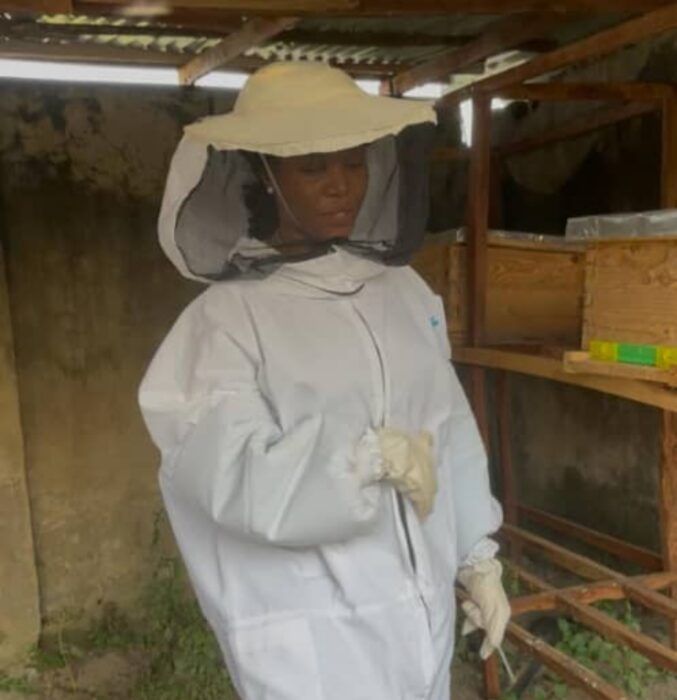
At a time when Nigeria is grappling with youth unemployment and the search for alternative sources of livelihood, a beekeeping initiative is opening new economic opportunities for young people through honey production and other valuable products derived from bees.
Macaney Beekeeping Institute and Macaney Sustainable Solutions have trained more than 5,000 young people and beekeepers across 28 states in Nigeria on honey and beeswax production, equipping them with practical skills to establish businesses and earn income from the growing beekeeping industry.
The initiative, according to its founder and chief executive officer, Orji Chiamaka is aimed at changing the perception of beekeeping from a traditional agricultural activity into a profitable business capable of creating jobs, supporting farmers and contributing to Nigeria’s economy.
Chiamaka said beekeeping remains one of the accessible agricultural ventures for young Nigerians because it requires relatively low startup capital and offers multiple income streams beyond honey production.
She explained that many Nigerians are unaware that beehives produce several commercially valuable products, including beeswax, propolis, royal jelly, honeycomb and bee venom, which have applications in the pharmaceutical, cosmetic, food and manufacturing industries.
According to her, pure bee venom commands between $80 and $200 per gram on the international pharmaceutical and cosmetic markets, representing an enormous economic opportunity that remains largely untapped in Nigeria.
She said beeswax and propolis could also be processed into lip balms, hair wax, body creams, wood polish, natural food preservatives, herbal tinctures and oral care products.
Chiamaka, who has spent the last six years building her career around beekeeping, said her journey started while she was in her 300 level at university, when she began tending beehives and experimenting with locally sourced beeswax and shea butter to produce lip balms, which she sold to her coursemates.
What started as a personal interest has since developed into Macaney Beekeeping Institute and Macaney Sustainable Solutions, two platforms focused on training, mentoring and promoting modern beekeeping practices.
“In six years, I have directly trained and sensitised at least 5,000 young people, plus thousands more through outreach,” she said.
Beyond training, the organisation has also developed ThinkBee, an artificial intelligence-powered beekeeping companion designed to help farmers inspect their hives, identify potential colony problems early and improve honey production.
Chiamaka said the technology was developed in response to challenges faced by many beekeepers, particularly farmers who struggle with hive inspections and detecting problems that could affect their colonies.
She noted that technology, combined with practical training, could make beekeeping more attractive to young people and improve productivity in the sector.
The entrepreneur also disclosed that she has built a network of more than 2,000 beekeepers across Nigeria, Uganda, Zimbabwe, South Africa, Germany and other parts of Europe, through which farmers share experiences, receive mentorship and explore opportunities for commercial apiary development.
She said the organisation was also promoting what it calls the “Macaney Standard”, an approach that prioritises sourcing honey directly from trained, modern beekeepers to guarantee purity, prevent contamination and encourage responsible management of bee colonies.
As part of efforts to expand knowledge and create more opportunities for beekeepers, Macaney plans to launch a monthly global online talk show, titled Tales of a Beekeeper, to showcase experiences, success stories and practical lessons from beekeepers across Africa and other parts of the world.
The organisation is also planning an International Beekeepers Conference in March 2027 to bring together Nigerian and international stakeholders, showcase local innovations and attract investment into the industry.
Chiamaka said the conference would provide a platform for Nigerian beekeepers, particularly farmers in Northern Nigeria who have developed locally designed beehives, to exhibit their innovations and connect with potential investors.
She disclosed that beekeepers and delegates from South Africa, Germany, Uganda and several Nigerian states had already indicated interest in participating.
We’ve got the edge. Get real-time reports, breaking scoops, and exclusive angles delivered straight to your phone. Don’t settle for stale news. Join LEADERSHIP NEWS on WhatsApp for 24/7 updates →
Join Our WhatsApp Channel