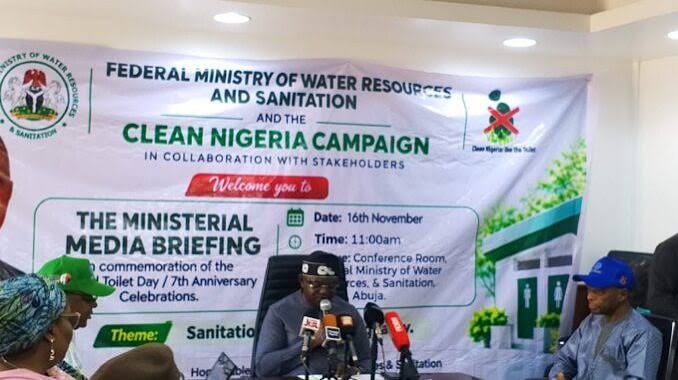
The federal government has reaffirmed its commitment to achieving an Open Defecation-Free (ODF) Nigeria by 2030, as it called for stronger collaboration among stakeholders to improve sanitation nationwide.
The minister of Water Resources and Sanitation, Engineer Professor Joseph Terlumun Utsev, gave the assurance in Abuja on Monday at a press conference to mark World Toilet Day, organised in conjunction with Sightsavers and other partners.
He said President Bola Tinubu’s Renewed Hope Agenda was focused on delivering practical results that improve Nigerians’ lives.
According to him, the Clean Nigeria campaign provides an important platform for translating that vision into improved sanitation, healthier communities, environmental protection and stronger institutions.
Utsev said the campaign, launched in November 2019 under the slogan “Use the Toilet”, had recorded appreciable progress, with 185 Local Government Areas attaining ODF status, while Jigawa and Katsina States had achieved statewide ODF status.
He attributed the progress to collaboration among federal, state and local governments, development partners, civil society organisations, the private sector and communities.
The minister, however, said ending open defecation was not the responsibility of government alone but required the collective efforts of all Nigerians.
“I therefore call on all stakeholders, governors, local government chairmen, traditional and religious leaders, development partners, the private sector, civil society organisations and community leaders to continue to strengthen their support for this campaign,” he said.
He urged Nigerians to make toilet use a daily habit and discourage open defecation in all its forms.
“Every household, community and institution has a responsibility to contribute to a cleaner and healthier Nigeria,” he added.
The minister said the objective was not simply to increase the number of local governments declared open defecation-free but to ensure that every Nigerian enjoyed safe, accessible and dignified sanitation.
“A clean Nigeria is a healthier Nigeria, and a healthier Nigeria is central to the Renewed Hope Agenda of President Bola Ahmed Tinubu,” he said.
Also speaking, the Director Overseeing the Office of the Permanent Secretary in the Ministry of Water Resources and Sanitation, Engr Ali Dallah, warned that sustaining the gains already made was as important as achieving new ones.
He said considerable challenges remained, including the need to prevent communities and local governments that had attained ODF status from reverting to open defecation.
“Attaining a fully open defecation-free Nigeria by 2030 will require sustained political commitment, increased investment in sanitation infrastructure, reliable monitoring and evaluation systems, stronger institutional coordination and continuous behavioural change interventions,” Dallah said.
He said the forthcoming national retreat, scheduled for November 17–18, 2026, would provide an opportunity for stakeholders to review implementation progress, exchange experiences, address emerging challenges and develop practical strategies for accelerating and sustaining ODF status across the country.
Dallah said the 2026 World Toilet Day theme, “Sanitation and Gender Equality”, would reinforce the importance of providing safe and quality sanitation facilities, particularly for women, girls and other vulnerable groups.
He described the media as an indispensable partner in the campaign, noting that its capacity to inform, educate, mobilise and influence public opinion was critical to achieving the behavioural changes required to end open defecation.
Utsev thanked stakeholders for their support and reaffirmed the Federal Government’s resolve to translate its commitments into measurable results.
We’ve got the edge. Get real-time reports, breaking scoops, and exclusive angles delivered straight to your phone. Don’t settle for stale news. Join LEADERSHIP NEWS on WhatsApp for 24/7 updates →
Join Our WhatsApp Channel