Ahead of the 2027 general election, Persons with Disabilities (PWDs) in Oyo State have been urged to demand proper documentation of their participation in elections and insist on accessible polling facilities, as part of efforts to eliminate barriers to their full participation in the 2027 general elections.
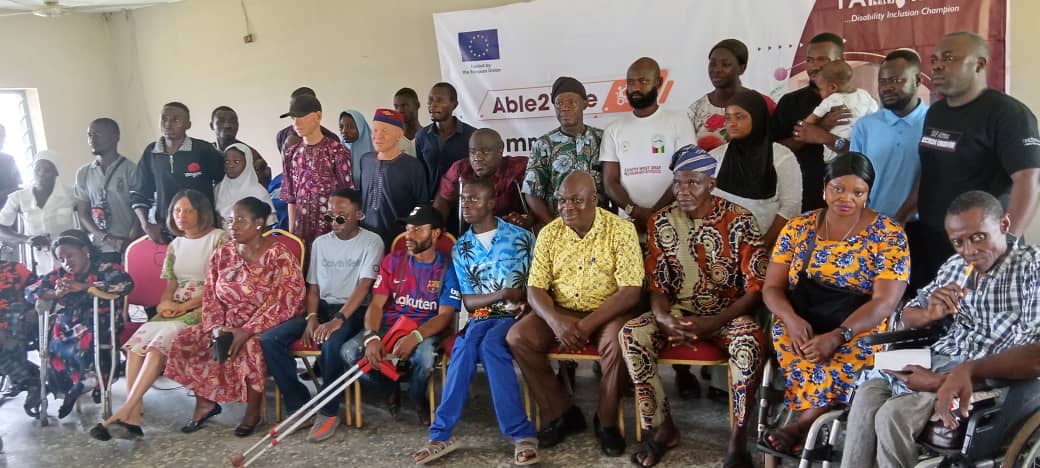
The call formed major part of a voter education and sensitisation programme organised by TAF Africa (formerly The Albino Foundation), with support from the European Union, to equip persons with disabilities with knowledge of their electoral rights, voting procedures and strategies for tackling misinformation ahead of the 2027 polls.
At the training, on Tuesday in Ibadan, participants were encouraged not to leave polling units after voting without ensuring that electoral officials documented their participation on the Independent National Electoral Commission’s (INEC) disability tracking form, EC40H, a measure considered crucial to improving electoral inclusion and planning for future elections.
The Able2Vote Voter Education and Sensitisation Programme, held at Cheshire Home Hall, Eleyele-Poly Road, Ibadan, was one of six targeted outreach sessions conducted across Oyo State between November 10 and 12, 2026.
Leading the sensitisation, TAF Africa’s Programme Manager, Dr Andrew Adaji, said the initiative was designed to ensure that voters with disabilities understood the specific legal provisions guaranteeing them an independent, dignified and accessible voting experience.
He explained that the training covered priority voting, which gives persons with disabilities the right to bypass queues and cast their ballots immediately upon arrival at polling units, as well as assistive voting, which allows blind, non-literate and physically impaired voters to be accompanied into the voting cubicle by trusted persons to mark their ballots strictly in accordance with their instructions.
Adaji noted that the provisions had been tested during off-cycle elections in Osun, Ekiti and Anambra states, with the results demonstrating progress in the implementation of disability-inclusive electoral guidelines, although further public awareness remained necessary.
He disclosed that compliance with priority voting stood at approximately 94 per cent in Osun and 92 per cent in Ekiti, figures he said underscored the importance of sustained sensitisation to ensure that eligible voters with disabilities were not denied their rights.
Speaking on the provision of sign language interpretation for voters with hearing impairments, Adaji said TAF Africa had supported the deployment of interpreters to polling units during off-cycle elections but might face funding constraints in extending the arrangement nationwide during the 2027 general elections.
He said, “For the off-cycle election, we were able to provide sign language interpreters to polling units where we have persons with hearing impairment.”
“But for the general election, we don’t have the fund to do that all over the country. We are collaborating with the Sign Language Interpreters Association of Nigeria and also INEC so that, if possible, INEC can engage them as ad-hoc staff.”
Participants were also educated on the specialised assistive devices provided by INEC to facilitate independent voting among persons with different forms of disabilities.
These include Braille ballot guides for visually impaired voters and magnifying glasses for persons with albinism and those with low vision, devices designed to reduce dependence on other people during the voting process.
A significant aspect of the training was the emphasis on Form EC40H, which Adaji explained was designed to enable presiding officers to document the turnout of voters with disabilities and identify their respective disability categories on Election Day.
He, however, raised concerns that some temporary electoral officials were either unfamiliar with the form or reluctant to complete it, warning that failure to properly document PWD voters could undermine INEC’s ability to determine their actual participation and make adequate provisions for them in subsequent elections.
He advised participants to politely but firmly insist that polling officials locate the form in their electoral booklets and record their details after they had voted.
Adaji said: “By the time you finish voting, do not just walk away, make sure they fill the form for you.”
“That is the only way INEC knows the exact number of persons with disabilities who voted and what assistive devices to bring to your polling unit next time.”
Beyond preparing participants to exercise their franchise, the programme also challenged persons with disabilities to seek elective and appointive positions and become active participants in the country’s political leadership.
Adaji encouraged them to look beyond voting and aspire to occupy positions such as special advisers, commissioners, governors and even the presidency, stressing the need for greater representation of persons with disabilities in governance and decision-making.
Reacting to the exercise, the Oyo State Chairman of the Joint National Association of Persons with Disabilities (JONAPWD), Mr. Abiodun Kolawole, described the sensitisation programme as a critical intervention in preparing the disability community for the 2027 general elections.
Kolawole stressed that continuous voter education was necessary to ensure that persons with disabilities understood not only how to exercise their voting rights but also the importance of ensuring that their participation was properly captured in INEC’s disability tracking records before leaving polling stations.
Reflecting on the 2023 general elections, another participant at the programme acknowledged that polling units were largely peaceful and that presiding officers generally managed the electoral process well, but lamented that physical barriers continued to prevent voters with mobility challenges from participating independently.
The participant said the absence of adequate physical accessibility at some polling locations remained a major concern, insisting that persons with disabilities should not have to depend on others to gain access to voting areas.
“Accessibility is very important because, as physically challenged voters, we want to be able to access every area of the polling unit independently without needing someone to carry or assist us,” the participant stated.
The participant consequently urged INEC to make the removal of physical barriers at polling units a priority alongside voter education and sensitisation ahead of the 2027 general elections.
We’ve got the edge. Get real-time reports, breaking scoops, and exclusive angles delivered straight to your phone. Don’t settle for stale news. Join LEADERSHIP NEWS on WhatsApp for 24/7 updates →
Join Our WhatsApp Channel