

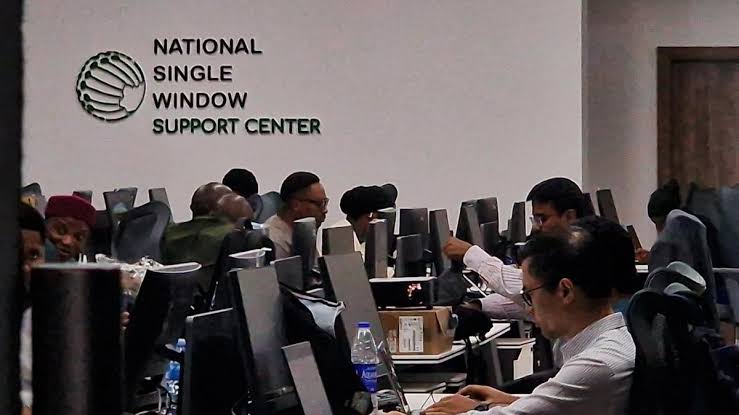
The National Single Window (NSW) has reiterated its target of drastically cutting the time it takes to export goods from Nigeria to about 24 hours, as the export phase of the platform goes live on December 14.
The NSW project director, Tola Fakolade, said made this known at a stakeholder sensitisation programme on the implementation of Phase Two of the NSW in Abuja on Tuesday, where agency heads and participants questioned the project team on how the platform will work.
Fakolade described the 24-hour cycle as the project’s “North Star” and said it would take a few years to reach. He said the goal covers both imports and exports, within 24 to 48 hours.
Imports currently take between 10 and 21 days, depending on circumstances, he said, while exports take about 10 to 12 days.
He said the delays hurt exporters of perishable produce, whose goods can spoil at the terminal while waiting for inspection. Goods that stay too long before shipment can also arrive in poor condition and be rejected at their destination, he said, adding that the issue was “not a blame game”.
The second phase of the digital trade platform will allow exporters to submit regulatory documents through one central portal, accessible to relevant government agencies. It is expected to reduce repeated visits, paperwork and approval delays that have long slowed Nigerian exports.
Fakolade, said, “Overall, the key takeaway from here is Single Window Phase 2 export is launching on Dec. 14,” Fakolade said.
“With that, exporters will be able to use the Single Window for all their documents and regulatory requirements to export.”
He said the platform would simplify export procedures, make the lives of exporters easier and improve the efficiency of Nigeria’s export processes.
Fakolade described the 24-hour export cycle as the project’s “North Star”, but said it would take a few years to achieve.
He said the wider goal was to complete both import and export processes within 24 to 48 hours.
According to him, imports currently take between 10 and 21 days, depending on the circumstances, while exports take about 10 to 12 days.
He said the delays were particularly harmful to exporters of perishable produce, whose goods could spoil at terminals while waiting for inspection.
Fakolade said goods that remained too long before shipment could also arrive at their destinations in poor condition and be rejected by buyers.
“We are just starting the journey,” he said.
He explained that the project was currently focused on documentation and approvals, while further gains would require collaboration with partners such as the Central Bank of Nigeria, the Nigerian Export Proceeds (NXP) system and terminal operators.
Fakolade said the project team would break the export journey into stages, set targets for the time to be saved each year and determine how progress would be measured.
How the platform works
The NSW is a centralised digital trade-facilitation platform established by the Federal Government to unify and automate import, export and transit processes.
It is designed to provide a single entry point for trade-related documentation and approvals, without taking over the statutory responsibilities of participating agencies.
Fakolade said the first phase, which focused on import regulatory licences, certificates and permits, had processed more than 169,000 documents.
He said users had provided feedback that helped improve the platform, adding that adoption had increased after initial learning challenges.
NEPC integration
The Nigerian Export Promotion Council (NEPC) said it was integrating its export registration and Export Expansion Grant (EEG) platforms into the NSW to simplify export procedures and reduce delays.
NEPC executive director, Nonye Ayeni, said the integration would address delays caused by multiple documentation and approval requirements across government agencies.
She said exporters currently faced repeated documentation and approval processes, sometimes resulting in delayed shipments and cancelled contracts.
“By the time the approval arrives, the buyer is already tired, frustrated, and this has led to contract cancellations,” Ayeni said.
She said delays could also affect perishable agricultural products, which might change colour or form before reaching their destinations.
Ayeni said NEPC would integrate its export certification and registration services, currently hosted on its electronic registration portal, into the NSW.
She added that the council’s automated EEG platform, developed by PwC, would also be connected through an application programming interface.
According to the implementation timeline presented at the meeting, the connection was expected within one or two weeks.
“What used to take weeks of frustration running around by different people will now become very seamless and very easy,” Ayeni said.
She urged exporters and other stakeholders to familiarise themselves with the platform and provide feedback to improve its implementation.
The Controller of Customs on ICT Modernisation, Aondona Fayam, said the platform would enable exporters to submit documents once for access by relevant agencies.
He said the first phase was operating at 99.9 per cent and had improved documentation and clearance through digitalisation.
Fayam said the second phase would cover export documentation and reduce the need for exporters to visit several regulatory agencies.
He said the Nigeria Customs Service was working to ensure compliance while making export processes more predictable for businesses.
Fayam identified knowledge gaps as an initial challenge with the platform and said sensitisation was being extended to exporters nationwide.
Performance measures
Fakolade said the first three to six months after the launch would focus on system stability, the number of users on the platform and the quality of customer support.
He said attention would later shift to efficiency, including the number of documents simplified or moved from manual to automated processing, and the number of days agencies took to approve permits.
The NSW project director said the platform had service-level agreements with participating agencies.
He said cases would be escalated where approvals exceeded the agreed time.
Responding to fears of disruption at the start of the new phase, Fakolade said the platform had operated for about eight months on the import side.
He said the fundamental issues had been fixed and the system was stable.
“Problems will still arise, but they will be resolved quickly,” he said.
On concerns about exporters in rural areas with poor internet access, Fakolade said the project had no “magic wand” for connectivity.
He said the plan was to establish locations similar to internet cafes, with computers, internet access and staff to train and guide exporters.
He, however, said the initiative required investment and would not happen immediately.
Fayam said NSW assistance centres were operating in Apapa in Lagos, Abuja and Port Harcourt.
The official said exporters could also approach the project manager or technical supervisor at any Customs office for support.
Widening exporter base
The director of Trade Information at NEPC, Ndubueze Okeke, said the engagement was aimed at sensitising exporters, particularly small and medium-sized enterprises.
He said about 40,000 exporters were registered on the NEPC portal and were migrating to the Single Window.
Okeke, however, said only about 1,003 of them were actively exporting.
He said the council wanted to widen the base of active exporters and advised beginners to take the export-readiness test on its website.
Okeke said the platform would harmonise export documentation and procedures across agencies, supporting the transition from paper-based to digital processes.
He said the rollout would be phased, with additional export processes, including EEG and CBN-related requirements, expected in March 2027.
Broader trade reform
The executive chairman of the Nigeria Revenue Service (NRS), Mr Zacch Adedeji, described the NSW as more than an information technology project.
He said it represented a comprehensive reform of Nigeria’s trade processes.
Adedeji was represented by Mr Alfred Okoh, Group Director, Transformation and Strategic Management Office, NRS.
“For the NRS, it represents a paradigm shift from revenue collection at the borders to trade facilitation for growth, from fragmented compliance to integrated data-driven efficiency,” he said.
He said Phase Two involved sensitisation, institutional alignment and preparation of the export ecosystem, including defining data flows and harmonising requirements.
Adedeji said the NRS would support the platform through technical and institutional collaboration, adding that it could strengthen voluntary compliance and competitiveness.
“If they are not on the platform, there is no trade we are facilitating,” he said.
Agency commitment
The director of Information and Communication Technology at NAFDAC, Femi Balogun, said agencies involved in cross-border trade needed to embrace digital transformation.
He said Phase Two would digitalise more aspects of trade processes, adding that NAFDAC supported efforts to improve service delivery.
Stakeholders at the forum said the successful implementation of the export phase could reduce delays, improve transparency and strengthen the
competitiveness of Nigerian products in international markets.
They also said the platform could help Nigeria position itself as a more efficient and attractive destination for international trade.
We’ve got the edge. Get real-time reports, breaking scoops, and exclusive angles delivered straight to your phone. Don’t settle for stale news. Join LEADERSHIP NEWS on WhatsApp for 24/7 updates →
Join Our WhatsApp Channel


