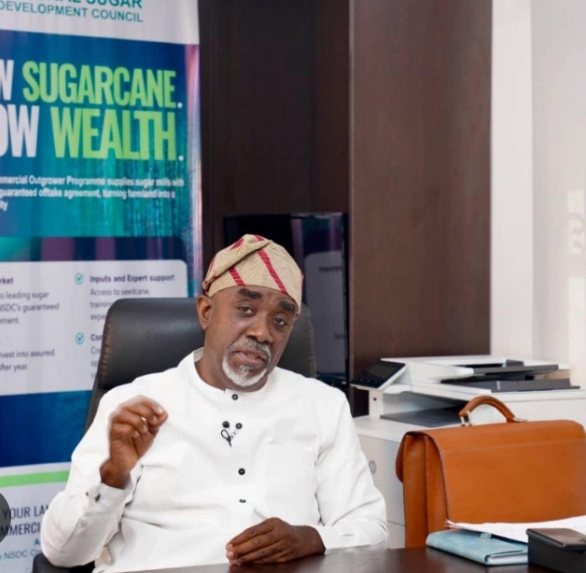
Nigerian manufacturers’ ₦1.34 trillion expenditure on self-generated electricity, coupled with high borrowing costs and poor logistics, is threatening the country’s ability to compete under the African Continental Free Trade Area (AfCFTA), the Executive Secretary of the National Sugar Development Council (NSDC), Mr. Kamar Bakrin, has warned.
Speaking at the technical session of the 17th National Council on Industry, Trade and Investment (NCITI) in Enugu, Bakrin said the rising cost of production has become Nigeria’s biggest obstacle to industrial competitiveness despite the country’s large domestic market and duty-free access to 1.4 billion consumers across Africa.
He disclosed that manufacturers spent an estimated ₦1.34 trillion generating their own electricity last year as unreliable power supply continued to force factories to rely heavily on diesel generators.
Bakrin noted that while industrial electricity costs about eight U.S. cents per kilowatt-hour in Vietnam and 10 cents in China, Nigerian manufacturers pay around 15 cents on the national grid and as much as 30 cents when they switch to self-generated power.
According to him, manufacturers also face working capital interest rates of between 27 and 35 per cent, compared with about nine per cent in Vietnam and three per cent in China, while Nigeria ranks 88th out of 139 countries on the World Bank’s Logistics Performance Index, far behind Vietnam and China.
The combined impact of these costs, he said, has left Nigeria’s manufacturing sector contributing only about eight per cent to the country’s Gross Domestic Product (GDP), with capacity utilisation falling to 57.7 per cent.
Bakrin warned that unless these structural constraints are addressed urgently, Nigeria risks losing the opportunities created by AfCFTA to more competitive economies.
“Either our goods are crossing borders going out, or everyone else’s goods are crossing ours coming in. We are either going to compete, or we are going to concede the market,” he said.
He stressed that Nigeria’s problem is not demand but the cost of producing goods.
“Nobody on this continent needs persuading to buy what Nigeria makes. It is a cost-of-production problem, and that distinction matters because costs, unlike demand, are within our power to fix,” he said.
Bakrin, however, said recent macroeconomic reforms, easing inflation and foreign reserves of about $51 billion have provided an opportunity to reposition Nigeria’s manufacturing sector for growth.
He cited the country’s urea industry as an example of what targeted industrial policies can achieve, noting that production capacity expanded from 500,000 tonnes in 2005 to 6.5 million tonnes, making Nigeria one of the world’s top 10 exporters of nitrogen fertiliser.
“When a country prices inputs as if it wants industry to live, industry lives,” he said.
To improve industrial competitiveness, Bakrin proposed four resolutions for adoption by the council. They include establishing dedicated power arrangements for at least one industrial cluster in every state within 12 months, harmonising taxes and eliminating informal checkpoints on industrial corridors, introducing an annual State Industrial Competitiveness Index, and enforcing Nigeria First procurement policies at both federal and state levels.
He also called for reducing industrial electricity costs to between eight and 10 U.S. cents per kilowatt-hour, providing manufacturers with single-digit interest loans, cutting port clearance time to less than seven days, and doubling labour productivity by 2030.
“The reform half of Nigeria’s story has been written. The industrial half will be written in kilowatt-hours, lending rates and port days. The window is open. No window stays open forever,” Bakrin said.
We’ve got the edge. Get real-time reports, breaking scoops, and exclusive angles delivered straight to your phone. Don’t settle for stale news. Join LEADERSHIP NEWS on WhatsApp for 24/7 updates →
Join Our WhatsApp Channel