
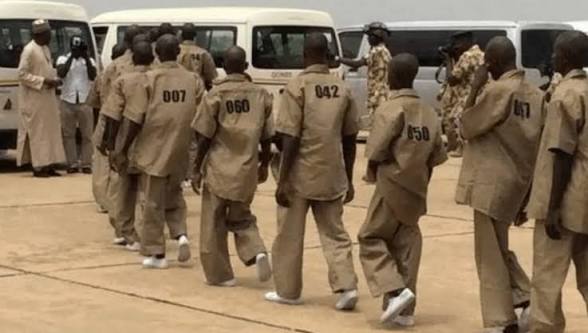
The federal government has launched new Standard Operating Procedures, SOPs, to guide the implementation of its Disarmament, Demobilisation and Reintegration, DDR, programme, with a clear warning that repentant terrorists accused of serious crimes will still face prosecution.
Speaking in Abuja on Monday at the national validation workshop on the SOPs for DDR, Adamu Laka, National Coordinator of the National Counter Terrorism Centre, NCTC, under the Office of the National Security Adviser, ONSA, said the procedures will promote transparency, accountability and coordination in handling repentant terrorists.
The workshop also validated state-level SOPs for pilot states: Kaduna, Katsina and Zamfara.
Laka said the SOPs were developed after extensive consultations and draw from Nigeria’s experience, international best practices and the country’s security realities.
“Recognising that a policy framework alone is insufficient to guide implementation, the National Counter Terrorism Centre and its partners subsequently developed a comprehensive set of standard operating procedures to translate the strategic objectives of the national DDR framework into practical guidance for implementing institutions,” he said.
He added that the SOPs will clarify institutional responsibilities, strengthen inter-agency collaboration, standardise operational processes, and ensure that DDR programmes comply with human rights principles and the rule of law.
Laka described DDR as a key element of Nigeria’s non-kinetic approach to tackling insecurity, noting that military operations alone cannot deliver lasting peace.
“These standard operating procedures have been developed through extensive consultations and draw upon national experiences, international best practices, and the unique realities of the Nigerian context,” he said.
“They are intended to clarify institutional mandates and responsibilities, strengthen inter-agency coordination, standardise operational procedures, and ensure that DDR programmes are implemented professionally, effectively, and in full compliance with human rights principles and the rule of law.”
Consultations held across the six geopolitical zones, according to him, showed broad support for a nationally coordinated, locally owned and human rights-based DDR framework.
Participants identified terrorism, violent extremism, armed banditry, communal clashes, farmer-herder conflicts, organised crime and separatist violence as evolving threats requiring coordinated responses.
Laka described the validation workshop as a significant step toward institutionalising a transparent and coordinated DDR architecture nationwide.
“The inclusion of state-specific standard operating procedures is particularly significant. These states continue to face distinct and evolving security challenges that require locally driven and well-coordinated responses,” he added.
Abimbola Wonosikou, Director of Preventing and Countering Violent Extremism at the NCTC, said the SOPs were developed to provide a coordinated national response to terrorism, violent extremism, banditry and other forms of armed violence.
She said while the programme offers eligible individuals a pathway to abandon violence and reintegrate into society, accountability will not be waived.
“The validation of these SOPs represents another significant milestone in Nigeria’s DDR journey. It demonstrates the country’s commitment to building a nationally owned, coordinated and accountable DDR system capable of supporting sustainable peace, preventing recidivism, strengthening community resilience and contributing to long-term national stability.
“However, those accused of serious crimes will still face prosecution through the appropriate legal processes,” she said.
Wonosikou said an integrated framework was needed to improve coordination and standardisation despite existing rehabilitation and reintegration initiatives across the country.
She added that the NCTC has established state DDR committees in Kaduna, Katsina and Zamfara. The committees include representatives of state governments, security agencies, justice institutions, traditional and religious leaders, women and youth groups, civil society organisations, and technical institutions.
According to her, the SOPs outline institutional responsibilities, referral pathways, case management procedures, information-sharing protocols, human rights safeguards, community engagement mechanisms, monitoring and evaluation systems, as well as coordination structures.
She also called for a coordinated communication strategy to counter misinformation and improve public understanding of the DDR programme.
Mario Nascimento, speaking on behalf of the UN Department of Peace Operations’ DDR Section, now under the UN Peace Support Office, commended the federal government for developing a framework that reflects the changing nature of armed conflict in Nigeria.
He said Nigeria’s approach has shifted from focusing solely on former combatants to strengthening community resilience and promoting collective responsibility for peace.
“No individual can be successfully reintegrated in isolation,” Nascimento said, adding that sustainable DDR requires the active participation of communities, civil society, local authorities and the private sector.
We’ve got the edge. Get real-time reports, breaking scoops, and exclusive angles delivered straight to your phone. Don’t settle for stale news. Join LEADERSHIP NEWS on WhatsApp for 24/7 updates →
Join Our WhatsApp Channel