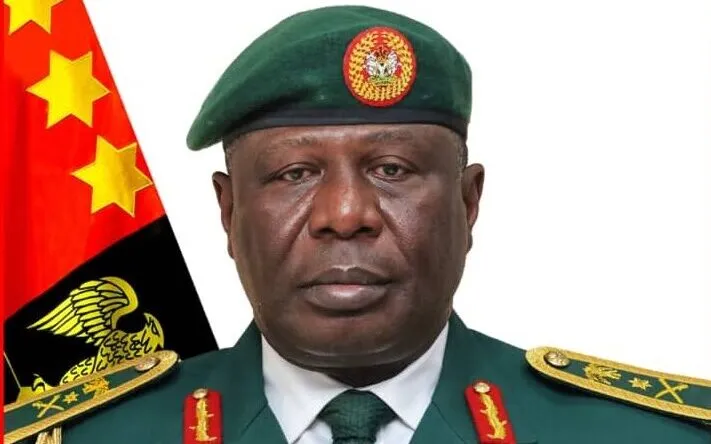
The Chief of Defence (CDS), General Olufemi Oluyede, has disclosed that the Defence Headquarters (DHQ) was finalising a review of the 2027 Joint Doctrine for the Armed Forces to enhance multi-dormain operations.
General Oluyede revealed this when he spoke as a guest speaker at the NISECEXPO-DICON International Defence and Security Show, organised by the Defence Industries Corporation of Nigeria (DICON) and the Nigeria Security Exhibition and Conference (NISEC).
Oluyede said the new doctrine, when fully in operation, will ensure that every service speaks the same operational and tactical language as well as operate towards a single unified national strategic objectives.
The CDS, who was represented by the Director-General, Joint Doctrine and Warfare Centre at the Defence Headquarters, Major General, Aniedi Edet, said that the nature of threats confronting the country has changed significantly, noting that adversaries were no longer conventional massed armies but fluid, adaptive networks operating across multiple domains.
He added that warfare has expanded beyond the traditional land, maritime and air domains, and now operate actively in the information, electromagnetic and cyber domains, with each requiring specialised capabilities, new thinking and enhanced collaboration.
According to the CDS, remaining ahead of the adversaries demand a shift from service-specific responses to a more unified, integrated and decisive joint approach.
“To ensure we remain ahead of evolving threats, the Armed Forces of Nigeria is strengthening its joint structures and operational frameworks,” the CDS said.
“A few key efforts include establishment of a Permanent Joint Theatre Command, moving beyond ad-hoc joint task forces to more enduring and coordinated structures; review of the 2017 Joint Structure, currently being finalised to reflect new realities and align with global best practices; creation of the Joint Doctrine and Warfare Centre, which tasked with driving joint doctrine development, joint training and joint operational concepts, and planning towards integrated command centres for future conflicts, ensuring unified situational awareness, faster decision-making and multi-domain coordination,” he disclosed.
According to the CDS, these reforms would guide future acquisitions, force design and operational readiness.
The CDS stressed that as the world moves rapidly towards autonomous systems, robotics, artificial intelligence and unmanned platforms, as well as future probably being fought with minimal human presence on the frontlines, the Nigerian military is paying close attention to these trends and exploring ways to integrate them into our defence posture.
“Similarly, our National Space Research and Development Agency and Defence Space Administration are increasingly focused on strengthening Nigeria’s cyber posture and space capabilities,” he said.
He stressed that the National Intelligence Fusion Centre under the Office of the National Security Adviser has become one of our most effective tools for real-time intelligence sharing among security agencies and partners. “It strengthens counter-terrorism, counters cybercrime, and enhances responses to transnational threats.”
While emphasising that security is no longer the exclusive responsibility of the military or security agencies, the CDS noted that Nigeria’s security challenges demand total societal cooperation, where every segment of society has an important role to play.
He assured as strategic communication now becomes central to national security, the military would continue to work closely with the media, civil society and community leaders to promote accurate narratives, protect civilians and build trust.
The Chief Executive Officer of NISEC, Frank Ohwofa, emphasised the significance of Nigeria to produce its defence needs locally, noting that failure to do so could make the country vulnerable, as global supply chain constraints make reliance on foreign imports risky.
“I am particularly impressed with the local companies showcasing their capacity to manufacture spare parts, vehicles, and other military requirements. This is essential for self-reliance and readiness,” he said.
“The technologies on display are far more advanced than those we have seen in previous editions. They will help security agencies evaluate what needs to change and what capabilities must be acquired,” he said.
We’ve got the edge. Get real-time reports, breaking scoops, and exclusive angles delivered straight to your phone. Don’t settle for stale news. Join LEADERSHIP NEWS on WhatsApp for 24/7 updates →
Join Our WhatsApp Channel