On 18th December 2024, when President Bola Ahmed Tinubu presented the 2025 budget to a joint session of Nigeria’s National Assembly, he acknowledged that the country was at “a crucial point in its development trajectory.” He assured Nigerians that the proposal would secure peace, prosperity, and renewed hope for a brighter future.
Although most Nigerians did not seem inclined towards President Tinubu’s administration when he assumed office in 2023, given the experience of the previous administration, they chose to give him the benefit of the doubt.
But one year later, that reality seems much less inspiring. The 2025 appropriation, called “Budget of Restoration: Securing Peace, Rebuilding Prosperity,” presented as the means to deliver the Renewed Hope Agenda, cannot convincingly be said to have restored or rebuilt much. The rhetoric was strong. The outcome, sadly, was weak.
Troubling disclosure
From the testimonies of ministers appearing before National Assembly committees for budget defence, a common explanation emerged: insufficient budgetary releases. Across the board, ministries, departments, and agencies complained that approved funds were not disbursed.
The budget defence has thus uncovered a troubling dilemma. Either Nigerians are being misled, or we are deceiving ourselves whenever we discuss the annual budget. How else can one explain that nearly every MDA that faced lawmakers complained about the failure to release funds? What then becomes of the impressive figures announced with such pomp?
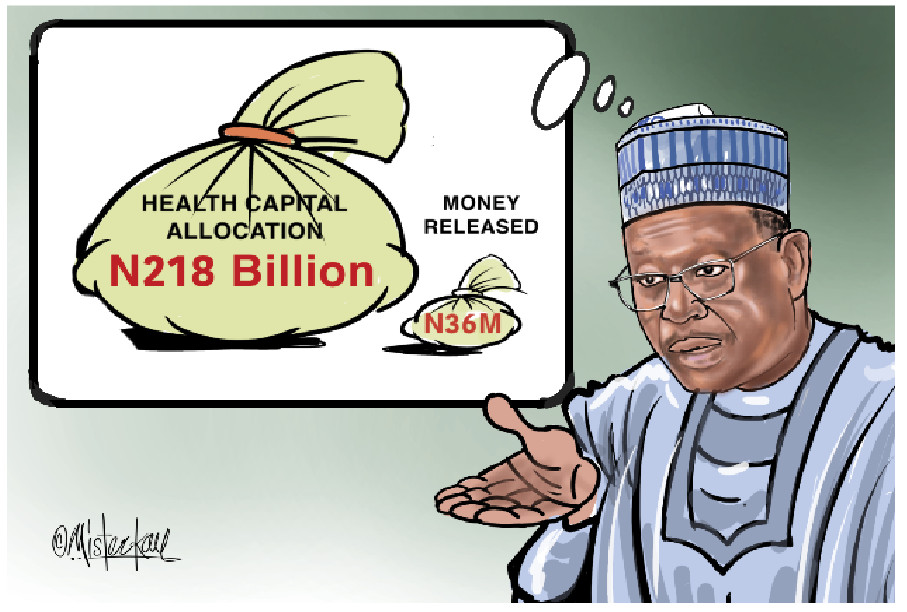
Perhaps the most troubling revelation came from the Minister of Health, Professor Muhammad Pate. He informed the lawmakers that out of the N218 billion capital allocation for the health sector in the 2025 budget, only N36 million had been released. The fact that only N36 million out of N218 billion was released is worrying. The capital vote was intended for infrastructure upgrades and essential equipment in public hospitals and healthcare centres. Without releases, these projects have come to a halt. The effects of such delays are extensive. Nigerians bear the greatest impact when health projects are postponed. It is ordinary Nigerians who cannot afford to travel abroad, or even access private healthcare, who suffer most.
Yet, while presenting the budget in December 2024, President Tinubu declared: “We have allocated 402 billion naira for infrastructure investments in the health sector in the 2025 Budget and another 282.65 billion naira for the Basic Health Care Fund. Our hospitals will be revitalised with medication and better resources, ensuring quality care for all Nigerians.”
Against that backdrop, it is hard to understand why less than one per cent of capital funds for health were released in 2025. In fact, N36 million accounts for a negligible 0.0165 per cent of the N218 billion budgeted. This extremely low capital release signifies one of the poorest performances the country has seen in recent years. It has never been this poor.
Disturbing pattern
Fundamentally, there is a steady decline in capital allocations to health, particularly under the current administration. Over the past decade, allocations stood at 53 per cent in 2016, 65 per cent in 2017, 60 per cent in 2018, 55 per cent in 2019, 50 per cent in 2020, 70 per cent in 2021, and 45 per cent in 2022. In 2023, when President Tinubu took office, it dropped to 30 per cent; it decreased further to 15 per cent in 2024, before falling to about one per cent in 2025. The trend remains evident.
Ironically, in 2025, while ministries like Health struggled for funds, the Federal Capital Territory Administration oversaw the construction of a N51 billion Kugbo Bus Terminal in Abuja. Between building a bus terminal and strengthening the health sector, which should take priority? The answer is clear. But even more troubling is that the terminal, despite costing N51 billion, has remained unused since its commissioning in July 2025. Priority indeed.
This raises fundamental questions. Why were ministries deprived of funds despite significant government borrowings? Why was implementation so ineffective even when revenue-generating agencies claimed to have exceeded their targets? Where exactly did the money go?
No sector can prosper without capital funding, but ignoring healthcare is especially dangerous. Nigeria’s health indicators are serious enough to compel any responsible government to treat the sector as an emergency.
Worrying indices
Nigeria accounts for about 27 per cent of global maternal mortality. Immunisation coverage remains inadequate. Diseases long eradicated in well-established healthcare systems still persist here. Rural health facilities are dilapidated. The country is grappling with a severe shortage of healthcare professionals as they continue to emigrate due to poor working conditions. If none of these factors compels the government to prioritise funding the health sector, then nothing else will.
When capital funds are not disbursed, projects remain unexecuted. Hospitals are neither built nor renovated. Equipment is not purchased. Repairs are delayed. The expected consequences are: postponed care and preventable deaths, especially for those who cannot afford private or overseas treatment.
The government fully recognises that a lack of capital funding weakens infrastructure and leaves the already demoralised health personnel without essential tools. It also worsens the ongoing brain drain as professionals seek better-equipped systems elsewhere. So why was the capital funding for this critical sector not prioritised?
What is the point of all the fanfare at the budget presentation if releases don’t follow through? Budgetary allocations on paper don’t treat patients. They are simply numbers that don’t heal the sick. Only functional facilities, medicines, equipment, and personnel can do that. And it requires timely releases to make this happen. The budget defence has once again highlighted the wide gap between appropriations and releases.
NASS must act
Beyond listening to ministers’ lamentations, the National Assembly must assert its authority by asking tough and necessary questions. Why were capital releases so limited across sectors? What about the borrowings reportedly linked to budget implementation?
It is disheartening to observe a troubling pattern: for reasons most Nigerians cannot explain, the government has chosen not to prioritise capital funding. The growing gap between promises made and funds disbursed weakens governance. In a vital sector like health, this gap becomes dangerous.
Given his impressive international record, the Minister of Health should be worried that inadequate budget allocations are undermining his efforts. If I were Pate, I would resign because, in a few years, when Nigerians assess the health ministry under his leadership, they might not focus on the failure to release capital funding. Instead, they will remember the years and the outcomes.
Villa Going Off-Grid?
By next month, the Presidential Villa will be completely off the national grid and will depend solely on solar power. There are already suggestions that this move could save the Villa from a significant electricity debt owed to the Abuja Electricity Distribution Company (AEDC). The Villa is telling anyone who cares to listen that there is no end in sight to the country’s persistent electricity crisis.
We’ve got the edge. Get real-time reports, breaking scoops, and exclusive angles delivered straight to your phone. Don’t settle for stale news. Join LEADERSHIP NEWS on WhatsApp for 24/7 updates →
Join Our WhatsApp Channel