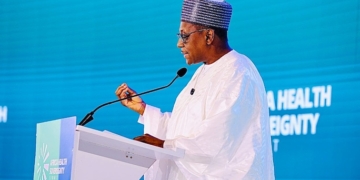
By Dr. Lolu Ojo
The allocation of approximately N2.48 trillion out of N58.47 trillion, representing roughly 4% of the 2026 national budget, to Nigeria’s health sector calls for careful and dispassionate reflection.
At first glance, N2.48 trillion appears substantial in absolute terms. However, sound budget analysis is not about nominal figures; it is about proportion, priority, and impact.
Nigeria, with a population exceeding 200 million, faces a dual burden of communicable and non-communicable diseases, rising healthcare costs, persistent medical brain drain, fragile primary healthcare systems, and growing dependence on imported pharmaceuticals. Within this context, a 4% allocation raises an important policy question: Is health being treated as a strategic investment in national development or merely as a recurrent social obligation?
Under the Abuja Declaration, African Union countries, including Nigeria, committed to allocating at least 15% of national budgets to health. While fiscal realities evolve, the underlying principle remains valid: health is not expenditure; it is investment in human capital, productivity, and national security.
When health systems are underfunded:
- Households bear catastrophic out-of-pocket costs.
- Preventable diseases proliferate.
- Workforce productivity declines.
- Medical tourism increases.
- Skilled professionals migrate.
Conversely, when health is adequately financed and strategically managed:
- Primary healthcare becomes functional and preventive care strengthens.
- Health insurance coverage expands.
- Local pharmaceutical manufacturing gains momentum.
- Employment is created across the healthcare value chain.
- National preparedness improves.
Yet allocation alone does not determine outcomes.
The more nuanced question is whether the current allocation is strategically sufficient and efficiently utilised to transform healthcare delivery.
Allocation: The Structural Constraint
At 4%, the health sector operates within a constrained fiscal envelope. Limited allocation affects:
- Infrastructure expansion
- Equipment modernisation
- Workforce recruitment and retention
- Research and development
- Support for local pharmaceutical production
Chronic underfunding inevitably weakens system resilience. One cannot build world-class primary healthcare, expand insurance coverage, and industrialise pharmaceutical manufacturing on marginal fiscal commitment.
However, increased allocation without systemic reform will not automatically produce better outcomes.
Utilisation: The Immediate Governance Challenge
Nigeria’s health sector has historically faced challenges such as:
- Delayed budget releases
- Low capital implementation rates
- Procurement inefficiencies
- Fragmentation across agencies
- Weak monitoring and evaluation
- Abandoned or stalled projects
In several fiscal cycles, capital health allocations were not fully released or effectively deployed. When funds are delayed, poorly sequenced, or weakly monitored, impact is diluted.
If allocations rise without strengthening governance mechanisms, inefficiency may simply scale upward.
Conversely, disciplined utilisation — characterised by transparency, measurable outcomes, and performance accountability — can deliver visible improvements even within constrained budgets, though not full transformation.
The Deeper Issue: Strategic Design
The core issue is not only “how much” or “how well spent,” but whether the budget reflects strategic clarity:
- Is preventive care prioritised over curative burden?
- Is primary healthcare adequately protected?
- Is domestic pharmaceutical production incentivised?
- Are mechanisms in place to reduce catastrophic out-of-pocket expenditure?
Ultimately:
- Allocation is a political decision.
- Utilisation is a governance decision.
- Impact is a leadership decision.
Allocation sets the ceiling of possibility; utilisation determines the reality of impact.
Nigeria must improve both. However, improving utilisation is the fastest pathway to restoring public confidence while building a credible case for progressive increases in health-sector funding.
The 2026 allocation should therefore not end the conversation. It should begin a deliberate national dialogue on positioning health as a central pillar of economic growth, industrial development, and human capital advancement.
We’ve got the edge. Get real-time reports, breaking scoops, and exclusive angles delivered straight to your phone. Don’t settle for stale news. Join LEADERSHIP NEWS on WhatsApp for 24/7 updates →
Join Our WhatsApp Channel