Unarguably, education is the most powerful weapon that can be used to change the world and Nigeria is not an exception.
The nation’s policy in that sector establishes the main goals and priorities pursued by the government with regard to specific aspects such as access, quality and teachers, or needs. It contains principles, regulations and rules that govern many of the decisions on how to educate children, where to get them educated, where to get them employed, who to teach them, how to finance their education, what to teach, how to impart skills, the goals, objectives and educational philosophy.
The 1999 Constitution places education in the concurrent legislative list. Specifically the Second Schedule, Part II, Sections 27-30 cedes education administration at all levels to the federal and state governments.
With the introduction of the 6-3-3-4 system of education in Nigeria, pupils are expected to spend six years in primary school, three years in junior secondary school, three years in senior secondary school and four years in a tertiary institution.
By that policy and In principle, primary and lower secondary education are supposed to be free and compulsory.
The presumption among experts is that primary school education is the foundation of individual and national development.
The skills learned at that level are the base on which the capacity for future economic productivity is built.
This means that whenever children are deprived of quality primary school education, they are at risk of having a damaged foundation that exposes them to the likelihood of lifelong technical and social incompetence that impairs their chances of achieving adequate integration into the family, workplace, and society as a whole. And if a significant portion of a society’s children are deprived of proper primary school education, then the society itself is likely to eventually pay a high social and economic cost.
Presently, Nigeria’s education sector is facing lots of challenges and several policies have been put in place to make it run smoothly and compete favourably with that of other nations.
One of such policies is the provision of support to basic education (in states) through fiscal transfers from the Universal Basic Education (UBE) Intervention Fund managed by the Universal Basic Education Commission (UBEC), the agency in charge. The UBE Intervention Fund receives at least two per cent of the Consolidated Revenue Fund (total federal government revenue).
The Universal Basic Education Commission (UBEC) was established by the Compulsory, Free Universal Basic Education and Other Related Matters Act of 2004 with a mandate to formulate policy guidelines for the successful operation of the Universal Basic Education Programme and prescribe the minimum standards for basic education.
However, the sector is beset by well-catalogued woes. Public primary schools suffer from poor teacher quality, dilapidated infrastructure (some pupils study under trees), and fluctuating enrollment rates in parts of the country
Private primary schools abound but they are often out of the reach of the average Nigerian family. The secondary school level is just as rotten. Although the federal government is involved, it is bedevilled by similar challenges being experienced at the primary level.
The United Nations Educational, Scientific and Cultural Organisation (UNESCO) stated that the total of out-of-school children (OSC) in the nation is more than 20 million whereas the Universal Basic Education Commission (UBEC) states it is slightly above 10 million.
According to UNESCO, the data is based on those aged six to 18 years, ranging from primary one to senior secondary school three, while UBEC’s figure is related to those aged six to 11.
Whatever numbers one looks at, the reality remains that Nigeria has one of the highest number of out-of-school children in the world.
In May this year, UBEC revealed that some state governments were yet to access matching grants meant for the development of public basic education system in their areas of jurisdiction.
UBEC said that while some states were yet to access two to three years grant, Anambra state was yet to access 2019 matching grant as at April 30th, 2023, that would have helped the state to further develop its basic education system.
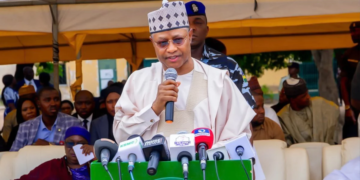
Acting Executive Secretary of UBEC, Prof. Bala Zakari, told members of Senate Committee on Basic and Secondary Education who were on oversight visit to the Commission, in Abuja, that over N46 billion matching grants for the development of public primary and junior secondary schools had remained un-accessed by some state governments.
He disclosed that over N162 billion was allocated to the states as Universal Basic Education (UBE) grants between 2019 and 2022, while N116 billion was accessed by 36 states and FCT as at 30th April, 2023, representing 71.52 per cent.
Further breakdown of the capital budget implementation report indicated that in 2019, 35 states and FCT accessed the 2019 allocation, with one state, Anambra, yet to access the grant as of 30th April, 2023.
On the 2020 matching grant, 30 states and FCT have accessed the grant, while six states namely; Abia, Adamawa, Anambra, Ebonyi, Kwara and Ogun, were yet to access the matching grant as at 30th April, 2023.
Eleven states namely; Bayelsa, Cross River, Delta, Ekiti, Jigawa, Kaduna, Kano, Nasarawa, Ondo, Taraba and Zamfara, have accessed 2021 UBE matching grant, while 25 states and FCT were yet to access the matching grant as at 30th April, 2023.
Similarly, 29 states have accessed 2022 matching grant for projects, while seven states and FCT are yet to access the matching grant as at 30th April 2023.
The Chairman, Senate Committee on Basic and Secondary Education, Senator Ibrahim Gaidam, said it was important to ensure that money released by the government was used for the purpose it was released.
The committee stressed the need for state governors to key into UBEC projects by accessing its fund to develop the nation’s basic education sector.
The Local government areas which should be in charge of primary school system are hamstrung by the joint account policy with states which has been assumed as an albatross.
We find it rather disconcerting that issues that are of grave importance like education are not given the attention they sorely need to lift the citizenry out of poverty.
Education is crucial to the wellbeing and development of any society, without which, the populace will remain illiterate and out of tune with governments’ policies.
It is the view of this newspaper that our state governments should re -evaluate their priorities by giving education its pride of place.
It is extremely important to understand that education not only plays a pivotal role in all of our lives and paves the way for all of us to reach our highest potential, it also promoted national interest.
We’ve got the edge. Get real-time reports, breaking scoops, and exclusive angles delivered straight to your phone. Don’t settle for stale news. Join LEADERSHIP NEWS on WhatsApp for 24/7 updates →
Join Our WhatsApp Channel