• Hausa Edition
  • Podcast
  • Conferences
  • LeVogue Magazine
  • Business News
  • Print Advert Rates
  • Online Advert Rates
  • Contact Us
Wednesday, September 9, 2026
Leadership Newspapers
No Result
View All Result
  • Home
  • News
  • Politics
  • Business
  • Sport
    • Football
  • Health
  • Entertainment
  • Education
  • Opinion
    • Editorial
    • Columns
  • Others
    • LeVogue Magazine
    • Conferences
    • National Economy
  • Contact Us
Hausa Edition
  • Home
  • News
  • Politics
  • Business
  • Sport
    • Football
  • Health
  • Entertainment
  • Education
  • Opinion
    • Editorial
    • Columns
  • Others
    • LeVogue Magazine
    • Conferences
    • National Economy
  • Contact Us
No Result
View All Result
Leadership Newspapers
No Result
View All Result

Lessons From Off-cycle Elections

Jonathan Nda-Isaiah by Jonathan Nda-Isaiah
3 years ago
in Columns
elections
Share on WhatsAppShare on FacebookShare on XTelegram

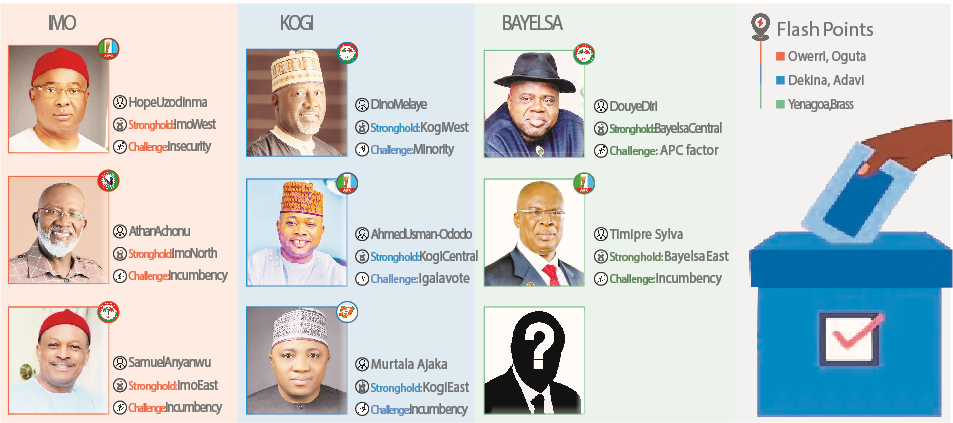
The off-cycle gubernatorial elections in Imo, Kogi, and Bayelsa states have concluded with no surprises.

Before the elections, I anticipated the three candidates in these states to win, and my predictions held true, especially in Kogi where I accurately foresaw the first three candidates.

This leads me to the primary lesson: the power of incumbency remains a formidable factor in our politics. In most cases, unseating an incumbent is particularly challenging in off-cycle elections, requiring substantial popularity.

Another lesson learned is that vote buying will persist in our elections unless we take drastic steps. Despite measures in place, such as increased deployment during elections making massive thumb printing and ballot box stuffing more difficult, politicians have devised new means like vote buying.

The electoral umpire should find ways to curb vote buying, contributing significantly to sanitizing our electoral system.

Another crucial point is that voter intimidation is likely to continue. Widespread cases were observed in the three states, and the solution lies in arresting and prosecuting electoral offenders.

Currently, offenders are arrested every electoral cycle, yet nothing substantial happens to them. If they were prosecuted along with their sponsors, it could serve as a deterrent to potential electoral offenders.

Achieving a free, fair, and credible election in Nigeria remains a slogan that may never materialize.

Despite INEC’s good intentions, the credibility of elections seems beyond reach. As efforts are made to sanitize the system, politicians are simultaneously devising means to circumvent it.

An additional lesson from the elections is that social media popularity doesn’t guarantee electoral success. Opinion polls don’t always translate to victory.

Many observers during the Kogi election predicted a win for the Peoples Democratic Party (PDP) candidate, Dino Melaye, based on his social media popularity. However, this was not the case, as he finished a distant third. His performance indicates he was never truly in the race.

RELATED NEWS

Size Matters: Correcting 500 Years Of Africa’s Minimisation

Rethinking Policy From The Ground (II)

Beyond The Ribbon: The Questions Nigeria’s 2027 Campaign Must Answer

Furthermore, the elections underscore the enduring influence of ethnicity and religion in Nigerian politics.

Regardless of education and intelligence, Nigerians often prioritize these factors over rational decision-making, as evidenced in the Kogi election being influenced by ethnic considerations.


We’ve got the edge. Get real-time reports, breaking scoops, and exclusive angles delivered straight to your phone. Don’t settle for stale news. Join LEADERSHIP NEWS on WhatsApp for 24/7 updates →

Join Our WhatsApp Channel

Nigerians can invest ₦2.5million on premium domains and earn about ₦17-25Million. Earnings in USD. Rather than wonder, click here to find out how it works

Jonathan Nda-Isaiah

Jonathan Nda-Isaiah

Jonathan Nda‑Isaiah is the Political Director at LEADERSHIP Newspaper and serves on the Editorial Board. Specialising in political reporting and editorial writing, he offers deep insights into governance, policy and national affairs. His analysis is known for its depth and balance, reflecting a strong commitment to accurate, thought‑provoking journalism that influences public discourse in Nigeria.

OTHER NEWS UPDATES

Size Matters: Correcting 500 Years Of Africa’s Minimisation
Backpage

Size Matters: Correcting 500 Years Of Africa’s Minimisation

15 hours ago
Rethinking Policy From The Ground (II)
Backpage

Rethinking Policy From The Ground (II)

2 days ago
Beyond The Ribbon: The Questions Nigeria’s 2027 Campaign Must Answer
Backpage

Beyond The Ribbon: The Questions Nigeria’s 2027 Campaign Must Answer

3 days ago
Next Post
Sultan Harps On Ethno-religious Harmony Among Nigerians

Sultan Harps On Ethno-religious Harmony Among Nigerians

Advertisement

LATEST UPDATE

FIFA U-20 Women’s World Cup: Nigerian Ambassador Lifts Falconets, Urges Focus On China Match

18 minutes ago

Chad Opens First FIFA Arena As Country Plans 23 Mini-Pitches

23 minutes ago

TotalEnergies, NNPC Boost STEM Education In Abuja School With New Lab Centre

27 minutes ago

Nigeria Gets Bigger Naira Figures, Less Value – Atiku

46 minutes ago

Imo Community Seeks Government Intervention Over Alleged Security Brutality

54 minutes ago
Load More
Advertisement
Facebook Twitter Instagram Youtube Whatsapp

© 2026 LEADERSHIP Media Group - All Rights Reserved | Hausa | Online Casino.

No Result
View All Result
  • Home
  • News
  • Politics
  • Business
  • Sport
    • Football
  • Health
  • Entertainment
  • Education
  • Opinion
    • Editorial
    • Columns
  • Others
    • LeVogue Magazine
    • Conferences
    • National Economy
  • Contact Us

© 2026 LEADERSHIP Media Group - All Rights Reserved | Hausa | Online Casino.