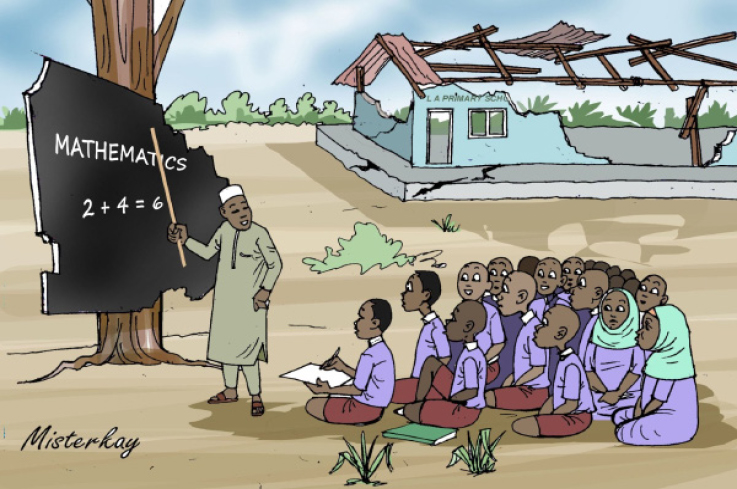
There has been no remarkable uproar on the public-school collapse in Nigeria, affecting primary, secondary, and university education. Our leaders do not view it as a crisis. The reason is evident: there is a widespread trend among the garrulous upper class and middle class to send their wards and children to pricey private schools in Nigeria, with most of them sending their kids abroad. This dislocation between the elite class and public schools means that they are not only unmoved by its decay, but sometimes they are not even aware of the extent of the problem.
Increasingly, public school is becoming the domain of low-income people who need more resources to send their children to good private schools. Good education is no longer affordable and is a class issue in Nigeria today. The paradox is that today’s elite and middle class are products of a robust public school system that existed between the 1930s and 1990s in Nigeria. During these golden years of public school in Nigeria, it provided an environment that allowed individuals of different socioeconomic backgrounds to interact with one another while removing barriers based on race, class, and religion. These schools also provided young Nigerians with the life skills they need to be self-sufficient and productive, and many of the products of this public school system became global giants and are still making waves worldwide and nationally in various fields of human endeavour. Quality public education has been steadily declining, particularly since the 1980s, which has led to the nearly total collapse of the system we have in place today. There has been a discernible drop in our public school system’s overall level of instruction since the 2000s, which has alarmed the populace.
Nigeria has faced numerous challenges in providing quality public education for all its citizens. Economic downturns, political instability, corruption, and conflicts harm the education sector. Over the years, various education policies and reforms have been implemented to address the sector’s challenges. These include the Universal Basic Education (UBE) programme, which provides free and compulsory education for all children up to junior secondary school level, and efforts to promote technical and vocational education to address skills gaps. Despite these efforts, significant disparities in access to quality education persist. The failure of public education in Nigeria has been a longstanding issue, marked by various challenges and setbacks that have hindered the system’s ability to provide quality education.
Six Key Challenges
These challenges include chronic underfunding of the public education sector, a significant issue in Nigeria. This lack of funding has resulted in inadequate infrastructure and a shortage of qualified teachers and essential educational resources. Second, there is a lack or insufficiency of essential infrastructure, including classrooms, libraries, labs, and restrooms in public schools. Dilapidated buildings, overcrowded classrooms, and unconducive learning environment make it difficult for students to learn effectively and for teachers to deliver quality instruction. Third, the quality of teaching in public schools is often compromised due to factors such as inadequate teacher training, low motivation, miserable wage , and poor working conditions. Fourth, the curriculum used in public schools is only sometimes relevant to the needs of students or the demands of the modern world. It may lack emphasis on critical thinking, problem-solving, and practical skills essential for success today. Fifth, the disparities in access to education persist in Nigeria, with rural and marginalised communities often having limited access to quality schools and educational resources. Sixth, corruption and mismanagement within the education sector are our albatross.
Addressing these issues requires concerted efforts from the government, civil society, the private sector, and international partners. But it also requires the active participation and support of each one of us. Priority should be given to increasing investment in education, improving teacher training and welfare, upgrading infrastructure, revising the curriculum to be more relevant and inclusive, and promoting access to education for all, especially marginalised groups. Additionally, efforts to tackle corruption and promote good governance are essential for building a more effective and sustainable public education system in Nigeria. Ironically, governments at both federal and state levels have paid lip service to public education over the years, leading to the rise of the private education sector to fill the gap. Although millions of children with no other option still receive their education in public schools, they are no longer the place teachers and students fervently desire to be. The clamour for private schools has led to the exponential rise in Nigeria’s private primary, secondary and tertiary schools. We, as citizens, as parents, as educators, as policymakers, have a role to play in reversing this trend and revitalizing our public education system.
In A Dangerous Place
A cursory look at statistics will show any keen observer that we are in a dangerous place with our future generation, most of whom will not get any meaningful education. We are cheaply mortgaging the future by continuing to underinvest in public schools. All we are doing is laying the groundwork for society to fail. It is not appropriate to do so. For instance, from 2018 to 2020, enrolment in primary school declined by 62,000 or 0.3% (from 22,384,755 to 22,322,234) in public schools but increased by about 82,000 or 1.51% (5,504,632 to 5,587,528) in private schools. Likewise, enrolment in public secondary schools increased by about 18% between 2016 and 2019, while in private secondary schools the increase is about 56%. Besides, the student-to-teacher ratio in public primary schools is about 1:49 (against the 1:35 recommended, while it is significantly lower, at about 1:30, in private primary schools. Relatively, more private schools are popping up in big cities than public schools, and the numbers are almost getting even in some cities. This trend is expected to continue this way unless there is a significant intervention to stop the decline in public school enrolment, especially in urban areas with substantial upper- and middle-class families. The urgency of the situation cannot be overstated. We must act now to save our public education system.
The problem with private education often is the cost. Quality education costs are so high that only a few Nigerians can afford it. Recently, some Nigerians were abhorred by the news of the cost of fees of British Charterhouse School (N43 million per annum) for its students. Most did not know that the school had a waiting list of over 1000 when it initially wanted only about 200 pupils. Other decent private schools cost millions of Naira yearly, and parents struggle to cover these costs. Ironically, private schools are not only about quality of education but also about class distinction. It is assumed that the more expensive the school is, the better the quality. Unfortunately, the current situation is a shift of emphasis to expensive private primary, secondary and tertiary education at the expense of public institutions.
Way Forward
The solution lies in a conscious public sector policy revision that encourages a renewal of the public education sector through curriculum renewal, teacher retraining, infrastructure renewal and renovation.
For instance, when former Governor Rotimi Amaechi of Rivers State revamped and modernised public schools with up-to-date modern facilities, parents began to return their wards to public schools that had become competitive with even the best private schools. Most recently I got involved in helping two state governments asses the state of education and I just wept but I could feel the seriousness and determination of the affected governors to fix the broken system.
I applaud the president’s plan to census the Nigerian school system to create the primary data for education planning and development. I sincerely hope that the federal and state governments give serious attention to our public education sector. No template exists in the world where a country develops its human resources through private education. All the developed countries we know of developed and sustained a robust quality public education system that is inclusive, equitable, and of high standards. Quality primary education is a fundamental right of every Nigerian child, and the government at all levels must be held accountable for failure to provide that.
We’ve got the edge. Get real-time reports, breaking scoops, and exclusive angles delivered straight to your phone. Don’t settle for stale news. Join LEADERSHIP NEWS on WhatsApp for 24/7 updates →
Join Our WhatsApp Channel