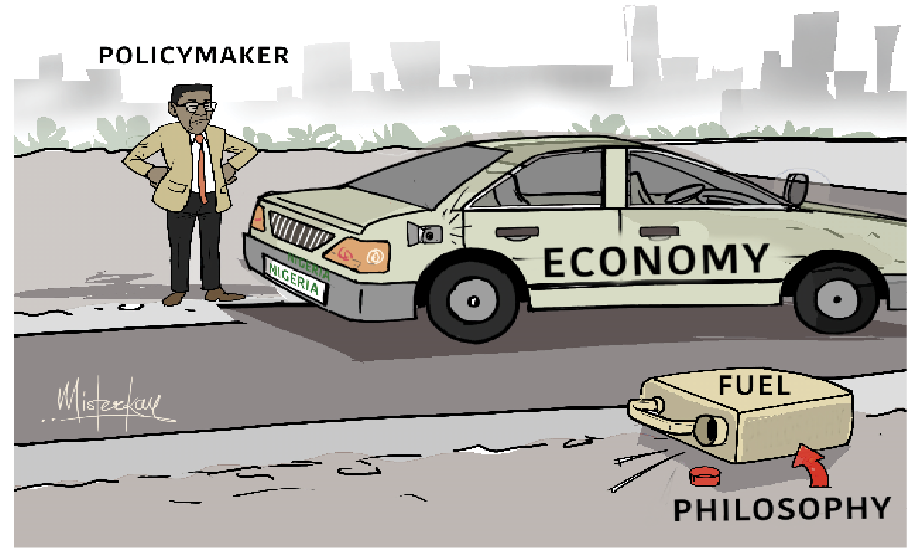
Picture this: You’re behind the wheel of a car, speeding down a road without a care in the world. Do you really need to understand the intricacies of internal combustion engines to drive? Of course not. But, let’s not forget, the very car you’re driving—and your ability to drive it—is deeply rooted in the knowledge of mechanics and engineering. You trust that those who built the car understood how everything works, even if you, the driver, don’t. Without that foundational knowledge, you’re just sitting in a machine, hoping it doesn’t break down mid-journey. Now, let’s take this analogy to Nigerian policy-making: The driver is the policymaker, and the car is the economic system. It’s quite simple: without a deep understanding of the foundational philosophical elements of economic doctrine, policy decisions are nothing more than driving blindfolded.
As my undergraduate Economics professor, AbdulGaniyu Garba, insightfully put it in his essay, “An Essay on the Philosophy and Methodology of Economics,” the policymaker—much like a car driver—relies on the doctrines of economics to navigate their way. But what if those doctrines aren’t grounded in a solid understanding of justice, ethics, or human well-being? What if those doctrines are mere technicalities, regurgitated without an ounce of philosophical reflection? Welcome to the modern economic policymaking conundrum, especially in Nigeria.
Economic doctrines are often treated as the ultimate manual for understanding the world and crafting effective policies. After all, it’s easy to believe that economic theories based on data and empirical evidence are all you need to make sound decisions. However, much like driving a car without understanding the mechanics that power it, policymaking without a philosophical foundation is bound to end in disaster. It’s all too common to see Nigerian policymakers relying on “received economic doctrines” without ever questioning the epistemological and ethical assumptions that underpin those doctrines. What happens when the tools we’re using to craft policy fail to account for deeper ethical questions, such as fairness and justice? Well, you get policies that, while technically sound, fail to actually serve the people they were designed for. The Social Investment Programme in Nigeria, anyone?
Evidence-Based Policy: A Noble, Yet Insufficient Goal
Let’s talk evidence-based policy for a second, since that’s the bread and butter of modern economics. The mantra of the day is that if the numbers add up, the policy is solid. We use econometric models, causal identifications, and cost-benefit analyses to craft policies. But here’s the kicker—those same tools, as magnificent as they are for drawing neat conclusions, fail miserably when we try to answer deeper questions about morality and justice. It’s like assuming that you can build a perfect, sustainable car without ever understanding the principles of balance and engineering.
Take for instance the way Nigerian policymakers frame policies around economic growth. They rely heavily on empirical data, often ignoring the philosophical underpinnings of fairness or equity. The lack of philosophical training in the education of policymakers—combined with a somewhat lazy reliance on economic theory—has led to policies that often overlook critical ethical implications. Let’s not forget that a policy’s effectiveness isn’t just measured by the number of people it serves, but by the justness of its outcomes. How, then, do we define justice without delving into philosophical discourse? Are we making assumptions about what is “just” based on convenient economic models, without fully realizing that fairness, in its true sense, is not something that can be reduced to mere data?
The crux of the problem lies in the disconnect between economic tools and the philosophical concepts that should guide their use. As Garba notes in his essay, economics is a tool—a means to an end. But that “end” is shaped by the deeper philosophical questions of what we, as a society, believe is just. And let’s not kid ourselves—economic models don’t answer questions like: “What is fairness?” or “What do we owe to future generations?” They just don’t.
The Bridge Between Evidence and Ethics
To take the analogy further, if economics is the car, then philosophy is the fuel. One cannot function optimally without the other. Policymakers may have access to all the technical tools and econometric models, but unless they’ve received training in philosophy, they are flying blind. How else can they tackle questions like: What is the role of the government in ensuring justice? Or how do we balance freedom with equity? These are not questions that can be answered by simply running numbers through a model. These are philosophical questions that require philosophical tools.
Consider Amartya Sen’s flute analogy, which beautifully encapsulates the essence of policy dilemmas. Just as a flute player must balance competing demands to create beautiful music, a policymaker must balance conflicting social values—freedom, equity, justice—to create policies that reflect the society’s broader moral vision. That balance cannot be achieved through economic theory alone. And yet, many economic policymakers in Nigeria—and beyond—have become so enamoured with the technicalities of their craft that they fail to ask themselves: Are we doing what’s right? Not just what’s efficient.
The Urgent Need for Philosophy in Nigerian Public Policy
Therein lies the fundamental issue with Nigerian economic policymaking. The relentless pursuit of data and evidence has fostered an intellectual environment where policymakers have increasingly neglected the importance of philosophical reflection. This absence of normative and or ethical consideration has a direct and damaging impact on the quality of policies produced. As I can personally attest, after years of studying economics, I came to realize that while tools like cost-benefit analysis and causal identification are vital for assessing the effectiveness of a policy, they cannot address the more profound, fundamental questions. Questions such as: How do we define fairness in the context of policy decisions?
It’s not enough to simply analyse data and run models; we must critically question the assumptions behind them. These assumptions shape the policies we create, yet too often they go unquestioned. We must ask ourselves: What values inform our analysis? Are we assuming that economic efficiency alone should be the guiding principle? Or are we also prioritizing equity, justice, and human dignity in our decision-making processes?
Policies are not just numbers and economic models; they reflect the values that shape our society. What we prioritize—whether it’s justice, fairness, or equity—must be carefully considered in the policymaking process. Relying solely on evidence and data ignores the deeper ethical questions that define how we structure our world. The complexities of human society cannot be reduced to spreadsheets; they are rooted in the competing beliefs and values that shape people’s lives. This deeper reflection must be a central part of how we design policies that affect real people.
If we continue to overlook these ethical considerations, we risk perpetuating ineffective and unjust policies. These policies, much like a car lacking an understanding of its mechanics, will inevitably fail when most needed. Without philosophical insight, we’ll keep crafting decisions that cater to narrow interests while ignoring the broader principles of justice, fairness, and dignity. But hey, who needs morals when we’ve got data, right? After all, that’s worked so well for us in the past, hasn’t it?
We’ve got the edge. Get real-time reports, breaking scoops, and exclusive angles delivered straight to your phone. Don’t settle for stale news. Join LEADERSHIP NEWS on WhatsApp for 24/7 updates →
Join Our WhatsApp Channel