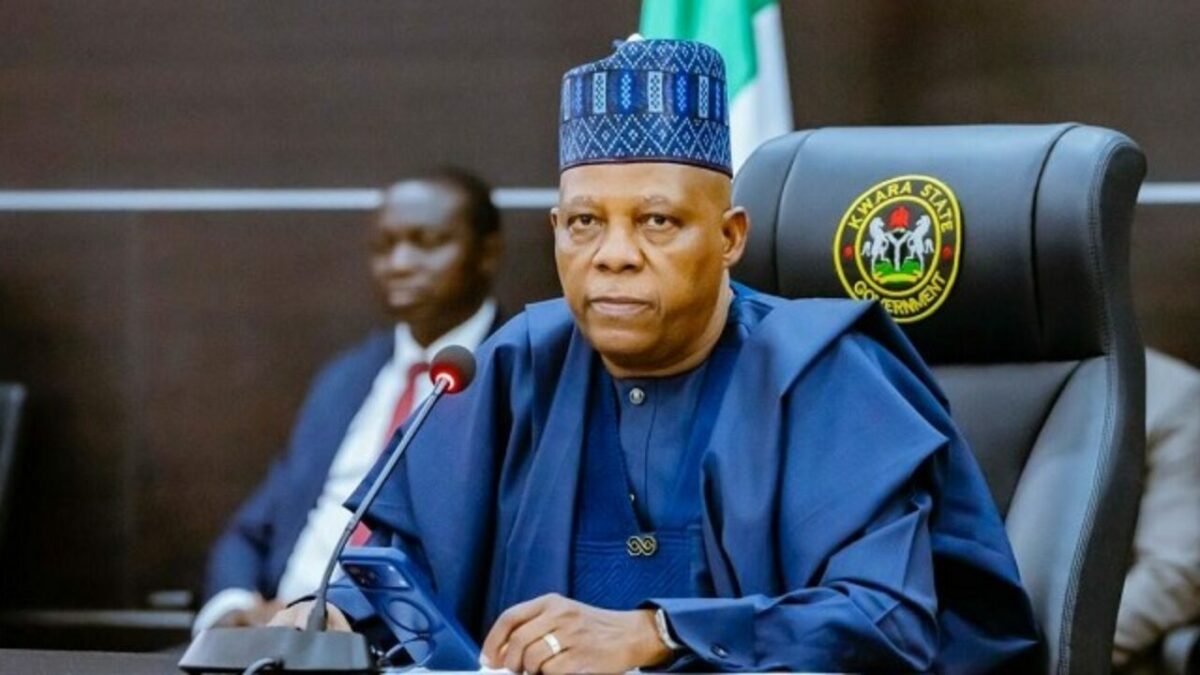
Vice President Kashim Shettima has urged the Federal Government to pay greater attention to Nigerians’ concerns over ongoing economic reforms, stressing that public confidence depends on transparent communication, credible evidence of progress and responsiveness to citizens’ experiences.
Shettima made the call on Thursday at The Duke’s Masterclass 2026, held at the Transcorp Hilton, Abuja, where he was represented by his Special Adviser on Economic Affairs, Dr Tope Fasua.
He said the success of the administration’s economic policies would depend not only on their implementation but also on the government’s ability to demonstrate tangible results and address the challenges confronting citizens.
“Government must continue to communicate its policies clearly, demonstrate progress with credible evidence, and listen attentively to the experiences of citizens,” he said.
Shettima defended the economic reforms introduced by President Bola Tinubu, including the removal of the petrol subsidy, foreign exchange market liberalisation, fiscal restructuring and revenue mobilisation, describing them as measures aimed at correcting longstanding economic distortions and strengthening Nigeria’s productive capacity.
According to him, the policies were designed to attract investment, boost business confidence, improve the allocation of public resources and create conditions for sustainable economic growth.
However, he stressed that announcing policies was not enough without ensuring that Nigerians understood their objectives and had confidence in their implementation.
The Vice President challenged Nigeria’s elite, professionals and middle class to acknowledge the difficulties facing ordinary citizens while helping to explain the objectives of the reforms.
“Your role is not to defend every government action uncritically, nor to dismiss the concerns of citizens. It is to help create a more informed and constructive national conversation,” he said.
He urged professionals engaging with traders to recognise the pressures confronting businesses, while those interacting with young graduates should acknowledge employment challenges and encourage entrepreneurship and innovation.
Shettima maintained that constructive criticism and informed public participation were essential to effective governance and the sustainability of economic policies.
“Constructive scrutiny strengthens governance. Informed public participation strengthens democracy,” he said.
He further emphasised that leadership required the flexibility to adjust policy implementation in response to evidence and changing economic circumstances without abandoning established objectives.
On the challenges posed by artificial intelligence and social media, Shettima warned that technological advances were making misinformation faster and more sophisticated, threatening public confidence and institutional reputations.
“A photograph can be manipulated, a voice can be cloned, and a video can be fabricated just with a simple prompt on social media to make an individual appear to have said or done something that never happened,” he warned.
He urged public institutions to strengthen information verification, correct false claims transparently and communicate through trusted channels, stressing that speed should never take precedence over accuracy.
He also called for improved digital literacy and the responsible use of artificial intelligence.
On economic opportunities, Shettima identified banking, financial technology, oil and gas, agriculture, real estate, construction, commodity exports and the creative industry as sectors with the potential to attract investment and create jobs.
He, however, acknowledged persistent challenges, including unreliable electricity, inefficient transportation, insecurity, limited access to finance, and weaknesses in education and public institutions.
The Vice President called for increased domestic production, export expansion and greater support for small businesses. He also urged the government to ensure that economic opportunities reached women, young people and rural communities.
In his opening address, the Chairman of Odu’a Investment Company Limited, Bimbo Ashiru, warned that poor leadership decisions and inadequate crisis preparedness could undermine institutional credibility.
“Reputation cannot be manufactured at the point of crisis. It is built over time through our decisions, our conduct, our values and the consistency between what we say and what we do,” he said.
Ashiru noted that geopolitical tensions, technological changes and economic disruptions were making leadership increasingly challenging, requiring organisations to strengthen accountability, transparency and crisis management.
He also disclosed plans to extend the masterclass to London in March 2027.
Former Commonwealth Secretary-General Emeka Anyaoku, who also spoke at the event, recounted his involvement in international conflict resolution, particularly negotiations surrounding South Africa’s transition from apartheid and political tensions in Bangladesh.
He stressed that successful mediation required a thorough understanding of the issues dividing opposing parties, the interests of their leaders and the appropriate timing of public communication.
“Because if you communicate the progress prematurely, you might sabotage the whole process,” Anyaoku said.
The Chairman of AXA Mansard and Group Managing Director of Sahara Power Group, Kola Adesina, criticised Nigeria’s persistent electricity challenges, arguing that public institutions and businesses should be judged by their service delivery rather than their explanations for poor performance.
“Rather than giving people megawatts of electricity, we are giving them excuses,” he said.
Adesina also condemned corruption, inflated public contracts and failures of accountability, warning that such practices weakened infrastructure, eroded public trust and endangered lives.
Meanwhile, the Chairman of the Duke of Shomolu Foundation, Joseph Edgar, said the masterclass was designed to equip organisations and individuals with practical strategies for anticipating crises, managing their consequences and protecting institutional reputations.
He added that the initiative complemented the foundation’s use of theatre to promote social cohesion and strengthen public engagement.
We’ve got the edge. Get real-time reports, breaking scoops, and exclusive angles delivered straight to your phone. Don’t settle for stale news. Join LEADERSHIP NEWS on WhatsApp for 24/7 updates →
Join Our WhatsApp Channel