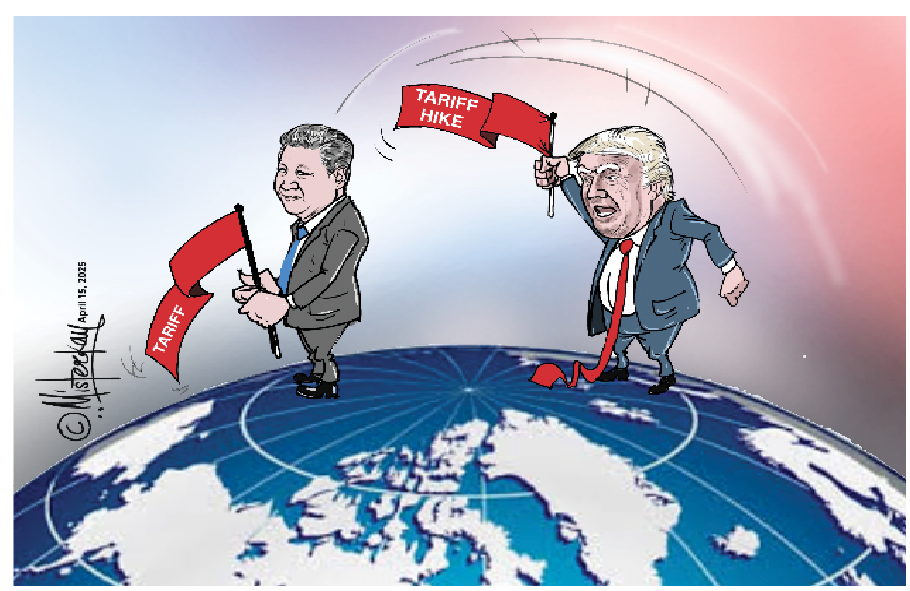
In recent months, a renewed tariff conflict between the United States and China has escalated into a broader struggle over global influence. This trade war, championed by the Trump administration and defended by figures like Vice President J.D. Vance, is not just about economics. It is a power struggle with implications far beyond trade balances, markets, and tariff rates. It is a geopolitical contest, and, more often than not, the rhetoric itself – sharp, combative, and sometimes reckless – carries the greatest risk.
Vance recently made headlines for his comments on Fox News, where he defended the Trump administration’s tariff policies by saying that the U.S. was “borrowing money from Chinese peasants to buy things that the peasants produce.” The remark, seemingly innocuous to some, triggered a swift response from China. Beijing’s Foreign Ministry called it “absurd, astonishing, and deplorable,” warning that if the U.S. wished to engage in a tariff war, they would respond with equal force.
What was striking about Vance’s comment was not just its economic implications but the language itself. In the context of international relations, words matter. The decision to frame the Chinese population as “peasants” was deeply disrespectful and undermined any attempt at constructive diplomacy. But more importantly, it was a signal that Washington views China’s economic and geopolitical rise as something to be suppressed, not engaged. The broader implications of such rhetoric may prove to be more damaging than the tariffs themselves.
The Role of Language in Geopolitics
The relationship between the United States and China has always been fraught with tension. However, it has never been as open or as public as it is today. The use of language in geopolitics – whether in speeches, social media posts, or media appearances – can escalate conflicts quickly. In this case, the choice of words used by American politicians to describe China and its people reveals a critical shift in the dynamics between the two powers. It is a shift away from diplomacy and toward a more confrontational, zero-sum approach to international relations.
China has long been aware of the narratives spun about it by Western leaders. The West often portrays China as a threat – a “rogue state” or a “rising power” that will soon surpass the United States in both economic and military strength. But in recent years, China has stopped apologising for its rise. It is no longer content to be portrayed as a passive, impoverished nation relying on Western markets for growth. Rather, it now presents itself as the rightful heir to global leadership.
This attitude has fueled China’s ambitious Belt and Road Initiative, its dominance in emerging technologies such as 5G, and its increasingly aggressive foreign policy. As China becomes more assertive, the United States must grapple with a question that has been around since the end of the Cold War: Can the global order continue to be defined by one superpower, or is it time for a more multipolar world?
The rhetoric that surrounds trade wars – the words chosen to describe China’s role in the world – will inevitably shape how the international community views both nations. While economic warfare can damage both sides, it is the rhetoric that can push the global order closer to irreversible conflict.
The Thucydides Trap: A Cautionary Tale
Graham Allison’s theory of the “Thucydides Trap,” outlined in his book Destined for War, offers a cautionary tale about the risks of great power competition. In essence, the Thucydides Trap describes the tendency of rising powers to clash with established ones. Throughout history, the rise of new powers has often been accompanied by conflict with the dominant power. Of the 16 instances in the last 500 years where a rising power challenged an established hegemon, 12 resulted in war.
China’s rise has been spectacular. It has transformed itself from an agrarian society into the second-largest economy in the world, while the U.S. remains the primary global power. But as China’s economic and military capabilities grow, the potential for a full-blown confrontation between the two powers increases. Both nations have competing visions of the future, and the ongoing trade war is simply one manifestation of this underlying competition.
The history of power transitions is clear: nations that resist change, even when it’s inevitable, often find themselves entangled in conflict. This is precisely the danger posed by the current trade war. The rhetoric used by the U.S. government risks solidifying a narrative of antagonism and exclusion that could escalate into broader conflict. And while trade wars may seem like an isolated economic issue, they are far more than that. At their core, they are a struggle for global dominance.
The Economic and Strategic Implications of Decoupling
The ongoing trade war between the United States and China highlights the fragility of the global economic system. Economic interdependence has long been a cornerstone of modern global relations. For decades, the U.S. and China have been tightly linked, with China becoming the manufacturing powerhouse for the world, and the U.S. being a primary consumer of those goods. This symbiotic relationship has allowed both nations to grow, while also ensuring that the world economy remains tightly interconnected.
But the trade war is eroding this interconnectedness. The Trump administration’s tariffs, initially aimed at protecting U.S. manufacturing jobs, have instead exposed the vulnerabilities of a highly globalised economy. Supply chains that once spanned continents are now facing disruption. The trade war has intensified the push for “decoupling,” where U.S. businesses look to relocate supply chains outside of China, and China, in turn, accelerates its efforts to develop its own technological innovations.
This process of decoupling is not without consequence. For the U.S., it risks increasing costs for both consumers and businesses. Higher tariffs inevitably lead to higher prices for everyday products, including electronics, clothing, and even food. For China, decoupling could harm its own economy by diminishing its access to critical U.S. technologies and markets. However, China is making strides to mitigate these risks by diversifying its trade relationships and increasing its investments in domestic industries.
The long-term impact of decoupling, however, goes beyond economics. The rupture between the two economic giants has the potential to fracture the global order. Countries that rely on the U.S. or China for trade, finance, or technology will now have to navigate an increasingly bifurcated world – one that is far less efficient and far more unpredictable.
The Path Forward: Strategic Diplomacy, Not Escalation
The trade war may have begun as a means of negotiating better deals for American companies, but it has evolved into something much larger – a defining moment in the future of global leadership. If both the United States and China continue to escalate the conflict through tariffs, retaliatory measures, and inflammatory rhetoric, the global economy risks a sharp, destabilizing downturn. It will harm the very citizens these policies are designed to protect.
Strategic diplomacy is the only path forward. It is crucial that the United States and China find ways to address their differences without resorting to all-out conflict. While tariffs may serve as a short-term solution, they are not the long-term answer. The global order is shifting, and both powers need to recognize that cooperation, even amid competition, is necessary for maintaining stability.
We’ve got the edge. Get real-time reports, breaking scoops, and exclusive angles delivered straight to your phone. Don’t settle for stale news. Join LEADERSHIP NEWS on WhatsApp for 24/7 updates →
Join Our WhatsApp Channel