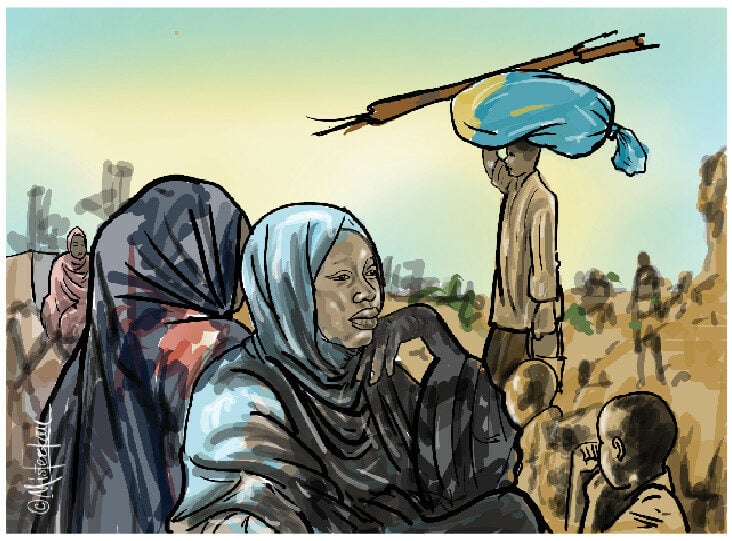
Sudan has been embroiled in a civil war between the army and the paramilitary Rapid Support Forces since April 2023, sparked by a power struggle between the two parties. The war has displaced more than 14 million people. Over half the population of about 50 million is facing acute levels of hunger.
Several mediation initiatives have been launched since the start of the war, with limited success. The African Union has also been unable to get the main warring parties to agree to a permanent ceasefire.
The four countries leading the main peace mediation effort (known as the Quad) are the US, Egypt, Saudi Arabia and the United Arab Emirates. They issued a joint statement in September 2025, calling for a ceasefire in Sudan and offering a roadmap to end the internal conflict.
I’ve been researching Sudan for over a decade, and in my view, these countries’ capacity to deliver a final political settlement for Sudan is severely constrained.
The prospects for peace rest on the resolution of three factors:
the sharp differences between the Sudanese army and the Quad over who should participate in post-war politics, a widening rift between the main protagonists in the war on the terms of ending it and internal divisions within the Quad – particularly between Egypt, the UAE and Saudi Arabia – over how to balance support for the army, curb Islamist influence and manage competing regional interests.
The Quad’s plan called for an immediate ceasefire, a three-month humanitarian truce and an inclusive political process to resolve disputes within nine months.
The statement was initially welcomed by the Rapid Support Forces and Sudan’s army leaders.
However, follow-up meetings between the Quad and representatives of the warring parties have failed to translate any of these proposals into action.
Meanwhile, the paramilitary troops and their allies captured the city of El-Fasher in North Darfur after a bloody 500-day siege. This was the army’s last major stronghold in Darfur.
Darfur encompasses nearly 20% of Sudan’s territory. It borders Libya, Chad and the Central African Republic. The capture has fuelled concerns of a de facto partition of the country in the western region.
Against this backdrop, the Quad’s latest initiative seems unlikely to achieve more than a fragile ceasefire.
The obstacles
Efforts to broker peace in Sudan are hindered by three key challenges.
- Diverging agendas between the Quad and the Sudanese army
Despite broad similarities between the Quad’s roadmap and a proposal the army submitted in March 2025 to the United Nations, key differences remain.
The core disagreement lies in the design of the political process to follow the ceasefire. The Quad insists that Islamist factions should be excluded from consultations over fears that these factions have close ties to terrorist groups and Iran. The army’s proposal, by contrast, opposes the exclusion of any party.
The military leadership has alliances with elements of the former Islamic Movement. Its fighters still help stabilise the army’s frontlines.
- A widening gap between the army and Rapid Support Forces on the terms of ending the war.
The army’s roadmap implicitly allows the paramilitary troops to remain in parts of Darfur for up to nine months, provided that local authorities consent. However, it also requires the withdrawal of the group from El-Fasher and North Kordofan.
The Rapid Support Forces’ behaviour on the ground reveals a very different mindset. Rather than preparing to withdraw, the group has expanded militarily in North Kordofan and intensified its drone attacks on Khartoum and other regions.
At its core, the dispute reflects conflicting end goals. The paramilitary group seeks to enter negotiations as an equal to the army. It wants a comprehensive restructuring of the armed forces. The army insists that it should be the only unit that supervises any reform of Sudan’s military institutions – the very issue that triggered the outbreak of war in 2023.
For the Rapid Support Forces, the calculation is different. After spending more than 18 months battling to capture El-Fasher, the group recognises that advancing further towards the capital would come at a high human and political cost. A temporary truce, therefore, could allow it to entrench its governance structures in Darfur and strengthen its military presence there.
In this sense, a short-term ceasefire remains the most practical outcome for both sides. Washington’s eagerness to secure conflict-ending deals is likely to push the Quad towards this scenario.
But a final political settlement in Sudan remains distant.
For now, the most any diplomatic initiative can achieve is to pause the fighting, not to end the war, as it remains difficult to bridge the political gaps between Sudanese powers.
Source:https://theconversation.com
We’ve got the edge. Get real-time reports, breaking scoops, and exclusive angles delivered straight to your phone. Don’t settle for stale news. Join LEADERSHIP NEWS on WhatsApp for 24/7 updates →
Join Our WhatsApp Channel