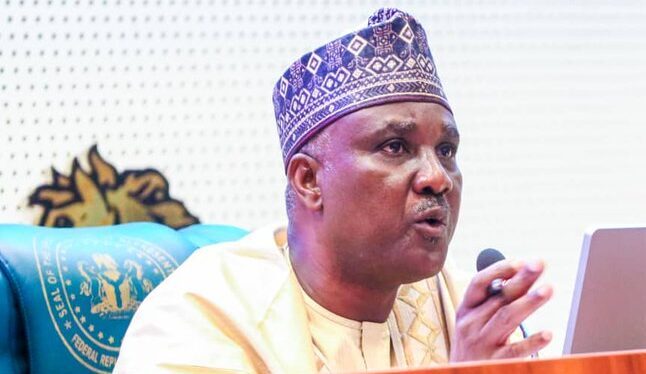
The Speaker of the House of Representatives, Hon. Abbas Tajudeen, has declared that the events of the past week revealed a deeply troubling escalation in violence across several states.
The Speaker said the various attacks are not only coordinated but designed to destabilise the country, aiming to create the impression that violent groups can act without restraint.
Abbas, who made this statement during a special plenary session on national security in the House chambers on Tuesday, also noted that the group’s focus is on soft and vulnerable targets.
“Their purpose is to instill fear, weaken public confidence, and give the illusion of being everywhere at once. Nigeria must reject this tactic. We must resist fear and stand firm against those who rely on cruelty and spectacle to advance their evil ideologies.
“The last few weeks have been difficult for our country. Communities have suffered severe attacks, including killings and multiple abductions targeting civilians, security personnel and other vulnerable groups. These incidents occurred in rapid succession and affected different parts of the country, underscoring the scale and coordination of the threat we face.
“The attack in Kebbi State shocked the nation. The abduction of students in Niger State caused deep distress. The kidnapping of worshippers in Kwara State brought fear to many communities. Families are grieving. Citizens are anxious. These incidents remind us of the scale of the threat we face and the seriousness of the work before us,” he said.
The speaker enjoined Nigerians to remain undaunted by the recent activities of terrorists and bandits but remain united in tackling the security challenges.
Speaker Abbas stated that the decision of the House to suspend all other matters to focus on national security was neither symbolic nor procedural but “reflects the seriousness of the moment and our duty to speak for our constituents.”
Abbas also commended President Bola Tinubu for showing leadership and stimulating a swift response from the security forces.
“Since President Bola Ahmed Tinubu assumed office, his administration has taken steps to reform the security architecture. There has been a shift in coordination among the services, accompanied by a more deliberate effort to regain the initiative.
“Evidence shows that these reforms have produced results. Thousands of captives have been freed. High-ranking commanders linked to violent networks have been eliminated. Millions of displaced people have returned to their communities. There was also a measurable decline in some categories of mass abductions and kidnappings. These gains reminded us that progress is possible when strategy, coordination and political will converge,” he said.
Abbas noted that, “we must, however, accept that certain forms of violence have resurfaced in different parts of the country and are evolving rapidly. The roots of this resurgence lie both within and beyond our borders.
“The Sahel has undergone significant upheaval. Changes in government in Mali, Burkina Faso, and Niger have created ungoverned spaces that armed groups now exploit. Illegal arms trafficking has increased. Nigeria, therefore, faces domestic and transnational pressures that require an integrated response.”
The speaker, while alluding to the designation of Nigeria as a Country of Particular Concern by the United States (U.S), said the government of Nigeria does not and will never support or sponsor violence against its own citizens.
Abbas declared that Nigeria’s sovereignty remains non-negotiable, yet partnership, especially when extended in good faith, can allow both countries to face shared threats with greater clarity and purpose.
“We conveyed our resolutions to the United States Congress, the Department of State and the United States Commission on International Religious Freedom.
“It is true that in some communities, Christians have been targeted, just as Muslim communities have suffered similar attacks in others. These acts have been carried out by violent groups pursuing their own agendas. They do not reflect the policy or practice of the Nigerian state.
“Terrorism, banditry, communal clashes and extremist violence have brought suffering to Nigerians of all faiths. Our Constitution guarantees freedom of religion, and every institution of government remains committed to protecting that right.
“With this context in mind, Nigeria continues to welcome partnership and constructive engagement. At the same time, we cannot accept conclusions that do not reflect the complexities of our security challenges. Our response to the Religious Freedom Accountability Bill has been calm and measured. We are mindful of our longstanding relationship with the United States. I wish to reaffirm that dialogue is more productive than recrimination.
“As highlighted in a recent meeting between the National Security Adviser, Nuhu Ribadu, and the US Secretary of War, Pete Hegseth, we are prepared to collaborate with partners on intelligence sharing, counterterrorism training, surveillance technology, and the disruption of financial networks linked to violent groups.
“A more confident engagement from the United States, championed by President Trump, would support Nigeria’s efforts to modernise equipment, reinforce training, and strengthen accountability systems.
“Nigeria welcomes this prospect and is prepared to work transparently and responsibly with American institutions. Our sovereignty remains non-negotiable, yet partnership, especially when extended in good faith, can allow both countries to face shared threats with greater clarity and purpose,” he added.
We’ve got the edge. Get real-time reports, breaking scoops, and exclusive angles delivered straight to your phone. Don’t settle for stale news. Join LEADERSHIP NEWS on WhatsApp for 24/7 updates →
Join Our WhatsApp Channel