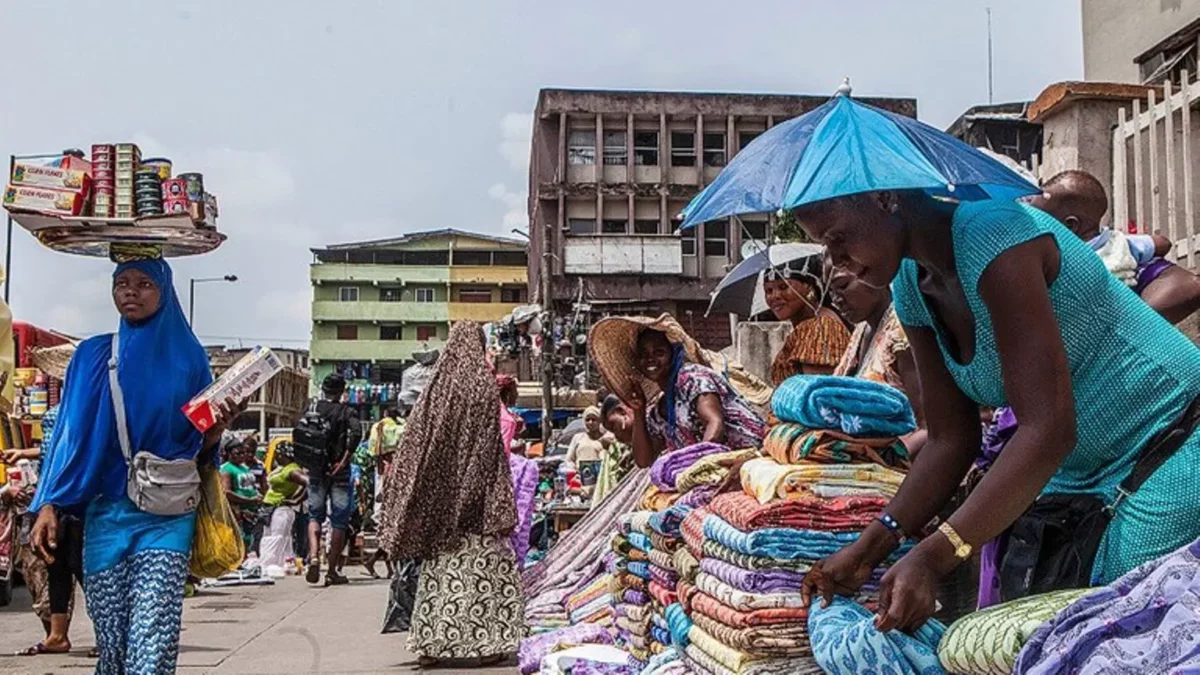
Street trading remains one of the most enduring features of urban life in Nigeria, especially in Lagos, where every major road, bus stop, and pedestrian walkway constitute a marketplace.
However, the practice is now overstretching public infrastructure and causing severe traffic congestion, environmental pollution, and unsafe urban conditions.
It often leads to the narrowing of roads, obstructs traffic, and contributes to accidents, making urban transportation difficult and hazardous. Additionally, street trading generates waste that pollutes the environment and degrades the visual appeal of cities, creating unattractive and unsanitary urban landscapes
To this end, experts have urged state governments to make addressing this scourge a matter of urgency to prevent environmental chaos and degradation.
From Agege to Yaba, Ikeja, Oshodi, CMS, Mile 2, Ojuelegba, and Berger, traders display fruits, vegetables, clothes, food items, and household goods in spaces never designed for commercial activity.
For some, street trading is an eyesore, an obstacle to movement and a threat to environmental sanity… However, for thousands of traders, it is nothing less than a lifeline.
The stories of those who stand by the roadside every day tell a consistent tale: survival.
Speaking to LEADERSHIP, a fruit seller along Agege Motor Road, Ajayi Mariam said “I started trading so I can take care of myself and my family,” Her display is small, but it pays the bills. “I have enough to take care of my children,” she added, adjusting a stack of oranges as customers approached.”
Another trader, who identified herself simply as Iya Miniras, described street trading as her only viable option in a country where jobs remain scarce. “I started this business to take care of myself and my family,” she said. “It gives me freedom and peace. I don’t pay rent anywhere, and I sell when I want.”
For many Lagos traders, the freedom attached to informal selling is not a luxury; it is a survival strategy in an economy sliding deeper into uncertainty. Street trading offers daily cash flow and an escape from the crushing overhead costs that drive small businesses under.
However, the human resilience that powers the informal economy coexists with the heavy environmental and infrastructural consequences that the city can no longer ignore.
Environmental experts have long warned that the disorderly expansion of street markets is straining Lagos’ infrastructure to its breaking point.
Environmentalist and operator in the environmental services sector, Godwin Agholor, put it bluntly during an interview for this report: “Street trading in Lagos is an environmental management nightmare. Waste is dumped into the drainage. Movement becomes chaotic. Flooding becomes worse. Pollution rises. Everything is connected.”
The environmental consequences are visible everywhere. Improperly disposed waste, including nylon bags, fruit peels, leftover food, and damaged goods, quickly fills the gutters around trading clusters. When rains fall, these blocked drainage systems overflow, causing flash floods that bring traffic to a standstill.
A LAWMA field supervisor, who gave his name as Femi, described the daily struggle of waste managers in picking PET bottles and nylon waste from drainage.
“Every morning, we clear waste that traders and buyers drop everywhere. These places were not intended to be markets. There are no bins, no waste points. So people throw everything in the drain,” he explained.
Given that the city bears the cost, it is expedient to note that pedestrian walkways are taken over, forcing people to walk on the road and creating unnecessary accidents. Vehicles navigating through crowd-heavy areas burn more fuel, release more emissions, and raise pollution levels. Repeated pressure on infrastructure accelerates wear and tear.
A senior officer at the Lagos State Ministry of Physical Planning and Urban Development, who spoke on condition of anonymity, described the situation, stating that structurally:
“When trading spreads uncontrollably, the entire urban system weakens. Roads are obstructed, emergency response is hindered, and the city becomes more difficult to manage.”
Behind every small roadside stall is a catalogue of silent battles. Street traders face the sun, rain, dust, heat, cold nights, the risk of accidents, and the fear of sudden raids. Their shops have no walls. Their roofs are the skies. Their stock is at the mercy of the weather.
“Sometimes the law enforcement officers disturb us,” said Iya Miniras. “When rain falls, we suffer. When customers do not come, we suffer. But what else can we do?”
At Yaba, a trader who identified himself as Tunde explained the core issue: “If markets were affordable, nobody would stay on the road. However, go to Tejuosho and ask for the price of a stall. It is too high. Many of us can’t pay that.”
Street trading is technically illegal in Lagos under the Street Trading and Illegal Market Prohibition Law of 2003. Yet enforcement has never truly eliminated the practice. The Lagos State government acknowledges that the situation is complex.
Lagos State officials insist that ongoing enforcement by the Lagos Environmental Sanitation Corps (LAGESC) is essential for safeguarding public health, preventing environmental degradation and flooding, maintaining the city’s cleanliness and visual appeal, and driving the long-needed shift toward responsible ecological behaviour among residents.
Commissioner for the Environment and Water Resources, Tokunbo Wahab, and the Corps Marshal, Major Olaniyi Olatunbosun Cole, have consistently maintained that strict penalties, including substantial fines and possible imprisonment, are necessary deterrents.
They urge residents to support the state’s efforts by using approved waste-disposal channels, such as those provided by PSP operators, and adhering fully to environmental regulations.
In his take, a public affairs enthusiast, Ken Iwuoha said, “Street trading endangers both the traders and the public. We have cases of traders being hit by vehicles. Once trading blocks pedestrian walkways, bridges, and roads, chaos ensues. There should be an urgent need for duty on the maintenance of order.”
However, even he acknowledged the limitations of force. He said. “Lagos State Government also need to create more structured markets and alternatives. Enforcement without support will not work.”
Other traders also demanded: fair, humane enforcement, access to low-cost stalls, protection from touts and area boys, microcredit support, clean, well-managed trading spaces, and consistent waste management around markets
Their requests show that traders do not reject regulation, they reject exclusion. Experts recommend a practical path forward.
Against the foregoing backdrop, urban planners and environmental specialists insist that Lagos needs to rethink its entire approach. Dr. Adetayo recommends three steps, which cut across establishing controlled micro-markets in hotspots, creation of a registry of street traders, launch and a citywide campaign on environmental responsibility.”
As gathered, without behaviour change, even well designed markets will fail. A senior LAWMA official added: “We understand the hardship people face. However, Lagos cannot survive chaos. The solution must balance empathy with firm regulation.”
A health practitioner, Gloria Ogbu, said, “Lagos State is a city caught between survival and sustainability”.
As gathered, street trading in Lagos is a double-edged reality, a human struggle on one side and a growing environmental burden on the other.
According to consumer affairs enthusiast, Mr Luke Onyia, “Real progress will require affordable markets, inclusive planning, fair policy enforcement, environmental education, targeted infrastructure and genuine engagement with traders”.
Onyia explained that Lagos is a megacity still grappling with its own growth, adding that until its urban system is strengthened and its economic challenges are confronted, street trading will remain a paradox: vibrant, necessary, chaotic, and environmentally costly. It is both a symptom and a survival mechanism. In addition, unless meaningful reforms are implemented, it will continue to shape daily life on the streets of Africa’s busiest city.
We’ve got the edge. Get real-time reports, breaking scoops, and exclusive angles delivered straight to your phone. Don’t settle for stale news. Join LEADERSHIP NEWS on WhatsApp for 24/7 updates →
Join Our WhatsApp Channel