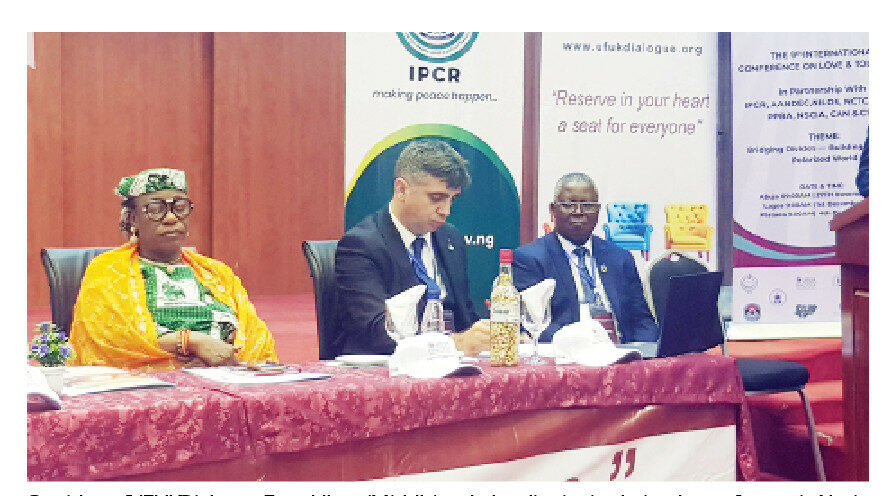
The Institute of Peace and Conflict Resolution (IPCR), the UFUK Dialogue and other partners have intensified efforts to bridge widening divides across cultures in order to rebuild trust in an increasingly polarized global community to enhance peace for all humanity.
This was the crux of the 9th International Conference on Love and Tolerance Held at the IPCR Conference Hall on November 27, 2025 with the theme “Bridging Divides: Building Trust in a Polarized World.”
It was a gathering of esteemed scholars, respected religious and traditional leaders, members of the diplomatic community, youth advocates, women leaders and civil society representatives. The necessity of this conference was predicated on the deepening division, mistrust, and social fragmentation in Nigeria and other parts of the world and the need to tackle these crises for a better world.
Director General of IPCR, Dr. Joseph Ochogwu, captured the essence in his remarks that the realities of widening ethnic, religious, political, generational, and economic fault lines must challenge stakeholders to reflect deeply and act intentionally to rebuild trust and heal fractures that threaten shared future.
Represented by Dr. Emmanuel Mamman, the IPCR boss said “In Nigeria today, polarization manifests through rising mistrust between communities, strained state-citizen relations, interfaith misconceptions, generational disconnects, and widening disparities between identities and regions. We also see how misinformation travels faster than truth, reinforcing suspicion and undermining solidarity.
“The consequences of this fragmentation are severe: increased violent conflicts, political tensions, declining social cohesion, weakened institutions, and diminishing public confidence. Yet, polarization is not destiny, and mistrust, though deep, remains reversible,”
He noted that the conference aimed to illuminate pathways to renewed trust and remind stakeholders that peace rests not only on policy or security measures but on relationships anchored in empathy, fairness, dialogue, and genuine commitment to the common good.
A major plank of the discussion was the advocacy for women, youths, and traditional and religious institutions at the mainstream of policies to build trust and cultivate peace through those who hold moral influence and generational reach.
President of UFUK Dialogue, Emrah Ilgen inspired the gathering with his delivery on love and tolerance, which he said are the pillars of civilisation, the infrastructure of peace, the sacred values of all religions, and the true compass of humanity.
He noted that the world is in need of healing saying “around the world, and indeed within our own communities we witness increasing polarization and divisions fuelled by fear, misinformation, economic struggles, ethnic tensions, and religious misunderstandings. But this conference stands as a reminder that division is not destiny.’’
For more than a decade, UFUK Dialogue has championed the transformative belief that: “Humanity is strongest when it chooses dialogue over suspicion, compassion over conflict, and understanding over prejudice.”
The Turkish Dialogue Group has built bridges between faiths, cultures, institutions, and communities. It has created spaces where people meet not as opponents, but as partners and nurtured a future where children grow up with trust rather than trauma.
Nigeria, with its rich diversity, has the potential to become a global beacon of peaceful coexistence leveraging UFUK dialogue. But the country must rise above its myriad of challenges characterized by terrorism and violent extremism raving parts of the country.
And from the office of the National Counterterrorism Centre (NCTC) came a strong advocacy for peace and tolerance at a time Nigeria is facing convoluted security threats associated with terrorism and violent extremism.
The center has maintained that extremist ideologies thrive in environments marked by distrust, misinformation, and social fragmentation, deepening divisions across political, ethnic, and religious lines. It is therefore incumbent to have a collective effort to strengthen social cohesion, promote inter-cultural understanding, and build platforms for constructive engagement.
The challenge of terrorism and violent extremism remains multifaceted threats confronting the Nigerian communities and nation and the response of the security appears not adequate enough to tackle the growing insecurity, and sometimes raising suspicions and mistrust of the people affected by terrorism.
Therefore there must be a robust and bold step taken to reassure victims of violent extremism and all forms of injustice in Nigeria by taking concrete steps to address the push and pull factors as social, economic and psychological conditions that violent groups exploit.
We’ve got the edge. Get real-time reports, breaking scoops, and exclusive angles delivered straight to your phone. Don’t settle for stale news. Join LEADERSHIP NEWS on WhatsApp for 24/7 updates →
Join Our WhatsApp Channel