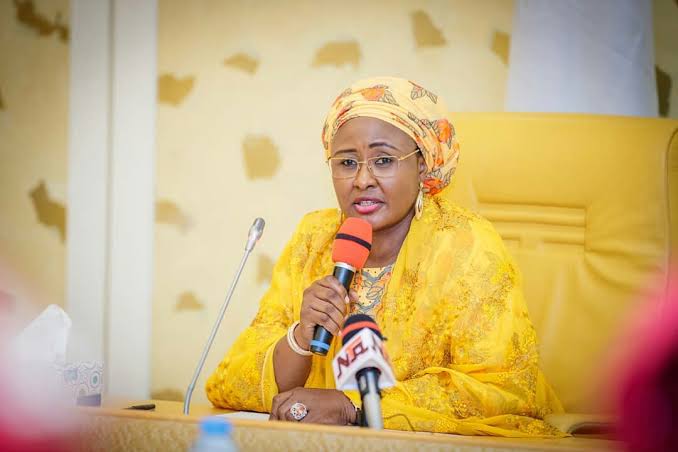
Former First Lady, Aisha Buhari, has dismissed claims and rumours that late President Muhammadu Buhari died from poisoning, saying doctors informed the family that the immediate cause of his death was pneumonia.
In her account contained in a newly released book, ‘From Soldier to Statesman: The Legacy of Muhammadu Buhari’, Aisha Buhari stated that there was no truth to suggestions of poison, air-conditioning sabotage, or any covert plot surrounding her husband’s death, describing such narratives as fear-mongering that obscured more basic issues of health management.
According to her, medical professionals who treated the former President told the family clearly that pneumonia caused his death.
She noted that while public reports at the time varied — with some media outlets describing a prolonged illness and others reporting a brief one, and a few mentioning leukaemia — the family relied on the doctors’ direct explanation.
The book presents her testimony alongside those media summaries, without attempting to resolve competing medical interpretations.
Aisha Buhari also addressed long-standing speculation about poisoning, rejecting it “flatly.”
She said rumours about poison or air-conditioning plots served as a cover for mismanagement and contributed to unnecessary fear that affected Buhari’s health routine.
She explained that similar misinformation had earlier trailed the President’s 2017 illness, which she attributed not to poison or any mysterious ailment, but to the collapse of a carefully supervised dietary and rest regimen, combined with age and heavy workload.
“In her account,” the book states, “not poison, not an arcane ailment,” but exhaustion and nutritional imbalance were responsible for the health crisis that forced Buhari to seek extended medical care abroad.
The former First Lady disclosed that once a stricter schedule and nutritional supplementation were reintroduced, Buhari’s condition improved, allowing him to resume work, including periods of recovery in London.
Beyond health issues, Aisha Buhari used the account to reflect on the broader challenges of governance during her husband’s presidency, particularly the role of gatekeeping and access control around the President.
She said such practices often delayed processes, restricted access selectively and weakened accountability within government.
However, she stressed that her own involvement in public matters never crossed into interference. She described her role as one of oversight — flagging bottlenecks, advocating transparency and defending the President’s stated priorities — while insisting she neither signed official memos nor awarded contracts.
On the removal of the Director-General of the Department of State Services (DSS), Lawal Daura, in 2018, Aisha Buhari recalled that the decision followed the blockade of the National Assembly by masked operatives, an action that violated constitutional norms.
She said she supported the sacking to avert chaos and that Buhari did not oppose it, a position corroborated by open-source reports of the incident.
Reflecting on life after the presidency, Aisha Buhari said she has chosen a quieter path, focused on family and service rather than politics.
She disclosed that her foundation has established a cardiovascular and medical centre in Kano, which has carried out over 200 procedures, describing it as a practical response to Nigeria’s healthcare challenges.
Asked about remarriage, she dismissed the idea with characteristic bluntness, saying the question itself reflects deeper issues of trust, capacity and the weight of public life.
We’ve got the edge. Get real-time reports, breaking scoops, and exclusive angles delivered straight to your phone. Don’t settle for stale news. Join LEADERSHIP NEWS on WhatsApp for 24/7 updates →
Join Our WhatsApp Channel