Lagos State has launched LASHMA-AID Emergency Services Programme to ensure no resident is denied life-saving care due to cost, delay, or paperwork confusion.
The programme, formally unveiled at GRA Ikeja, institutionalises emergency medical stabilisation for insured and vulnerable residents under the Lagos State Health Insurance Scheme, ILERA EKO, in line with Governor Babajide Sanwo-Olu’s Executive Order on Mandatory Social Health Insurance.
Delivering the keynote address, the Special Adviser to the Governor on Health, Dr Kemi Ogunyemi, described the launch as a historic milestone that strengthens Lagos State’s commitment to universal health coverage and responsive governance.
She said LASHMA-AID reflects the governor’s resolve to guarantee unhindered access to healthcare, noting that health remains a core pillar of the THEMES Plus Agenda, alongside sustained investments in infrastructure, digital health systems and emergency response.
Dr Ogunyemi highlighted reforms including the Smart Health Information Platform linking public facilities, expansion of 24-hour primary healthcare centres, upgrades of over 27 PHCs under the World Bank-supported IMPACT Programme, and the growth of functional PHCs to over 336 across the state.
She further noted that Lagos had reduced out-of-pocket spending through health insurance and strengthened protection for the poor by dedicating one per cent of the Consolidated Revenue Fund as an equity fund, increased to N3 billion annually and made a first-line charge.
According to her, LASHMA-AID is a lifeline that addresses long-standing gaps in emergency response by providing a structured, coordinated and financially protected system that prioritises saving lives before administrative checks.
Dr Ogunyemi explained that residents can access emergency care through the universal emergency numbers 112 or 767, or the dedicated LASHMA toll-free line, 0800 000 LASHMA, while medical evacuation and response are delivered through LASAMBUS, recently strengthened with ambulance bikes and MICU ambulances.
She disclosed that LASAMBUS attended to over 5,000 cases this year alone, with plans approved for additional recruitment of nurses and bike riders to further boost rapid response capacity.
In his goodwill message, Chairman of the House Committee on Health, Hon. Musibau Aina Lawal, said LASHMA-AID translates legislative intent into practical, life-saving action by ensuring that stabilisation takes precedence over enrolment verification or payment.
He noted that the initiative aligns with the Health Scheme Law and the Governor’s Executive Order, reinforcing the principle that preservation of life must always come first, while assuring continued legislative support.
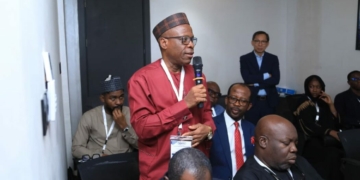
Earlier in a welcome address, Chairman of the Lagos State Health Management Agency, Dr. Adebayo Adedewe, said the programme was conceived from Sections 6 and 7 of the Executive Order and developed through extensive stakeholder engagement with empanelled and non-empanelled providers.
Dr. Adedewe explained that LASHMA-AID covers up to 48 hours of in-facility emergency stabilisation for enrollees and vulnerable residents, supported by clear operational guidelines, provider handbooks and escalation pathways.
He stressed that no emergency patient should be turned away, adding that the initiative integrates hospitals, ambulance operators and LASHMA’s internal coordination unit into a single response chain for pre-hospital care, transfers and early stabilisation.
Speaking further in an interview, Dr. Adedewe urged residents not to fear seeking care during emergencies, assuring that LASHMA would bear the cost while affected persons are stabilised and subsequently registered on the scheme.
He said data-driven monitoring would track response times, utilisation and outcomes, enabling continuous improvement, with target response times of two to three minutes for emergency activation.
Permanent Secretary, LASHMA, Dr. Emmanuella Zamba, said the programme closes a major gap that previously discouraged private providers from emergency participation due to lack of guaranteed payment.
She explained that both empanelled and non-empanelled facilities are now covered for emergency stabilisation, with LASHMA assuming responsibility for payment whether the patient is insured or identified as vulnerable.
We’ve got the edge. Get real-time reports, breaking scoops, and exclusive angles delivered straight to your phone. Don’t settle for stale news. Join LEADERSHIP NEWS on WhatsApp for 24/7 updates →
Join Our WhatsApp Channel