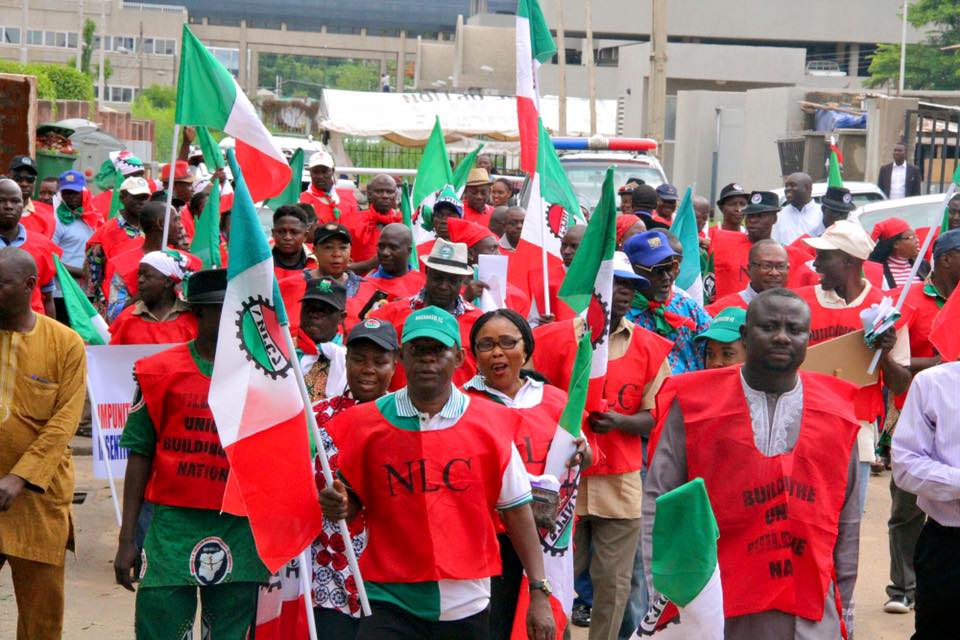
The nationwide protest organised by the Nigeria Labour Congress (NLC) over insecurity, economic hardship and governance failures is a continuation of the country’s long history of labour agitation.
The protests, according to the workers, were organised with the aim “at awakening the government to its responsibilities of tackling crushing economic hardships, insecurity, banditry, and other abnormalities in the country.”
The protesters stated that worsening insecurity was affecting workers’ safety and livelihoods, with many fearing commuting or travelling during the festive season. The protests are a moment that forces a more complex, more uncomfortable question: how much strain can Nigeria’s social contract absorb before it begins to rupture?
Governments often prefer to frame labour protests as transactional disputes – about wages, allowances or compliance with past agreements. That interpretation is convenient, but in this case, it is dangerously incomplete.
What brought workers out across the federation is not a single unmet demand but a convergence of anxieties. From worsening insecurity, the erosion of purchasing power, job precarity, and a pervasive sense that ordinary citizens are bearing the full cost of policy choices over which they have little influence.
According to the World Bank’s Nigeria Development Update, released in October 2025, approximately 139 million Nigerians, about 61–62 per cent of the population, are living in poverty, a sharp increase from previous years. In this sense, the NLC protest functions less as an industrial action and more as a referendum on the state’s performance.
Therefore, these protests signal a crisis of confidence. The NLC has previously stressed that demonstrations are necessary to draw attention to government failures in addressing insecurity, economic hardship, industrial disputes, and political accountability.
It raised concerns about the state of the tertiary education sector, noting that university infrastructure continues to deteriorate, teaching and research resources remain outdated, and staff allowances are often unpaid. The fact that teachers, health workers, civil servants and artisans collectively mobilise simultaneously shows that the action goes beyond labour-management relations; it borders on legitimacy. A state may survive economic hardship, but it struggles to endure prolonged loss of trust – especially when that distrust is organised, disciplined and nationwide.
Equally important is the state’s response. The deployment of a heavy security presence ahead of the protests reflects a familiar instinct – treat mass mobilisation first as a security problem. There is, of course, a legitimate duty to maintain public order and prevent violence or sabotage.
No responsible government can ignore intelligence warnings or abdicate its duty to protect lives and property. However, when peaceful civic action is met primarily with a forceful posture rather than engagement, the optics – and the implications – are troubling.
Democratic maturity is not measured by the absence of protest but by how a state manages dissent. Nigeria’s Constitution guarantees the right to peaceful assembly. When that right is exercised by a broad coalition of citizens, suppressing or intimidating it does not restore stability; it just postpones reckoning.
Worse still, it risks radicalising what is currently structured, predictable dissent into something more volatile and less controllable.
Labour Unions remain one of the few national institutions with a cross-ethnic and cross-religious reach. Unlike political parties, which increasingly mobilise along sectional lines, organised labour speaks a language of shared material conditions. When such an institution signals distress, it should be viewed as an early warning system for broader societal stress. Ignoring it or reducing it to a nuisance is strategically unwise.
The economic backdrop makes this moment even more significant. Inflationary pressures continue to squeeze households, while insecurity – whether from banditry, kidnapping or communal violence – undermines productivity and mobility.
For millions of Nigerians, the future feels narrower than the past. In such an environment, calls for patience ring hollow unless accompanied by visible, credible action. Citizens do not demand perfection; they require direction and honesty.
This is where leadership matters, as it involves sequencing priorities. The state cannot continue to ask citizens to endure hardship without a convincing demonstration that sacrifice is shared and purposeful.
Fiscal reforms, security operations, and structural adjustments must translate into tangible improvements, not just macroeconomic indicators. Otherwise, protest becomes the only remaining language available to those who feel unheard.
The NLC, for its part, also carries responsibility. Mobilisation must remain peaceful, disciplined and anchored in constructive engagement. The moral authority of labour rests on its ability to articulate grievances without tipping into disruption that harms the very citizens it seeks to defend.
A protest that degenerates into chaos ultimately strengthens the hand of those who argue for repression. Labour must therefore guard its legitimacy jealously.
Yet the larger burden lies with the state. The recurring cycle of protest, police deployment, temporary dialogue and eventual relapse into silence suggests a failure to address root causes. Nigeria does not suffer from a lack of committees or consultations; it suffers from weak execution, policy inconsistency, and an accountability gap between the promises made and the outcomes delivered.
What is needed now is not performative toughness or rhetorical reassurance, but a recalibration of governance priorities. Security must be treated as a public good, not a political talking point.
Economic reforms must be accompanied by social protection mechanisms that provide a safety net for the most vulnerable. Dialogue with labour and civil society must be institutionalised, not activated only when streets are filled.
Ultimately, the NLC protest is a mirror held up to the Nigerian state. It reflects accumulated frustrations and unaddressed vulnerabilities. Smashing the mirror will not change what it shows. Only deliberate, sustained governance reforms will.
Leadership demands the courage to listen, the discipline to act, and the humility to admit when existing approaches are failing.
Nigeria is at one of those moments where ignoring warning signals carries higher costs than confronting them. The protests should therefore be read not as an act of defiance, but as an urgent appeal for course correction.
We’ve got the edge. Get real-time reports, breaking scoops, and exclusive angles delivered straight to your phone. Don’t settle for stale news. Join LEADERSHIP NEWS on WhatsApp for 24/7 updates →
Join Our WhatsApp Channel