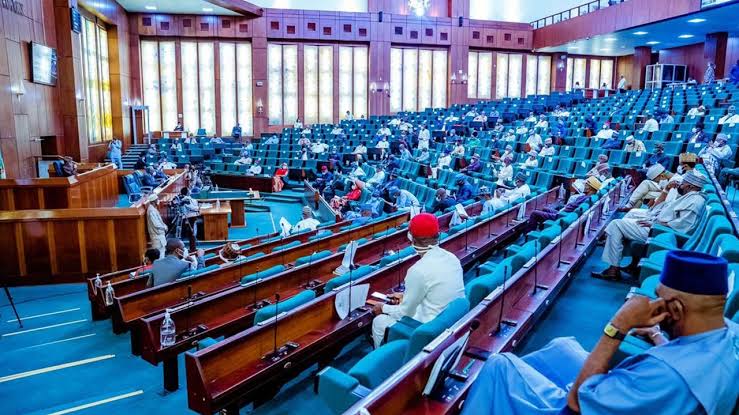
The House of Representatives has approved the electronic transmission of election results from polling units to the Independent National Electoral Commission (INEC) Result Viewing Portal (IREV).
This followed the adoption of a clause aimed at enhancing the transparency and credibility of elections in the Electoral Bill, 2025, during consideration by the committee of the whole.
Clause 60(3) of the Electoral Act amendment bill mandated INEC to electronically transmit results from polling units to the INEC Result Viewing Portal (IREV) in real time, together with physical collation of results.
The proposal states that result transmission must be carried out simultaneously with physical collation, strengthening safeguards against manipulation.
The House also approved a provision which allows the use of electronically generated voter identification, including downloadable voter cards with unique QR codes, or any other identification prescribed by INEC, for voter accreditation and voting.
In the approved report, the House also prescribes stiffer penalties for vote buying and selling, including a minimum of two years’ imprisonment or a fine of N5 million, or both, alongside a 10-year ban from contesting elections.
Under the amended Clause 22 (a and c), individuals involved in vote buying or selling, as well as those with voter cards, will face tougher sanctions than previously provided, where penalties were capped at N500,000 or a maximum of two years’ imprisonment.
The Green Chamber also amended the sanctions for presiding officers who deliberately breach procedures for counting, announcing, and transmitting polling unit results.
A new Section 60(6) prescribes a minimum fine of N500,000 or at least six months’ imprisonment, or both, for any presiding officer who willfully violates the provisions.
It further approved a clause mandating the release of election funds to INEC at least one year before a general election, in an effort to enhance early planning and the efficient conduct of polls.
The House equally increased penalties for multiple voter registration. Under the amended Clause 12(3), offenders now risk a minimum fine of N100,000 or at least one year’s imprisonment, or both.
It extended the deadline for political parties to submit their list of candidates to INEC from 180 days to 210 days before an election, allowing the Commission more time for processing.
The House also approved clause 93(2-9), increasing the maximum election expenses to be incurred by a presidential candidate from the previous N5 billion to N10 billion; governorship from N1 billion to N3 billion; senatorial and House of Representatives candidates from N100 million and N70 million respectively to N500 million and N250 million respectively.
For the State Houses of Assembly, campaign expenses were increased from N30 million to N100 million; chairmanship expenses were increased from N30 million to N60 million, while councillorship expenses were increased from N5 million to N10 million.
The proposed law provides that an individual or other entity shall not donate to a candidate more than N500 million.
The House, however, dropped a clause seeking to penalise inducements of delegates during primaries, congresses and conventions.
The clause, 89(4) provides that “a person that financially or materially induces a delegate for the purpose of influencing the outcome of party primaries, congresses and conventions commits an offence and is liable on conviction to imprisonment for a term of two years without an option of fine.”
Members of the House raised concerns that the proposal could be an entrapment for them, but it was approved.
Addressing journalists after considering the report, the chairman of the House Committee on Electoral Matters, Hon. Adebayo Balogun, stated that the Electoral Act 2022 remains one of the most progressive electoral laws in the country’s history.
He, however, said the amendments proposed under the Electoral Bill, 2025, are designed to consolidate its strengths, address observed gaps, and improve implementation, without undermining the stability of the existing legal framework.
Balogun said: “…several of the proposed provisions, such as Early Voting, Inmate Voting, Removal of the Permanent Voters Card (PVC), election timelines, amongst others, that would have occasioned such a fundamental transformation were not approved at the committee stage.
“The House, sitting as a Committee of the Whole during the consideration of the report, wisely resolved that it would be more appropriate to proceed by way of amendment rather than outright repeal of the Electoral Act 2022.
“This decision is not a setback to electoral reform. Instead, it reflects the maturity of our democracy and the responsibility of Parliament to legislate in a manner that is inclusive, balanced, and anchored on broad agreement.
“While some innovative proposals could not be accommodated at this stage, they remain part of our national discourse on electoral reform. As our democracy evolves and a broader consensus is achieved, such ideas can be revisited in the future through further legislative intervention.
“As we have concluded consideration of this report, I reaffirm the commitment of the House of Representatives, and indeed the National Assembly, to credible elections, democratic stability, and the continuous improvement of our electoral laws.”
Meanwhile, the House of Representatives has retained the 2026 President Bola Tinubu-led Federal Government’s proposed budget, with a spending of N54.46 trillion, a revenue projection of N31.83 trillion, new borrowings of N20.38 trillion, and debt service valued at N15.52 trillion. Additionally, the budget includes pensions, gratuities, and retirees’ benefits of N1.376 trillion, as well as a fiscal deficit of N22.63 trillion.
Out of the total sum, capital expenditure is pegged at N20.131 trillion, statutory transfers – N3.152 trillion; sinking fund – N388.54 billion; total recurrent (non-debt) – N15.265 trillion; special intervention for recurrent and capital – N200 billion and N14 billion.
This followed consideration and approval of the report of the House Committees on Finance and National Planning and Economic Development on the 2026–2028 Medium-Term Expenditure Framework (MTEF) and Fiscal Strategy Paper (FSP) on Thursday.
The House also approved the projected crude oil benchmark prices of US$64.85, US$64.30, and US$65.50 per barrel for 2026, 2027, and 2028, respectively. The projections for domestic crude oil production for 2026, 2027, and 2028 are 1.84 million barrels per day (mbpd), 1.88 mbpd, and 1.92 mbpd, respectively.
It gave nod to the projected exchange rate for 2026, 2027 and 2028, which are N1,512, N1,432.15 and N1,383.18, respectively, in line with CBN’s policy to stabilise the naira and promote effective fiscal and monetary policy coordination;
“Inflation rate projections for 2026, 2027 and 2028 are 16.5%, 13% and 9%, respectively, and are expected to be sustained based on the commitment of the nation’s monetary policy authority to moderate inflationary pressure.
“The GDP growth rate is projected at 4.68%, 5.96% and 7.9% for the years 2026, 2027 and 2028
respectively. Amidst reform in the Nigerian economy and prospects for reforms to take effect in 2026, it is recommended that the projection for real GDP be sustained.
“The real GDP growth rate is projected at 4.68%, 5.96% and 7.9% for the years 2026, 2027 and 2028, respectively, and is expected to be sustained in anticipation of the gains of Tax reforms.
“Effective implementation of the new Tax Acts as veritable instruments for economic reforms for growth and development
“In line with the ongoing economic reforms and the activation of the Tax Act, it is recommended that the Federal Government implement a National Scanning Policy within the National Single Window of the Nigeria Revenue Services (NRS), in collaboration with the relevant Agencies. This
will enhance revenue assurance, improve trade facilitation, reduce leakages, and strengthen transparency and national security,” the approved report reads.
We’ve got the edge. Get real-time reports, breaking scoops, and exclusive angles delivered straight to your phone. Don’t settle for stale news. Join LEADERSHIP NEWS on WhatsApp for 24/7 updates →
Join Our WhatsApp Channel