President Donald Trump’s dramatic claim on Saturday that the United States has captured Venezuelan President Nicolás Maduro and his wife, Cilia Flores, following what he described as a “large-scale strike” on Venezuela, has sent shockwaves around the world.
Venezuela’s Vice President, Delcy Rodríguez, in an emotional address broadcast on state television Saturday, said the government had lost contact with the presidential couple and demanded proof that they were still alive.
“We do not know the whereabouts of our President and First Lady. The Venezuelan government demands evidence that they are alive,” Rodríguez said in the audio statement.
The development came amid reports of US air and naval operations across the Caribbean Sea and eastern Pacific Ocean, which Washington claimed were targeting drug-smuggling vessels and alleged Venezuelan military docking areas.
If confirmed, Maduro’s capture would mark the latest in a long and controversial history of direct US interventions and forceful seizures of leaders of sovereign nations, recalling the fates of Panama’s Manuel Noriega and Iraq’s Saddam Hussein.
In December 1989, the US launched its largest combat operation since the Vietnam War — the invasion of Panama to remove military ruler Manuel Noriega. Washington accused him of corruption, election fraud, and drug trafficking, the same allegations it has levelled against Maduro 36 years after.
Noriega, once a US ally, was captured, flown to Miami, and tried on drug-smuggling charges. After serving time in the United States and France, he was extradited to Panama, where he died in prison in 2017.
Similarly, in 2003, the then Iraqi leader Saddam Hussein was seized by US forces nine months after the invasion of Iraq, launched on claims but later proven false that Baghdad possessed weapons of mass destruction (WMD) and supported terrorist groups like al-Qaeda.
Saddam was found hiding near his hometown of Tikrit. He was later convicted by an Iraqi court and executed by hanging in December 2006.
Observers have also drawn comparisons to the 2022 arrest of Honduras’ former president, Juan Orlando Hernández, who was extradited to the US over drug-trafficking charges shortly after leaving office. He was sentenced to 45 years in prison but pardoned by Trump in December 2025.
His release sparked outrage in Honduras, where prosecutors have since issued an international warrant for his re-arrest.
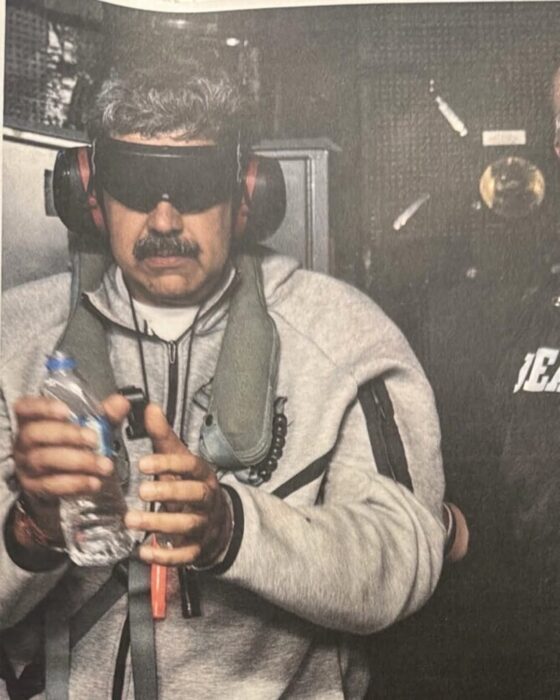
As of Sunday, Washington released images of Maduro in handcuffs on arrival in New York on Saturday, while the Venezuelan government continued to insist that its president’s fate remained unknown.
We’ve got the edge. Get real-time reports, breaking scoops, and exclusive angles delivered straight to your phone. Don’t settle for stale news. Join LEADERSHIP NEWS on WhatsApp for 24/7 updates →
Join Our WhatsApp Channel