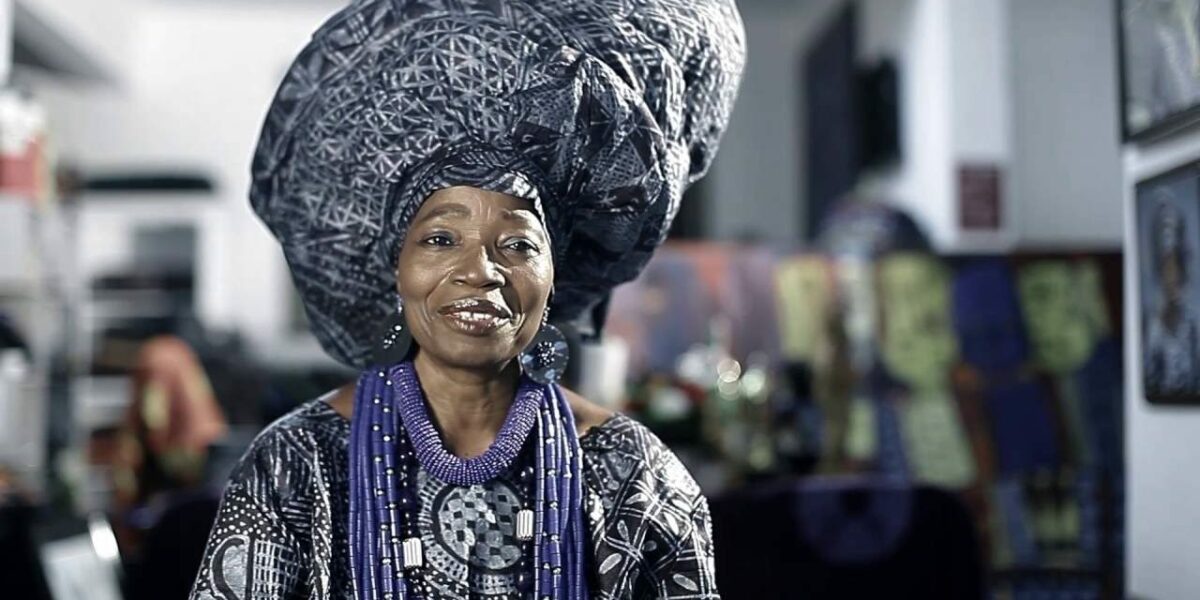
Chief (Mrs.) Nike Monica Okundaye is not merely an artist; she is a cultural institution in human form. For over five decades, she has stood at the intersection of art, heritage, gender empowerment, and cultural preservation, shaping how Nigerian and African art is taught, practiced, and perceived both locally and globally. Popularly known as Mama Nike, her influence extends far beyond the gallery walls into the very fabric of Nigerian cultural consciousness.
Born in 1951 in Ogidi-Ijumu, present-day Kogi State, Nike Okundaye was raised in an environment steeped in traditional knowledge. She learned the art of textile dyeing, weaving, and pattern making from her great-grandmother at an early age, long before formal art institutions acknowledged indigenous techniques as legitimate artistic practice. This early exposure grounded her in Yoruba artistic traditions, particularly adire (indigo resist-dyed cloth), which would later become central to her life’s work.
Unlike many contemporary artists who found their footing through formal Western education, Nike’s artistic journey was largely experiential and communal. She honed her skills through practice, apprenticeship, and cultural immersion, developing a visual language rooted in African symbolism, mythology, daily life, and womanhood. Her works—often vibrant, layered, and emotionally charged—tell stories of ancestry, spirituality, resilience, and social identity.
However, Nike Okundaye’s greatest contribution may not be the art she created, but the artists she created.
The Teacher and Cultural Architect.
In 1983, Nike founded her first art centre in Osogbo, a city already rich with artistic history. What began as a modest space quickly evolved into a training ground for young, underprivileged artists, particularly women. Her philosophy was radical in its simplicity: art should be accessible, practical, and economically empowering.
She trained thousands—many for free—in painting, textile dyeing, batik, beadwork, sculpture, and traditional crafts. For women who had limited access to formal education or financial independence, Nike’s centres became places of skill acquisition, self-worth, and economic survival. This commitment to empowerment earned her respect not just as an artist, but as a social reformer.
Nike Art Gallery: A Monument to African Creativity
The establishment of the Nike Art Gallery in Lekki, Lagos, in 2009 marked a defining moment in Nigeria’s art history. The multi-storey gallery—one of the largest in West Africa—houses thousands of artworks by Nigerian and African artists across generations. It functions as a gallery, archive, marketplace, training space, and cultural meeting point.
More than a tourist attraction, the gallery is a living ecosystem where traditional and contemporary art coexist without hierarchy. Emerging artists hang beside masters. Textile art shares space with sculpture, painting, photography, and mixed media. In doing so, Nike challenges elitist notions of art and insists on cultural continuity.
Beyond Lagos, she established art centres in Abuja, Osogbo, Ogidi-Ijumu, Abeokuta (Olumo Rock), and other locations, ensuring that artistic knowledge is decentralized and accessible across regions.
Global Recognition, Local Commitment
Nike Okundaye’s work has been exhibited internationally across Europe, North America, and Asia, and she has represented Nigeria at major cultural festivals and exhibitions worldwide. She has received numerous awards and chieftaincy titles recognizing her contributions to art, culture, and women’s development.
Yet, despite global acclaim, she remains deeply committed to grassroots cultural preservation. She continues to wear traditional attire daily, speak indigenous languages, and teach ancestral techniques—making a quiet but powerful statement about cultural pride in a globalized world.
Legacy and Impact
Today, Nike Monica Okundaye stands as a bridge between generations—between the ancestral past and the contemporary present. Her life’s work challenges the erasure of indigenous knowledge, redefines women’s roles in cultural production, and proves that art can be both economically viable and socially transformative.
In an era where African art is increasingly commodified on global stages, Nike’s legacy reminds us that authenticity, community, and cultural ownership matter. She did not wait for institutions to validate African art; she built the institutions herself.
Nike Okundaye did not just preserve culture—she made it sustainable.
We’ve got the edge. Get real-time reports, breaking scoops, and exclusive angles delivered straight to your phone. Don’t settle for stale news. Join LEADERSHIP NEWS on WhatsApp for 24/7 updates →
Join Our WhatsApp Channel