BABAJI USMAN BABAJI writes on the ongoing power play in Gombe State as politicians prepare for the 2027 general elections
With the 2027 general elections still some distance away, political activity in Gombe State increasingly suggests that the contest has already begun, not through open campaigns or formal declarations, but through a calculated and deliberate struggle for structure, relevance and narrative control.
Across the state, defections, opposition regrouping and discreet but sustained grassroots mobilisation are steadily reshaping the political landscape, reflecting both the advantages of incumbency and the enduring limitations of a fragmented opposition.
At the centre of this realignment is the ruling All Progressives Congress (APC), which has continued to tighten its grip on the state’s political architecture through a steady inflow of defectors from opposition parties, particularly the Peoples Democratic Party (PDP).
The recent defection of two PDP members of the Gombe State House of Assembly has further tilted the balance of power, leaving the APC with near-total legislative control and reinforcing its institutional advantage well ahead of the next electoral cycle.
While party leaders routinely describe these defections as expressions of confidence in the leadership and governance style of Governor Muhammadu Inuwa Yahaya, political analysts tend to interpret the trend through a broader and more familiar lens.
In Nigeria’s political culture, defections are rarely driven solely by ideological alignment; more often, they reflect the gravitational pull of power.
Access to state resources, proximity to decision-making centres, political appointments and the ability to influence grassroots patronage networks frequently shape political loyalty, primarily as elections draw closer.
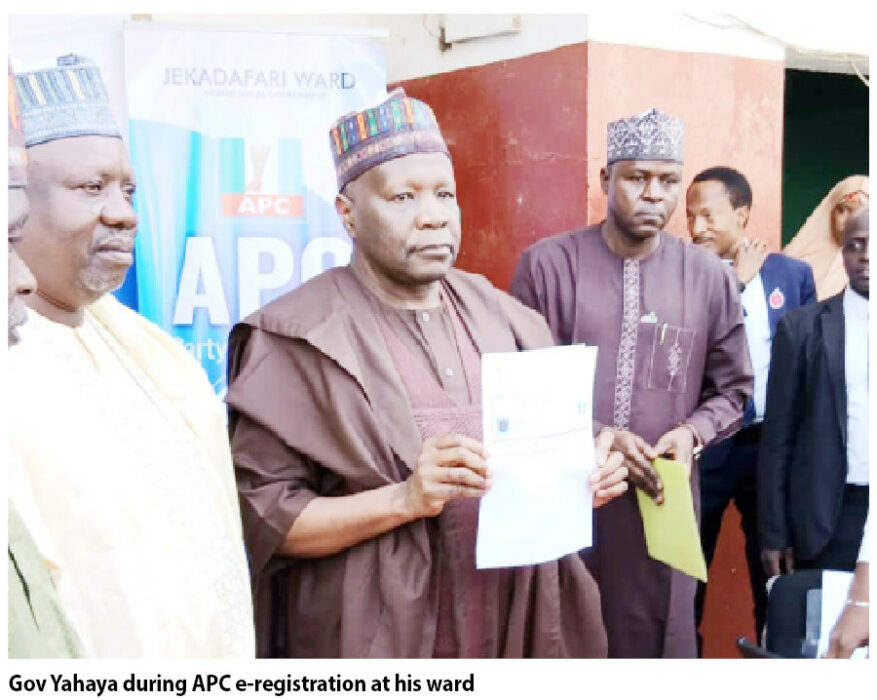
Governor Yahaya’s remarks during the flag-off of the APC’s electronic re-registration exercise in his ward subtly underscored this reality.
His call for increased support, allegiance and loyalty was not merely an administrative appeal, but a strategic signal of consolidation , a reminder to party members that political relevance and survival in the state are increasingly tied to active participation within the ruling structure.
With the APC controlling 23 of the 24 seats in the State House of Assembly and all 11 local government chairmanships, governance and party machinery have effectively merged, creating a dominant political bloc that leaves little institutional space for rivals.
.For the APC, therefore, the road to 2027 is less about territorial expansion and more about managing cohesion, ambition and internal equilibrium.
Yet numerical dominance does not automatically translate into political invincibility.
Beneath the surface of APC supremacy lies a persistent undercurrent of voter fatigue, youth discontent and quiet concern over the long-term implications of near one-party control.
It is within this political opening, however narrow, that the African Democratic Congress (ADC) has begun to position itself as a rallying point for opposition forces seeking relevance beyond protest politics.
The decision by a coalition of opposition actors and parties to converge around the ADC reflects a strategic acknowledgement that fragmented platforms and isolated candidacies cannot realistically challenge an entrenched ruling party.
The defection of former governorship candidate Mohammed Jibrin Barde from the PDP to the ADC has added both visibility and symbolic weight to the platform, reinforcing its claim as a credible alternative.
However, beyond symbolism, the ADC faces a familiar challenge: translating elite alignments, media visibility and policy rhetoric into ward-level organisation, sustained voter mobilisation and internal discipline. Without this, it risks replicating the same vulnerabilities that have steadily weakened the PDP.
For the PDP, the crisis in Gombe extends well beyond the loss of legislative seats and prominent figures.
The party has continued to experience a gradual but consistent erosion of its grassroots structures, as ward executives, youth leaders, and long-time loyalists either defect to the APC or quietly disengage from active political participation.
Party meetings that once drew substantial turnout have reportedly thinned, while unresolved internal disagreements over leadership direction, strategy and control have further undermined cohesion at both state and ward levels.
As former party loyalists increasingly concede, the resulting organisational vacuum is now being filled by the ruling APC and, in some instances, by alternative platforms such as the ADC.
Perhaps more significantly, some of the most consequential political movements currently unfolding in Gombe are taking place outside the formal boundaries of party politics.
Socio-political support groups associated with former minister Professor Isa Ali Pantami have become increasingly visible across parts of the state, particularly through youth-driven engagements, community outreach and media interactions in rural local government areas.
While Pantami has not made any formal declaration of political ambition, the growing visibility and coordination of these groups suggest a deliberate effort to shape public discourse around leadership, governance and youth participation ahead of 2027.
Such movements reflect a broader trend in Nigerian politics, where personality-driven mobilisation and issue-based engagement often precede formal party alignment.
Within the APC itself, the emergence of figures such as businessman and political actor Aliyu Mohammed Kombat adds another layer to the evolving equation.
His messaging, widely circulated among party supporters, emphasises unity, continuity and measured mobilisation, signalling an internal effort to balance ambition with administrative stability.
Political analysts interpret this approach as a conscious strategy to avoid premature factional rivalry while preserving party cohesion as the election season gradually approaches.
Across communities, in local discussions and on digital platforms, political conversations in Gombe are increasingly focused on youth participation, economic pressures, unemployment, and growing calls for accountable governance.
While these conversations have yet to crystallise into a unified political movement or structured opposition, they represent emerging fault lines that could influence voter behaviour and shape campaign narratives in the months ahead.
Taken together, the unfolding dynamics suggest that the 2027 contest in Gombe will be decided long before ballots are cast..
The ruling party’s consolidation of power through defections, the opposition’s ongoing search for unity under a viable platform, and the quiet cultivation of grassroots relevance by influential individuals all point to a political struggle already in motion.
In this contest, control of structure, loyalty and narrative may ultimately prove more decisive than the formal campaign season itself.
We’ve got the edge. Get real-time reports, breaking scoops, and exclusive angles delivered straight to your phone. Don’t settle for stale news. Join LEADERSHIP NEWS on WhatsApp for 24/7 updates →
Join Our WhatsApp Channel