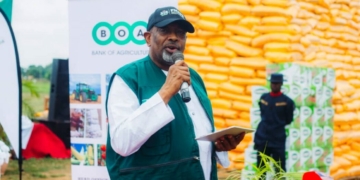

Federal Ministry of Agriculture and Food Security has entered into a strategic partnership with the International Institute of Tropical Agriculture (IITA) to improve soil health, enhance fertiliser efficiency and transform the agricultural ecosystem.
The collaboration was formalised with the signing of a Memorandum of Understanding (MoU) at the ministry’s headquarters in Abuja, under the Presidential Soil Health Scheme.
The initiative is designed to introduce data-driven soil management practices that will guide farmers in selecting appropriate crops and applying fertiliser, while addressing land degradation, nutrient depletion and climate-related challenges.
Under the agreement, both parties will work to strengthen agricultural land management and climate services, build national capacity through applied research and soil fertility data systems and promote a collaborative model that could be replicated across the Economic Community of West African States (ECOWAS) sub-region.
The programme also includes plans to establish soil-testing laboratories in the country’s 774 local government areas to enable farmers access location-specific recommendations.
The partnership will support the Nigerian farmers’ soil health scheme and the continued development of the Nigerian National Soil Information System, with implementation coordinated through IITA’s Regional Hub of Fertiliser and Soil Health for West Africa and the Sahel.
Key staples targeted include rice, maize, sorghum, wheat and yams, alongside broader interventions in digital soil information systems, laboratory standards and capacity building.
At the event, the minister of Agriculture and Food Security, Abubakar Kyari, said the initiative aligned with the federal government’s strategy to reform soil management practices and improve agricultural productivity nationwide.
“Beyond food availability and affordability, the government is committed to ensuring nutritional quality and safety. If the soil is not healthy, no matter the effort, the desired results cannot be achieved,” Kyari said.
In his remarks, the minister of State for Agriculture and Food Security, Aliyu Sabi Abdullahi, explained that the MoU sets out a framework for collaboration without creating binding legal obligations, while providing a platform for joint studies, data generation and policy support.
“This scheme is designed to remove guesswork for Nigerian farmers by giving them facts, what to plant, where to plant, and the type of fertiliser required for each soil type,” Abdullahi said.
Also, the director-general of IITA, Dr. Simeon Ehui, said the agreement represents a shift from generalised advice to precise, location-specific recommendations for farmers, leveraging regional expertise and shared standards.
We’ve got the edge. Get real-time reports, breaking scoops, and exclusive angles delivered straight to your phone. Don’t settle for stale news. Join LEADERSHIP NEWS on WhatsApp for 24/7 updates →
Join Our WhatsApp Channel