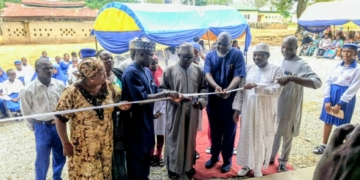
Lead director for Sustainability of Agrarian Societies in the Lake Chad Basin, Prof Frederi Viens, has dismissed widespread claims that Lake Chad is shrinking. He argued that the real challenge facing farmers in the region is erratic rainfall and limited access to irrigation.
The professor of Statistics at Rice University in Houston, United States of America, said this during a training workshop in Nigeria on data-driven approaches to sustainable agriculture.
He said preliminary evidence from field surveys and long-term data collection by his team shows that Lake Chad, which nearly disappeared during the severe Sahelian droughts of the 1970s and 1980s, has since recovered and continues to support farming, fishing and grazing activities.
“Lake Chad had almost completely disappeared by the mid-1980s, but it came back by the mid-1990s and has remained a viable ecosystem since then,” he said. “If the lake were shrinking, it would still be gone. But that is not what the data or the farmers are telling us.”
The professor said his research team has interviewed about 2,000 farmers across the region, including communities in Yobe and Borno states. According to him, none of the farmers identified a shrinking lake as their major problem.
“What farmers consistently tell us is that rainfall has become increasingly unpredictable,” he explained.
“The rains now stop for weeks in the middle of the growing season, something they were not used to in the past.”
He noted that most agriculture in the Lake Chad Basin is rain-fed, making crops highly vulnerable to interruptions in rainfall, especially during critical stages such as flowering. As a result, farmers are being forced to change cropping patterns, shifting from water-sensitive crops like maize to more drought-tolerant ones such as millet.
Prof. Viens stressed that expanding access to small-scale irrigation, particularly through groundwater and boreholes, could significantly improve farmers’ resilience. He said the availability of irrigation would allow farmers to save crops during dry spells and stabilize food production.
“There is water in the system, including groundwater, but many farmers simply cannot access it,” he said. “Small-scale irrigation could make a big difference, provided it is managed sustainably.”
He added that his team is using advanced statistical tools to combine scientific data with farmers’ local knowledge in order to better understand climate risks and guide practical solutions.
“Our goal is to understand what is really happening on the ground and ensure farmers have the information and tools they need to adapt,” he said.
The Registrar and Chief Executive Officer of the Nigerian Institute of Animal Science (NIAS), Prof. Udo Herbert, said the project provides an important bridge between research and government, noting that efforts are underway to ensure the participation of relevant government agencies in the ongoing workshop.
He explained that, as a regulator of animal husbandry in Nigeria, NIAS has a strong interest in developments within the Lake Chad Basin, particularly the movement of pastoralists, livestock production systems and the environmental factors influencing them.
Prof. Herbert said the outcomes of the project would be presented to government as evidence-based guidance to support better policy choices, especially in sustaining livelihoods across crop farming, livestock and fisheries. He stressed that climate change affects the entire food system, adding that challenges facing crops eventually impact livestock and fish production.
According to him, improved data, modern production practices and coordinated food systems are critical to achieving food security, increasing animal protein supply and improving productivity nationwide.
Also, a Professor of Soil Science specialising in soil fertility and plant nutrition, Prof. Adam Lawan Ngala, said the research is examining whether observed changes in Lake Chad are driven by climate variability or by natural climate cycles, stressing that the work is still ongoing and no final conclusions have yet been reached.
He explained that the project combines farmer surveys, focus group discussions and soil sampling to determine the true condition of soils and farming systems in communities around the lake.
Prof. Ngala noted that the research is expected to have significant impact on local communities as well as government decision-making, as findings would translate into practical recommendations and policy direction. He urged the Nigerian government to support the initiative through funding and grants, adding that once results are finalised, they should be utilised to formulate policies that will positively affect millions of people whose livelihoods depend on the Lake Chad region.
One of the workshop participants, Mr. Favour Okoro, an agronomist, said the training had strengthened his interest in applying advanced statistical tools to agriculture, particularly in addressing long-standing data gaps in the sector. He said acquiring skills in modern statistical analysis would enable agricultural professionals to better predict yields, manage risks and improve productivity across crop production, soil management and pest control.
Okoro described the workshop as a foundation for deeper learning and collaboration, expressing hope that participants would form clusters to drive data-driven agricultural solutions across Nigeria.
He said the skills gained could be cascaded through universities and rural programmes, helping farmers access better information and improve output. According to him, with adequate support and funding, the initiative could spark a broader movement towards precision agriculture and sustainable food production in the country.
We’ve got the edge. Get real-time reports, breaking scoops, and exclusive angles delivered straight to your phone. Don’t settle for stale news. Join LEADERSHIP NEWS on WhatsApp for 24/7 updates →
Join Our WhatsApp Channel